
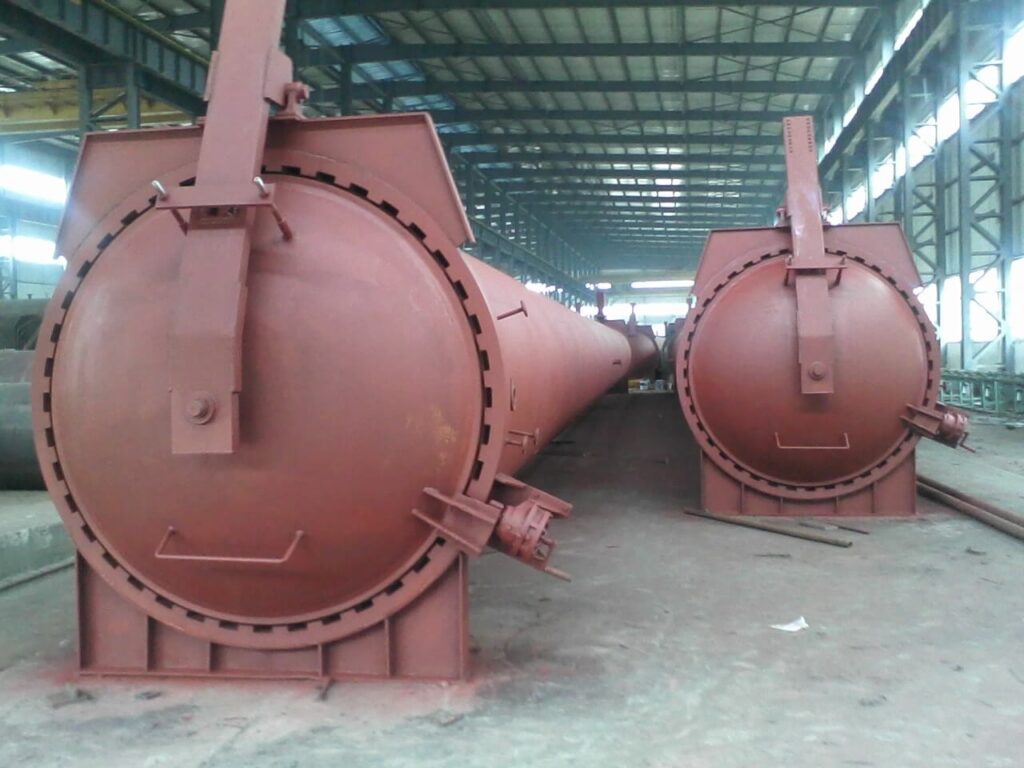
Industrial Autoclaves for AAC Production & Wood Preservation Applications
CNMIRACLE, the international engineering and export division of Taiguo Boiler Group, provides industrial autoclave systems designed for high-pressure steam curing, AAC block production, wood preservation treatment, and other industrial material processing applications.Our industrial autoclaves are customized according to chamber diameter, working pressure, length, and production requirements to meet different industrial processing needs.
Manufactured at the Henan Taiguo Boiler production base, our autoclaves are engineered with precision pressure vessel fabrication, advanced welding technology, and strict quality control standards to ensure safe and reliable operation under continuous high-temperature and high-pressure conditions.
With optimized pressure control, uniform steam distribution, and seamless integration with industrial steam systems, CNMIRACLE and Taiguo Boiler deliver reliable autoclave solutions for building materials, timber processing, and modern manufacturing industries worldwide.
Industrial Autoclave Systems for AAC Block Production
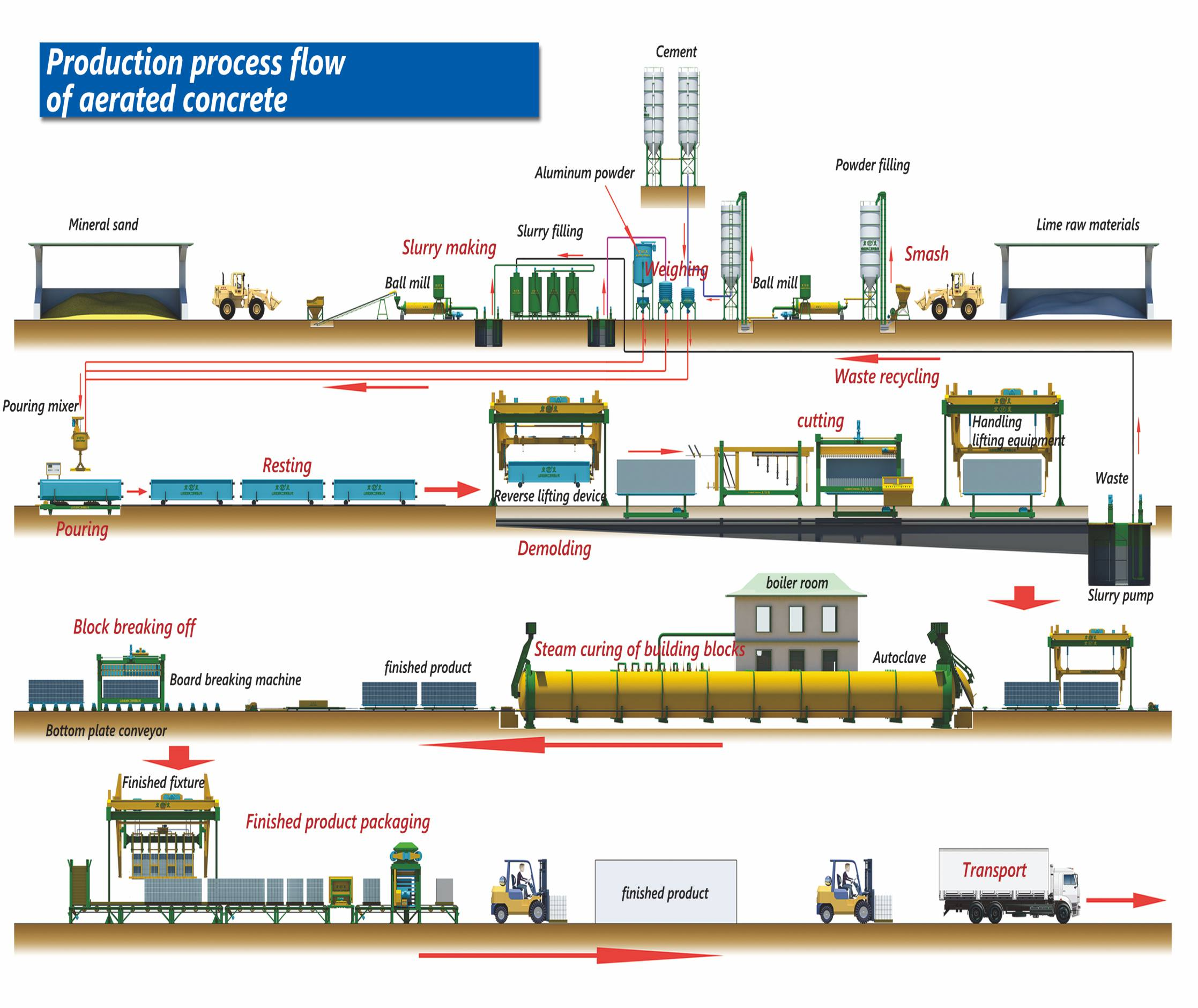
Autoclaves play a critical role in producing Autoclaved Aerated Concrete (AAC). Inside the pressure chamber, high-pressure saturated steam triggers a hydrothermal reaction between siliceous and calcareous materials. This reaction forms calcium silicate hydrate (C-S-H), giving AAC blocks their core strength and low density.
AAC Hydrothermal Process
Autoclaving Stage1. Industrial Autoclave Design and Key Components
A high-performance AAC autoclave must withstand rigorous daily operations. Our industrial autoclave design focuses on structural integrity, fatigue resistance, and rapid cycles.
- Precision Steam Distribution Rails: Internal steam distribution pipes ensure uniform temperature profiles across the entire vessel, preventing uneven curing.
- Forged Steel Flanges: Integrated forged flanges eliminate weak welds, preventing stress cracking under repeated pressure loading.
- Quick-Opening Door Mechanism: Hydraulic or motorized safety door systems allow safe, rapid opening and closing. They include mechanical safety interlocks that prevent operation while pressurized.
- Autoclave Shell & Saddle Supports: Built with specialized high-strength pressure vessel plates, the shell rests on fixed and sliding saddle supports to accommodate thermal expansion.
- Vessel Shell: We use specialized Q345R pressure vessel steel. Every longitudinal and circumferential weld undergoes 100% X-ray flaw detection.
- Support Saddles: Designed to accommodate thermal expansion, preventing stress fractures in the shell.
Industrial Autoclave Shell Structure
Pressure Vessel Layout2. The AAC Curing Process: The Science of Hydrothermal Synthesis-Mastering the 12-Hour Curing Cycle
The AAC curing process inside an autoclave is a complex hydrothermal reaction. It transforms the raw slurry (silica and lime) into a high-strength crystalline structure called Tobermorite. To achieve this, the autoclave must strictly follow a four-stage pressure and temperature curve.
1. Pre-heating & Vacuum Phase (Air Removal)
Before injecting steam, we must remove the air trapped inside the autoclave. Residual air creates “cold spots” that prevent uniform heating.
- The Action: We use a high-efficiency vacuum pump to reach a negative pressure.
- The Benefit: Consequently, the saturated steam can penetrate the center of every block instantly. This ensures the entire batch heats up at the same rate.
2. The Ramp-up Period (Pressure Building)
In this stage, we slowly introduce high-pressure saturated steam.
- The Action: We increase the internal pressure from 0 to 1.2 MPa over 2 to 3 hours.
- The Logic: A gradual temperature rise is essential. If the temperature rises too fast, thermal stress will crack the “green cakes” (uncured blocks). Our SZS boilers provide the stable flow needed for this precise transition.
3. The Constant Temperature & Pressure Soaking
This is the most critical 8 to 10 hours of the production cycle.
- The Environment: We maintain a steady environment of 1.2 MPa and approximately 193°C to 201°C.
- The Chemistry: Under these conditions, silica and calcium hydroxide react to form stable crystals.
- The Guarantee: Our autoclave’s high-density insulation layer keeps heat loss below 5%. This stability ensures all blocks achieve identical strength.
4. Controlled Depressurization & Waste Heat Recovery
The final stage involves releasing pressure safely while capturing valuable energy.
- The Action: We exhaust the steam through a controlled valve system.
- Waste Heat Recovery (WHR): Instead of venting steam into the atmosphere, we divert it to a Heat Exchange System.
- Energy Reuse: This recovered heat pre-heats the boiler feed water or the next autoclave batch. Consequently, you reduce fuel consumption by 10% to 15% per cycle.
- Risk Mitigation: Controlled exhaust prevents the “flashing” effect, preserving the structural integrity of the finished AAC panels.
Maximizing Profit with Taiguo’s Waste Heat Recovery (WHR)
As the overseas director, I emphasize that efficiency equals profit. Our integrated WHR system turns waste into wealth.
How Our WHR System Transforms Your Factory:
- Flash Steam Capture: We collect high-temperature flash steam during the depressurization phase.
- Boiler Feed Water Pre-heating: We use the captured heat to raise the boiler feed water temperature to 80 ℃+.
- Reduced Thermal Shock: Pre-heated water reduces the thermal stress on your SZS boiler. Therefore, you extend the service life of your entire steam system.
- Environmental Compliance: Lower fuel consumption means lower carbon emissions. This helps your factory meet increasingly strict global environmental standards.
Comparative Advantage: Standard vs. Taiguo Integrated System
| Performance Metric | Standard Autoclave | Taiguo WHR System |
|---|---|---|
| Energy Consumption | 100% Base | 85% – 90% Base |
| Curing Cycle Time | 12 – 14 Hours | 11 – 12 Hours |
| Batch Consistency | Variable | High Precision (PLC Controlled) |
| Environmental Impact | High Emission | Low Emission |
Wood Preservation Autoclaves for Timber Treatment
In wood treatment, wood preservation autoclaves use vacuum-pressure cycles (such as the Full-Cell or Empty-Cell process) to drive preservatives deep into the timber structure.
Wood Preservation Vacuum-Pressure Cycle
Full-Cell ProcessDeep Preservative Penetration Technology
Treating industrial timber requires precise pressure control to prevent wood structure collapse while achieving maximum chemical penetration.
- Multi-Stage Vacuum & Pressure Control: High-vacuum pumps evacuate air from wood cells before liquid injection. The wood preservation autoclave then applies sustained hydraulic pressure.
- Preservative Solution Compatibility: Stainless steel or anti-corrosive alloy liners protect the vessel shell from corrosive treatments like CCA, ACQ, or fire retardants.
- Integrated Chemical Recovery: Drainage systems capture excess preservative, cutting chemical waste and supporting clean factory operations.
1. System Components
- Treatment Tank: A horizontal pressure vessel built for chemical resistance.
- Mixing System: Ensures preservatives remain homogeneous for consistent treatment.
- Vacuum & Pressure Pumps: These control the “breathing” of the wood cells.
- Storage Tanks: For efficient chemical recovery and reuse.
2. The Full-Cell Process (Bethell Process): The Science of Deep Saturation-The Full-Cell Process (Bethell Process): The Science of Deep Saturation
The Full-Cell process, also known as the Bethell Process, is the industry gold standard for maximum preservative retention. Unlike surface coating, this vacuum-pressure cycle forces chemicals deep into the wood’s cellular structure. Taiguo’s wood preservation systems automate this four-stage cycle to ensure every fiber is protected.
Stage 1: The Initial Vacuum (Evacuating the Pores)
The secret to deep penetration is not just pressure, but the quality of the initial vacuum.
- The Action: We use heavy-duty liquid ring vacuum pumps to extract air from the wood cells. We maintain a vacuum level of -0.085 MPa to -0.098 MPa for 30-60 minutes.
- The Science: Wood is a porous material filled with air. By creating a deep vacuum, we remove the “air cushion” that would otherwise resist chemical entry. This stage prepares the wood to “drink” the preservative.
Stage 2: Preservative Injection (Submerged Filling)
Once we achieve the target vacuum, the injection phase begins without breaking the airtight seal.
- The Action: We flood the treatment tank with preservatives (such as CCA, ACQ, or Creosote).
- The Logic: The vacuum remains active during the initial filling. This prevents air from re-entering the wood pores. Consequently, the preservative occupies the maximum available space within the cellular cavities.
Stage 3: The High-Pressure Phase (Active Impregnation)
This is where the actual “Full-Cell” saturation occurs.
- The Action: Our high-pressure pumps ramp up the internal environment to 1.2 MPa – 1.5 MPa.
- The Precision: We maintain this pressure for several hours, depending on the timber species (e.g., Pine vs. Hardwood).
- The Benefit: The pressure forces the chemical deep into the heartwood, not just the sapwood. Taiguo’s automated control system ensures zero pressure drops, guaranteeing that every batch meets international retention standards (e.g., AWPA standards).
Stage 4: The Final Vacuum (Surface Conditioning & Recovery)
The final stage ensures the wood is safe to handle and minimizes chemical waste.
- The Action: After draining the excess liquid, we apply a second vacuum cycle.
- The Result: This “pulls” excess surface chemicals back into the recovery tank. It eliminates the “bleeding” or dripping of chemicals.
- The Business Value: You save up to 5% in chemical costs per batch. More importantly, the wood emerges touch-dry and environmentally compliant for immediate transport.
Why Taiguo’s Bethell Process Systems are superior?
| Technical Feature | Taiguo Engineering Standard | Impact on Your Factory |
|---|---|---|
| Vacuum Depth | Up to -0.098 MPa | Maximizes chemical loading in dense species |
| Pressure Stability | Automatic Compensation within 0.01 MPa | Eliminates “soft spots” in treated timber |
| Cycle Automation | One-touch PLC operation | Reduces labor costs and human error |
| Chemical Recovery | Integrated 3-stage filtration | Pure chemical reuse and zero waste |
Autoclave & Wood Preservation System Configuration
CN MIRACLE &Taiguo Factory delivers complete turnkey heavy-duty pressure solutions. We do not just sell a bare steel cylinder shell. Our engineering team configures fully integrated, highly automated pressure vessel systems for global B2B industrial buyers.
1. Standard Configuration (Heavy-Duty Processing Package)
Our standard configuration includes all essential mechanical and safety components. We guarantee robust, safe, and stable continuous pressure operations after correct installation.
- Vessel Proper (Shell): High-grade Q345R specialized pressure vessel steel. It features automated submerged arc welding for maximum structural integrity.
- Safety Door Mechanism: Quick-opening manual or hydraulic door system. It features a heavy-duty rotating locking ring to secure the chamber.
- Triple Safety Interlocks: Mechanical, manual, and electrical safety devices. They prevent the door from opening while internal pressure exists.
- Sealing Ring Module: Premium imported silicone or rubber sealing ring. It uses internal vessel pressure to self-seal the door gap perfectly.
- Chamber Track System: Internal heavy-duty rail tracks. They allow smooth loading and unloading of material transport carts.
- Basic Control Console: Centralized electrical control panel. It monitors real-time internal pressures, processing temperatures, and cycle times.
2. Optional Configuration (Automation & Process Upgrades)
We offer advanced optional components. These upgrades optimize chemical penetration, reduce processing cycle times, and enable plant-wide digital automation.
- Liquid Ring Vacuum Pump: Extracts air from the chamber to create a deep initial vacuum. Benefit: Forces wood preservation chemicals deep into the wood cells.
- High-Pressure Fluid Pump: Injects chemical preservatives or water mixtures into the sealed tank under high pressure. Benefit: Achieves complete chemical absorption metrics.
- PLC Smart Control System: Uses premium Siemens PLC hardware with a colorful touchscreen interface. Benefit: Automates complex multi-stage vacuum-pressure recipes with one-button operation.
- Hydraulic Door Drive Unit: Upgrades the door opening mechanism to a powerful hydraulic cylinder system. Benefit: Reduces manual labor and accelerates cycle changeover times.
- High-Temperature Heating Coils: Internal steam or thermal oil heating grid lines. Benefit: Accelerates rubber vulcanization or composite curing speeds significantly.
- Material Loading Carts: Custom-engineered heavy steel transport carts. Benefit: Perfectly matches internal track profiles to maximize chamber volume usage.
3. Complete Pressure System Layout Blueprint
We design full custom material-processing layouts. The technical flowchart below shows how our complete pressure system manages vacuum and chemical injection:
Material Loading ➔ Initial Vacuum Extraction ➔ Chemical Fluid Injection ➔ High-Pressure Pressurization ➔ Pressure Relief & Drainage ➔ Final Product Output
4. Customized Engineering by Target Industrial Applications
Different processing sectors require distinct chemical, temperature, and pressure profiles. We customize our auxiliary equipment packages to match your exact application requirements:
- Timber Treatment & Wood Preservation: Liquid Ring Vacuum Pump + High-Pressure Injection Pump + Chemical Mixing Tank Skids. Wood treating requires deep chemical penetration. Our powerful vacuum-pressure cycle protects timber against rot and insects permanently.
- AAC Block Curing Factories: High-Pressure Steam Inlet Manifold + Automatic Condensate Drainage Valves + PLC Control. Autoclaved Aerated Concrete requires precise steam curing. Our automated drainage system prevents water accumulation to ensure uniform block strength.
- Industrial Rubber Vulcanization: Internal Heating Coils + High-Accuracy Temperature Probes + Digital Data Loggers. Rubber curing demands absolute temperature uniformity. Our multi-point sensor array guarantees consistent vulcanization quality across every batch.
5. Heavy-Duty Export Package for Global Projects
We understand the logistics and operational challenges of overseas heavy industrial installations. Taiguo Factory provides an exclusive export support package to guarantee zero-risk deployment:
- Pressure Sealing Spare Parts Pack: Includes two premium replacement door gaskets, heavy-duty valve seals, and critical control relays for two years.
- English Operational Interface: All digital controller screens, PLC touchscreens, and technical safety warnings feature fluent English terminology.
- Complete Engineering Layouts: We supply detailed foundation loading diagrams, complete P&ID piping schematics, and electrical connection drawings.
- Remote Video Commissioning Support: Senior pressure-vessel engineers guide your local mechanical and electrical teams through initial pressure testing and startup.
- International Standards Compliance: We provide fully validated GOST/EAC certificates to ensure fast customs clearance in Central Asian markets, including Uzbekistan.
6. Technical Checklist for Pressure Auxiliary Equipment
| Auxiliary Equipment Name | Necessity Level for Autoclaves | Taiguo Factory Supply Capability |
|---|---|---|
| Safety Interlock System | 100% Mandatory (Safety Critical) | Triple-Redundant Systems Integrated Directly |
| Liquid Ring Vacuum Pump | 100% Mandatory for Wood Preservation | High-Vacuum Industrial Pumps Supplied |
| High-Pressure Injection Pump | 100% Mandatory for Fluid Treating | Heavy-Duty Chemical Skids Delivered |
| Hydraulic Door Power Pack | Optional / Highly Recommended | Fully Wired and Plumbed Hydraulic Skids |
| Chemical Mixing & Storage Tank | Recommended for Timber Processing | Custom Volume Tanks Assembled with Agitators |
DIVERSE APPLICATIONS & EXTENSIONS
Expanding the Scope: Applications Beyond Construction
Taiguo’s pressure vessels serve a vast range of industrial needs. Their versatility makes them a cornerstone of modern manufacturing.
| Application | Process Target | Key Benefit |
|---|---|---|
| AAC Blocks/Panels | Hydrothermal synthesis | High structural load capacity |
| Timber Sleepers | Deep chemical penetration | 30+ years of rot resistance |
| Composite Curing | Controlled thermal bonding | Aerospace-grade material density |
| Rubber Vulcanization | Cross-linking polymers | Enhanced elasticity and durability |
| Food Sterilization | High-temp pathogen removal | Extended shelf life without chemicals |
1. AAC Blocks & Panels: The Foundation of Modern Construction
In the construction materials industry, Autoclaved Aerated Concrete (AAC) is preferred for its lightweight and thermal insulation properties.
- Process Requirement: The “green cakes” require a precise 12-hour hydrothermal reaction to achieve structural hardness.
- Taiguo Solution: We provide massive autoclaves (up to 3.5m diameter) that maintain a constant 1.2 MPa saturated steam environment. Our integrated Waste Heat Recovery system captures flash steam to pre-heat the next batch.
- Business Impact: You achieve maximum load-bearing strength with 15% lower energy consumption, making your blocks more competitive in markets like Uzbekistan and Indonesia.
2. Timber Sleepers: Engineering Rail & Infrastructure Durability
Railway sleepers and utility poles face harsh outdoor exposure, requiring the deepest possible preservative penetration.
- Process Requirement: Using the Full-Cell (Bethell) Process, timber must be evacuated of air before being injected with preservatives at high pressure.
- Taiguo Solution: Our wood preservation vessels achieve a deep vacuum of -0.098 MPa, ensuring no air pockets remain in the wood cells. We then apply a stable 1.5 MPa pressure to force chemicals into the heartwood.
- Business Impact: This process extends the service life of timber sleepers to over 30 years, significantly reducing replacement costs for rail infrastructure projects.
3. Composite Curing: Precision for High-Tech Manufacturing
Aerospace, automotive, and sports equipment manufacturing rely on composite materials like carbon fiber.
- Process Requirement: These materials require perfect thermal bonding under pressure to eliminate voids and ensure density.
- Taiguo Solution: We offer high-precision curing autoclaves with a temperature uniformity of ±2°C. Our PLC systems manage complex temperature-pressure ramping profiles required for sensitive resins.
- Business Impact: You get aerospace-grade material consistency, reducing batch rejection rates and ensuring the safety of high-performance components.
4. Rubber Vulcanization: Enhancing Elasticity & Strength
From industrial tires to conveyor belts, vulcanization is the critical step that gives rubber its durable properties.
- Process Requirement: Saturated steam must be applied to cross-link polymer chains at specific temperatures.
- Taiguo Solution: Our vulcanizing tanks feature rapid-heating steam jackets and internal circulation fans. This ensures that every part of the rubber product reaches the vulcanization temperature simultaneously.
- Business Impact: Faster cycle times and superior product elasticity allow you to scale production without compromising on the durability of the rubber.
5. Food Sterilization: Guaranteeing Safety & Shelf Life
In the food and beverage industry, large-scale sterilization is mandatory for safety and preservation.
- Process Requirement: Pathogens must be eliminated using high-temperature steam without damaging the nutritional value or packaging.
- Taiguo Solution: We design medical-grade sterilization autoclaves that use clean saturated steam. The systems feature precision cooling cycles to prevent packaging deformation after the heating phase.
- Business Impact: You achieve 100% sterilization compliance, extending shelf life and expanding your export potential to global markets with strict safety standards.
Heavy-Duty Autoclave & Vessel Selection Guide
Industrial processing requiring high-pressure saturation demands heavy-gauge steel engineering. Our D1/D2 class pressure vessels provide critical structural thermal processing for wood treatment plants, rubber vulcanization, and AAC building material curing. Use the engineering matrix below to identify the ideal vessel configuration and door-opening mechanics for your manufacturing yard.
| Core Industrial Application | Required Operating Pressure | Recommended Vessel Series | Structural Opening Mechanism | Typical Material Loads |
|---|---|---|---|---|
| Timber & Pole Treatment Yards | 1.0 MPa – 1.4 MPa | Wood Preservation Vessel | Manual Hydraulic / Mechanical Swing Door | Raw pine utility poles, construction timber, and railway ties. |
| Rubber & Tire Vulcanization | 0.8 MPa – 1.2 MPa | Industrial Vulcanizing Autoclave | Automated Pneumatic / Hydraulic Rotary Door | Truck tire retreading loops, rubber hoses, and conveyor belts. |
| AAC Block Curing Factories | 1.6 MPa – 2.0 MPa | Large-Scale Curing Autoclave | Heavy-Duty Double-Ended Slide Door | Autoclaved aerated concrete blocks and high-strength silicate boards. |
| Glass / Composite Laminations | 1.0 MPa and above | Precision Composite Autoclave | Fully Sealed Automatic Interlock Door | Automotive safety glass and aerospace carbon fiber panels. |
1. Autoclave Diameter
- DN1200 – DN2000: Ideal for smaller pilot plants, specialized timber preservation, or composite curing setups.
- DN3200 – DN3600: The global standard for high-capacity AAC production lines, fitting standard cake cutting dimensions without wasted internal volume.
2. Working Pressure
- AAC Block Curing: Requires 1.6 MPa to 2.0 MPa saturated steam to complete the hydrothermal C-S-H chemical reaction.
- Wood Treatment: Operates under hydraulic liquid pressures from 1.0MPa to 1.4 MPa, combined with deep initial vacuums down to -0.098 MPa.
3. Chamber Length
- 10 m to 20 m: Common for timber impregnation and specialized pressure vessel processing.
- 30 m to 40 m+: Optimized for high-volume AAC factories, allowing long trains of curing cars per cycle.
Structural Structural Integrity & Operational Safety ROI
Operating large-diameter vessels under deep vacuum and intense pressures requires premium materials and precise welding protocols. We utilize automated submerged arc welding systems to eliminate structural fatigue and guarantee a 15-year operational service life.
| Structural Component | Manufacturing Material Grade | Non-Destructive Testing (NDT) | Safety Interlock Mechanism | Design Working Life |
|---|---|---|---|---|
| Vessel Main Shell | Q345R / Q245R Boiler Plate Steel | 100% X-Ray Radiographic Inspection | Hydraulic Safety Pins + Limit Switches | 15+ Years (Heavy-duty cycle resistance) |
| Forged Door Flanges | Integral Forged 16Mn Steel | Ultrasonic Testing (UT) | Mechanical Interlock Safety Bar | 20+ Years (Anti-deformation guarantee) |
| Sealing Element | High-Temperature Silicone Rubber | Pressure Hold Certified | Self-Sealing Internal Pressure Lip | 12 to 18 Months (Easy replacement layout) |
Why Our Interlock Door Mechanisms Protect Your Workforce
Traditional heavy vessels face severe operational wear along the door locking rings. Our advanced Triple Safety Interlock System prevents the door from opening if internal pressure exceeds 0.002 MPa. A mechanical blocking bar, a hydraulic lock pin, and an electronic limit sensor work together simultaneously. This multi-tier setup prevents operator errors and guarantees absolute factory site safety.
Extension: Integrated Steam Solutions – The Heart of Your Production Line
While the autoclave or preservation vessel acts as the reactor, the boiler remains the industrial heart. Choosing the right steam source is critical for maintaining process stability and reducing energy waste. At Taiguo Factory, we offer three primary boiler series to power your high-pressure systems.
1. SZS Series: The High-Capacity D-Type Water Tube Boiler
For large-scale AAC plants or heavy-duty industrial autoclaves, the SZS Series is our premier recommendation.
- Design: These D-type water tube boilers feature a large steam drum and a membrane water-wall structure.
- Performance: They deliver the rapid ramp-up speeds required to reach 1.2 MPa working pressure without delay.
- Application: Best suited for high-throughput factories requiring a constant, massive volume of high-dryness saturated steam.
2. WNS Series: The Efficient Horizontal Fire Tube Boiler
The WNS Series is the global standard for medium-sized wood preservation and food sterilization plants.
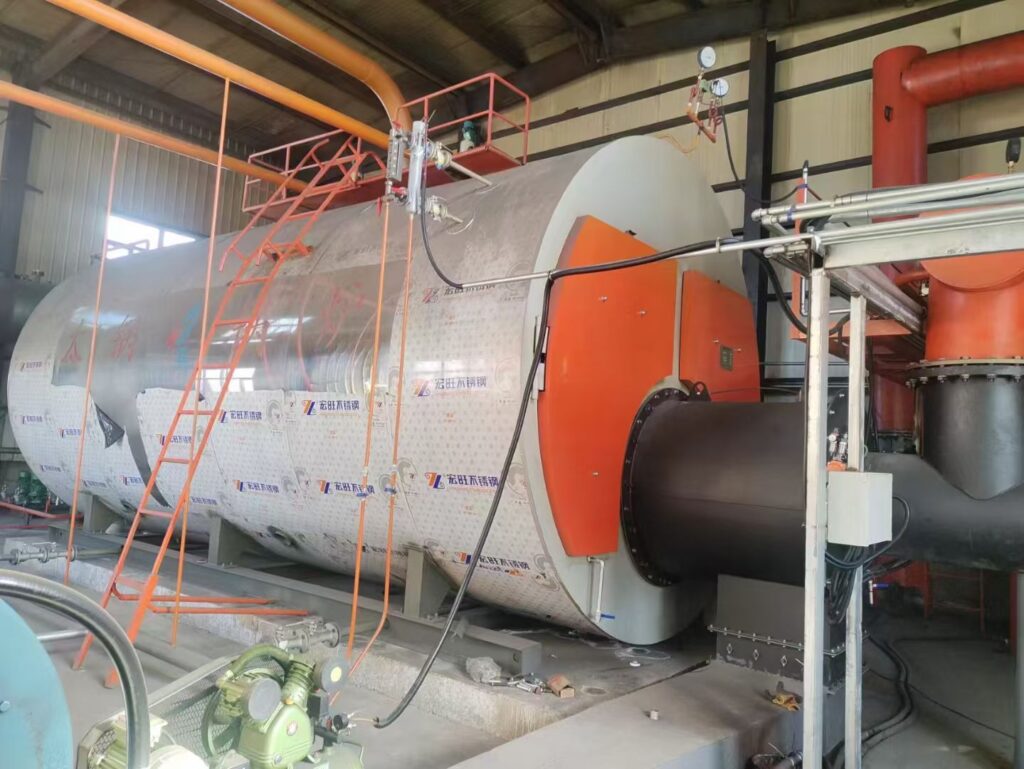
- Design: This is a three-pass, wet-back gas/oil fired boiler with a corrugated furnace design.
- Performance: It offers high thermal efficiency (up to 98%) and a compact footprint. Consequently, it is easy to install in existing factory layouts.
- Application: Ideal for facilities prioritizing low maintenance costs and quick deployment for gas or oil fuels.
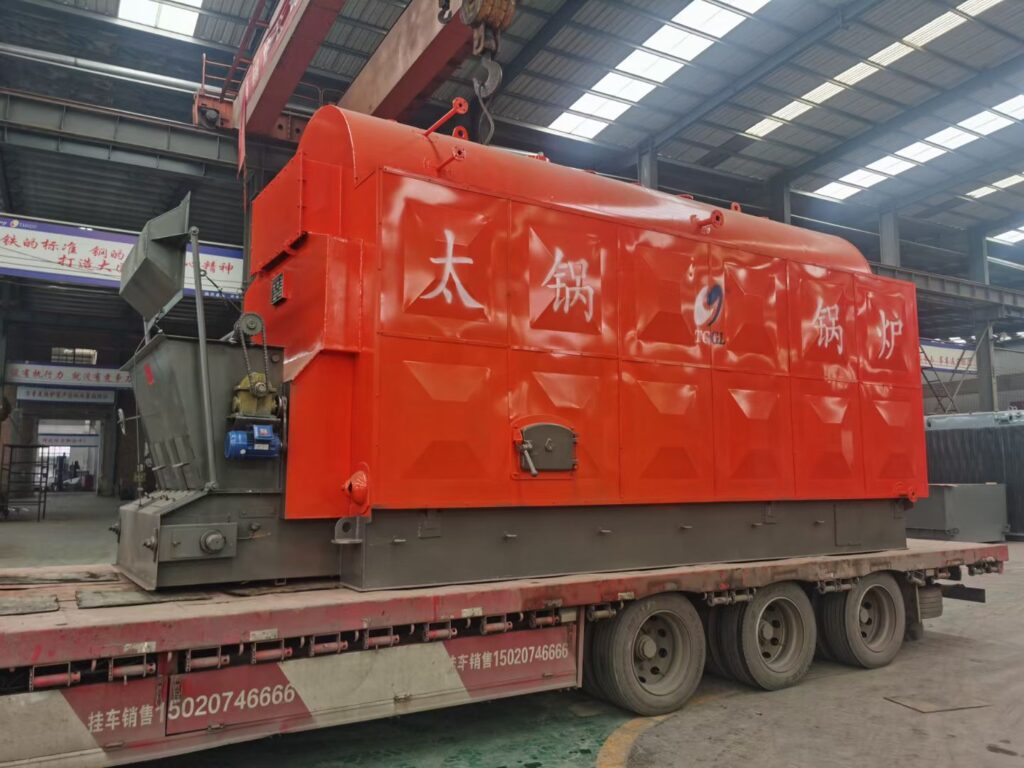
3. DZL Series: The Robust Biomass & Coal Fired Solution
In regions where natural gas is expensive or unavailable, the DZL Series provides a cost-effective alternative.
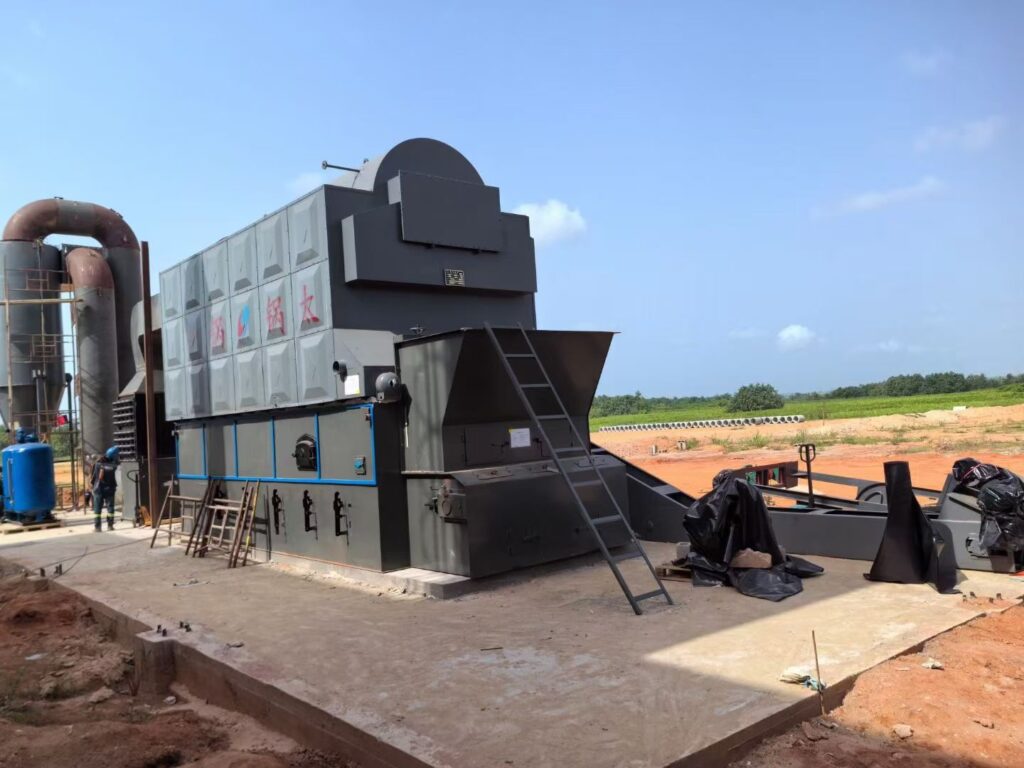
- Design: This is a horizontal, single-drum, longitudinal chain grate boiler.
- Performance: It burns biomass pellets, wood chips, or coal efficiently. The robust design handles the fluctuating loads typical of batch-curing cycles.
- Application: Perfect for wood treatment plants that can utilize their own wood waste as a free fuel source, significantly lowering operational ROI.
Achieving Technical Synergy: Vessel-Boiler Integration
Integrating your steam source with your pressure vessel is not just about piping; it is about synchronization. According to our technical standards, Taiguo’s integrated solutions provide three key operational benefits:
- Minimized Pressure Drops: Our boilers anticipate the “load surge” when an autoclave cycle begins. Therefore, the vessel reaches the hydrothermal synthesis stage faster.
- Steam Quality Control: All our boilers (SZS, WNS, and DZL) produce steam with a dryness fraction above 98%. This ensures uniform heat transfer during the Full-Cell Process.
- Automated Energy Management: The boiler’s PLC communicates with the autoclave’s control system. This synchronization maximizes your daily throughput while reducing fuel consumption by up to 15%.
Summary of Boiler Selection for Pressure Vessels
| Boiler Series | Fuel Type | Best For (Application) | Key Advantage |
|---|---|---|---|
| SZS Series | Gas/Oil | Large AAC Blocks/Panels | Rapid ramp-up & high capacity |
| WNS Series | Gas/Oil | Food Sterilization & Composites | Compact design & 98% efficiency |
| DZL Series | Biomass/Coal | Timber Sleepers & Wood Treatment | Low fuel cost & waste utilization |
Operational Benefits: Maximizing Your Return on Investment
Investing in Taiguo’s integrated autoclave and steam systems is a strategic move for long-term profitability. We focus on four core pillars that directly impact your factory’s bottom line.
1. Significant Reduction in Operational Downtime
Reliability is the foundation of industrial success.
- Heavy-Duty Engineering: We use specialized Q345R pressure vessel steel and perform 100% X-ray flaw detection on all welds.
- Minimized Maintenance: Our SZS and WNS boilers feature optimized heat surfaces that reduce scale buildup.
- Result: You experience fewer unplanned shutdowns, ensuring your production line meets tight delivery schedules consistently.
2. Enhanced Product Quality & Batch Consistency
In the AAC and timber industries, consistency defines your brand reputation.
- Precision Control: Our PLC-automated systems maintain pressure stability within ±0.01 MPa.
- Uniform Heat Transfer: High-dryness saturated steam (above 98%) eliminates “cold spots” inside the vessel.
- Result: You achieve superior hydrothermal synthesis in AAC blocks and 100% chemical penetration in timber sleepers.
3. Lower Fuel Costs through Energy Intelligence
Fuel is often the largest ongoing expense for pressure vessel operations.
- Waste Heat Recovery (WHR): Our systems capture flash steam during depressurization to pre-heat boiler feed water.
- High Thermal Efficiency: Our WNS boilers reach up to 98% efficiency using corrugated furnace technology.
- Result: You reduce overall fuel consumption by 10% to 15%, significantly lowering the cost per production cycle.
4. Stability for Long-Cycle Production
AAC and wood treatment require continuous operation for 12 hours or more.
- Synchronized Performance: Our boilers (SZS, WNS, DZL) are designed to handle the heavy load surges of batch-curing.
- Durability: The D-type water tube structure of the SZS series allows for 24/7 high-pressure output without thermal fatigue.
- Result: You gain a stable, long-term production partner capable of scaling with your business growth for 20+ years.
| Financial Driver | Taiguo Technical Advantage | Strategic Benefit |
|---|---|---|
| Lower OpEx | Waste Heat Recovery (WHR) | Improved cash flow and fuel savings |
| Market Lead | Precise Pressure Control | Higher product grade and premium pricing |
| Asset Safety | Triple Interlocking Safety Doors | Zero-risk environment and lower insurance |
Safety Standards and Global Compliance
As a factory leader, I prioritize safety above all. High-pressure operations leave no room for error.
- Safety Relief Valves: Redundant systems trigger automatically if pressure exceeds 5% of the limit.
- Automated Control: PLC systems monitor temperature-pressure curves in real-time. This ensures every batch meets your quality standards.
- Global Certification:EAC & ASME Standards: We manufacture according to the highest global safety codes. Every vessel exported to the Eurasian Economic Union includes a full EAC (TR CU) Technical Passport.
- X-Ray Tested Welds: 100% of our longitudinal and circumferential welds undergo X-ray flaw detection. We don’t just hope it’s safe; we prove it with documented non-destructive testing (NDT) reports.
Why Global Industrial Clients Choose Taiguo & CNMIRACLE
CNMIRACLE, as the international engineering and export division of Taiguo Boiler Group, works together with Henan Taiguo Boiler Manufacturing Co., Ltd. to deliver fully integrated industrial thermal systems for global factories.
This dual-brand structure combines manufacturing strength, engineering capability, and international project execution, ensuring stable performance, reliable delivery, and long-term operational value for industrial clients worldwide.
1. Long-Term Industrial Investment Value
Industrial boiler and pressure systems are long-term capital assets that must operate under continuous thermal and mechanical stress. Our systems are designed to maximize service life, energy efficiency, and return on investment across the full operational cycle.
- High-strength pressure vessel steel (Q345R or equivalent industrial-grade materials) ensures structural durability under long-term operation
- Full radiographic inspection and hydrostatic pressure testing before shipment guarantee zero-defect manufacturing quality
- Optimized thermal insulation and combustion system design reduce long-term energy loss
- Integrated waste heat recovery systems improve overall thermal efficiency and fuel utilization
As a result, industrial clients benefit from extended equipment lifespan, reduced replacement frequency, and improved long-term operational profitability.
2. Global Engineering & EPC Delivery Capability
CNMIRACLE provides complete engineering and international project delivery support, ensuring seamless system integration from factory design to onsite commissioning.
- Full system engineering design including boiler selection (SZS, WNS, DZL, thermal oil systems)
- Steam load calculation and process integration for industrial applications
- Boiler room layout planning and piping system design (including 3D engineering drawings)
- Global logistics coordination and export documentation management
- On-site installation supervision and commissioning support by experienced engineers
This integrated EPC capability ensures that every system operates reliably under real industrial conditions across diverse global markets.
3. Manufacturing Authority & Quality Assurance
All equipment is manufactured at the Henan Taiguo Boiler production base, a Class-A certified industrial manufacturing facility specializing in heavy-duty thermal equipment.
- ISO 9001 quality management system compliance
- China Class-A boiler manufacturing license certification
- ASME / CE standard manufacturing capability for international markets
- Automated welding, structural fabrication, and precision assembly lines
- 100% X-ray weld inspection and multi-stage pressure testing before shipment
This manufacturing foundation ensures consistent product quality, structural safety, and compliance with international industrial standards.
4. Lifecycle Technical Support System
CNMIRACLE provides full lifecycle technical support to ensure stable operation and continuous optimization of industrial systems after delivery.
- PLC-based automation system for centralized operation and monitoring
- Remote diagnostics and technical troubleshooting support
- On-site installation supervision and operator training
- Spare parts supply strategy for key system components
- Long-term technical consultation for system expansion and optimization
This lifecycle support system minimizes operational risks while ensuring long-term stability and efficiency of industrial thermal systems.
Strategic Summary: Integrated Industrial Value System
| Value Pillar | Technical Capability | Business Impact |
|---|---|---|
| Investment Value | Long-life design + energy optimization | Higher ROI and lower lifecycle cost |
| Engineering Capability | Full EPC design + system integration | Reduced project risk and faster deployment |
| Manufacturing Strength | Class-A factory + global certifications | Stable quality and international compliance |
| Lifecycle Support | Remote monitoring + full service system | Lower downtime and operational stability |
Strategic Global Markets: Where Our Technology Drives Growth
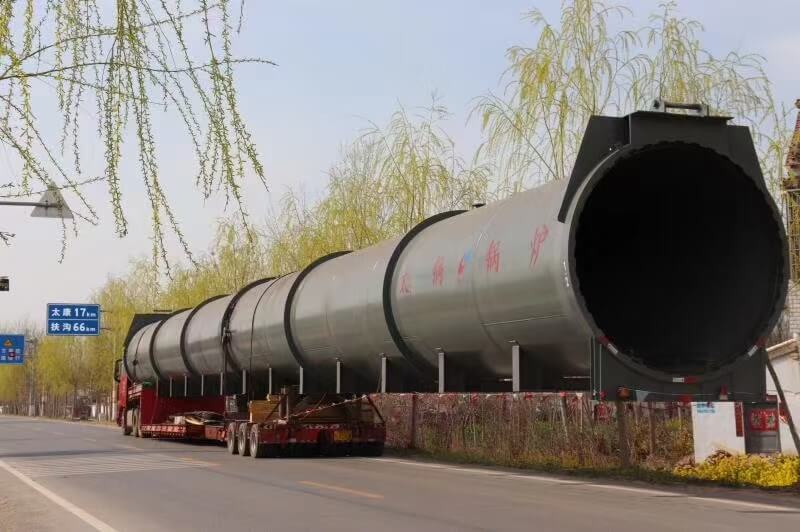
Taiguo Factory provides specialized steam solutions for rapidly industrializing regions. We understand that every market has unique fuel availability and regulatory standards. Based on our export data, we have identified the most high-performing markets for autoclaves and wood preservation systems.
1. Uzbekistan & Central Asia: The Infrastructure Hub
Uzbekistan is our primary priority market for gas-fired steam solutions. The country’s booming construction sector has created a massive demand for high-quality building materials.
- Focus Industry: AAC block production is currently the leading application in this region.
- Tailored Solution: We recommend our SZS Series Gas Boilers paired with heavy-duty autoclave. These systems leverage the local natural gas abundance to power massive hydrothermal synthesis plants.
- Success Record: We have successfully commissioned multiple projects in Tashkent, ensuring compliance with local safety and energy standards.
2. Indonesia & Southeast Asia: The Biomass Powerhouse
The Southeast Asian market, particularly Indonesia, offers a unique opportunity for sustainable industrial growth.
- Focus Industry: The palm oil and timber industries require robust wood preservation and sterilization systems.
- Tailored Solution: Our DZL Series Biomass Boilers are the “Gold Standard” here. They allow factories to utilize wood waste or palm shells as free fuel, significantly lowering operational costs.
- Strategic Advantage: We provide the Full-Cell Process (Bethell Process) systems to ensure timber sleepers and utility poles achieve 30+ years of rot resistance in tropical climates.
3. The Philippines & Vietnam: Rapid Urbanization
Both countries are investing heavily in residential and commercial infrastructure, driving the need for efficient autoclaved materials.
- Focus Industry: Lightweight AAC panels for high-rise buildings and food sterilization systems for the export market.
- Taiguo Advantage: We provide modular autoclave layouts that allow local manufacturers to scale their production capacity as urban demand surges.
4. African & Emerging Markets: Rugged Reliability
In markets like Africa, reliability and ease of maintenance are the top priorities for enterprise founders.
- Focus Industry: Timber treatment for telecommunication poles and basic construction materials.
- Tailored Solution: Our WNS Series Oil-Fired Boilers are preferred for their compact footprint and high thermal efficiency in regions with limited gas infrastructure.
Local Technical Challenges & Solutions
Operating heavy autoclaves and vacuum impregnation plants involves managing intense hydraulic cycles, chemical corrosion, and rigid regulatory approvals. Our engineering facility delivers specific hardware upgrades to solve these common onsite operational hazards.
Problem 1: Aggressive Chemical Corrosion in Wood Treatment Plants
- The Challenge: Hardwood preservation chemicals (like CCA, ACQ, or Tanalith) contain copper compounds that aggressively attack standard carbon steel interiors, causing pitting corrosion and structural thinning.
- Our Solution: We apply a heavy-duty internal anti-corrosion lining or utilize premium 304/316 Stainless Steel Cladding inside the wood preservation tanks. This metallurgical shield prevents chemical degradation and doubles the service life of the vessel shell.
Problem 2: Door Flange Distortion under Continuous Thermal Cycling
- The Challenge: Constantly heating and cooling a 30-meter vessel creates massive structural expansion. Standard welded steel door rings can warp over time, leading to dangerous pressure leaks and seal failure.
- Our Solution: We manufacture our door rings from single-piece Integral Forged 16Mn Steel Flanges, bypassing weaker welded segment alternatives. Every forging undergoes full-volume ultrasonic testing to ensure zero internal voids or hairline cracks under extreme stress.
Problem 3: Complex Local Pressure Vessel Registration and Licensing Delays
- The Challenge: National safety watchdogs require extensive technical engineering data packs before allowing heavy-duty autoclaves to pass through customs and begin factory testing.
- Our Solution: We deliver a comprehensive, bilingual technical data dossier with every vessel package. This folder contains certified independent NDT inspection sheets, hydraulic pressure hold test logs, and stamp credentials tailored to align smoothly with Uzstandard, SNI, or GOST frameworks.
Industrial Autoclave & Wood Treatment System: Technical Checklist
1. Structural & Material Integrity
- Pressure Vessel Material: We use high-grade Q345R specialized steel for the main shell。
- Welding Quality Control: Every longitudinal and circumferential weld undergoes 100% X-ray flaw detection.
- Surface Defense: For wood preservation tanks, we apply industrial-grade anti-corrosion coatings or stainless steel cladding to resist aggressive chemicals like CCA or ACQ.
- Thermal Expansion Design: The support saddles are designed to accommodate thermal expansion, preventing structural fatigue during heating cycles.
2. Safety Interlocking Systems
- Triple Safety Door: Our autoclaves feature manual, electric, or hydraulic door systems with a triple interlocking mechanism.
- Zero-Pressure Protection: The system prevents the door from opening if there is even 0.01 MPa of residual pressure.
- Redundant Relief Valves: Dual safety valves are calibrated to trigger automatically if the pressure exceeds the limit by 5%.
3. Process Performance & Automation
- Vacuum Depth Capability: The system must achieve a deep vacuum of -0.098 MPa to prepare wood pores for the Bethell Process.
- Pressure Stability: Our PLC systems maintain working pressure (e.g., 1.2 MPa for AAC) with a precision of ±0.01 MPa.
- Temperature Uniformity: For composite curing or food sterilization, we guarantee temperature uniformity within ±2°C across the chamber.
- Waste Heat Recovery (WHR): The integration includes a heat exchange module to capture flash steam, reducing fuel costs by 10% to 15%.
4. Integrated Steam Source Pairing
- SZS Series (Water Tube): Recommended for large AAC plants requiring rapid ramp-up speeds and high capacity.
- WNS Series (Fire Tube): Ideal for medium-sized wood treatment or food sterilization with 98% thermal efficiency.
- DZL Series (Biomass/Coal): The best choice for wood factories using their own wood waste to achieve a lower ROI.
5. Global Export & Engineering Support
- Compliance Certification: All equipment is manufactured to ASME, CE, and ISO international standards.
- Regional Documentation: We provide EAC certification specifically for the Uzbekistan and Central Asian markets.
- On-Site Commissioning: Our engineers supervise the installation and perform safe pressure testing at your site.
- Operator Training: We provide comprehensive training on PLC operations and safety protocols for your local staff.
Integrated Thermal Systems and Engineering Support
An industrial autoclave cannot operate alone. It requires a stable, high-efficiency steam source and well-designed piping.
- Steam Source Integration: Pair your autoclave plant with high-capacity steam supply systems like our Industrial Steam Boiler Systems. For medium-scale production, explore WNS Gas Boilers, or choose a SZS Water Tube Boiler for large-scale multi-autoclave AAC plants. For indirect heat processes, consider a Thermal Oil Heater.
- Industry Applications: We provide custom pressure solutions for the AAC Production Plant, the Wood Processing Industry, and the broader Building Materials Industry.
- Complete Engineering Services: Our team assists with complete Steam System Design, plant layout planning through Boiler Room Layout, and full Pressure Vessel Installation.
📋 AAC Block & Wood Curing Technical Reference
Frequently Asked Questions (FAQ)
How do you handle high-moisture timber in your preservation system?
We utilize a multi-stage vacuum-pressure cycle to ensure deep penetration even in denser wood species. Consequently, your timber meets international anti-decay standards.
Can your equipment handle various chemicals like CCA or ACQ?
Yes, we use anti-corrosive coatings or stainless steel linings based on the chemicals used. Therefore, the main shell is protected for a 20+ year lifespan.
What is the maximum size of the autoclave you can manufacture?
As an A1/A2 certified manufacturer, we can produce autoclaves up to 3.5m in diameter and 40m in length.
Do you provide a “Turn-Key” solution for wood treatment?
Absolutely. We offer the complete system including vacuum pumps, mixing tanks, and control systems. Consequently, you can start production immediately after installation.
Why is an ASME certified autoclave Critical for wood preservation in 2026?
Safety and legality are Authoritative in 2026. An ASME Certified Wood Autoclave ensures the vessel can withstand repeated high-pressure cycles without fatigue. This is Essential for passing mandatory 2027 safety audits and ensuring the protection of your workforce.
How does the vacuum process improve preservative penetration?
The initial vacuum stage is Superior because it removes air from the wood’s cavities. When the preservative is injected under pressure, it occupies those voids Seamessly, resulting in Validated protection that lasts up to 40 years for utility poles.
Can these systems be used for “Thermal Modification” of wood?
The initial vacuum stage is Superior because it removes air from the wood’s cavities. When the preservative is injected under pressure, it occupies those voids Seamessly, resulting in Validated protection that lasts up to 40 years for utility poles.
What is the expected ROI for a modern wood treatment plant?
Due to Critical automation and chemical recovery systems, most plants report a Validated full ROI within 18 to 24 months. The Reliable increase in timber value from “raw lumber” to “treated UC4 timber” provides a significant profit margin boost.
What is an industrial autoclave used for?
An industrial autoclave is a heavy-duty pressure vessel designed for high-pressure hydrothermal curing, vacuum timber preservation, composite material processing, and high-temperature material treatments across manufacturing industries.
How does an AAC autoclave work?
An AAC autoclave supplies high-pressure saturated steam (1.2–1.6 MPa) to aerated concrete cakes. The heat and moisture spark a reaction between silica sand or fly ash and lime, forming calcium silicate hydrate to create durable, high-strength lightweight concrete.
How much does an industrial autoclave cost?
The cost of an industrial autoclave depends on vessel diameter, length, design pressure, door safety mechanisms, automation level, and application requirements. Contact our engineering team with your required production volume for an exact equipment proposal and quote.
Request Your Portfolio Now
Request a customized project drawing from our Engineering Team.
A large autoclave needs a stable steam source. Explore our WNS Gas Boilers