
Empowering the Uzbekistan Textile Revolution: Strategic Steam Engineering & Energy Economics for Global Export Leadership
As of April 2026, Uzbekistan has successfully transitioned from a raw cotton exporter to a global textile manufacturing powerhouse. With the national target to reach $7 billion in textile exports by the end of 2026, the industry has entered a “High-Quality Era.” In this competitive landscape—spanning the massive textile clusters of Fergana, Namangan, and the Tashkent Region—the industrial Steam Boiler for Textile Industry in Uzbekistan is no longer a peripheral utility; it is the core engine of production quality.
At Henan Taiguo Boiler, we understand that in a modern spinning, weaving, or dyeing mill, the difference between “Grade A” fabric and a rejected batch lies in the Enthalpy, Pressure Stability, and Steam Dryness. This exhaustive explores the technical metallurgy, regional energy mapping, and regulatory engineering required to build a world-class textile thermal plant in Central Asia.
1. The 2026 Uzbekistan Textile Context: Export Standards & Energy Reality
The “New Uzbekistan” 2026 economic roadmap has placed unprecedented pressure on textile mill owners to modernize and full guide to steam boiler technology in Uzbekistan
A. Meeting European & American Audit Standards (GOTS & OEKO-TEX)
To secure contracts with global retail giants, Uzbek factories must prove both Product Consistency and Environmental Responsibility.
- The Steam Quality Factor of Steam Boiler for Textile Industry in Uzbekistan: Inconsistent steam pressure during the dyeing process leads to “Temperature Fluctuations” in the bath, causing uneven color absorption (Color Shading).
- The Finish Factor of Steam Boiler for Textile Industry in Uzbekistan: Modern stenter frames require precise heat settings. Our boilers guarantee 99.5% steam dryness, ensuring that your fabric “Hand-Feel” and color depth meet the luxury standards of Milan and Paris export audits.
B. Navigating the 2026 Energy Pricing Shift
The Uzbek government’s pivot toward market-based energy pricing means that Thermal Efficiency is now your primary driver of net profit. A legacy Soviet-era boiler with 75% efficiency is no longer an asset; it is a financial drain. By upgrading to Taiguo’s 104% Efficiency Condensing Systems, mills can reduce their OPEX enough to offset rising global raw cotton costs.
2. Regional Textile Cluster Analysis: Tailoring the Solution by Steam Boiler for Textile Industry in Uzbekistan
Uzbekistan’s textile industry is organized into specific “Clusters.” Each region presents a unique “Thermal Profile” that requires custom engineering.
- The Fergana & Namangan Clusters (Dyeing & Finishing Hubs): These regions require massive volumes of saturated steam for fabric finishing.
- The Challenge: Seasonal load spikes during peak export windows. When multiple dyeing vats open their valves simultaneously, a standard boiler’s pressure will collapse.
- The Taiguo Solution: We equip our WNS Series Gas Steam Boiler for Textile Industry in Uzbekistan with an Extra-Large Steam Space. This acts as a thermal buffer, absorbing the sudden “Steam Pull” and maintaining a flat pressure curve. This stability is the secret to achieving zero-defect dyeing.
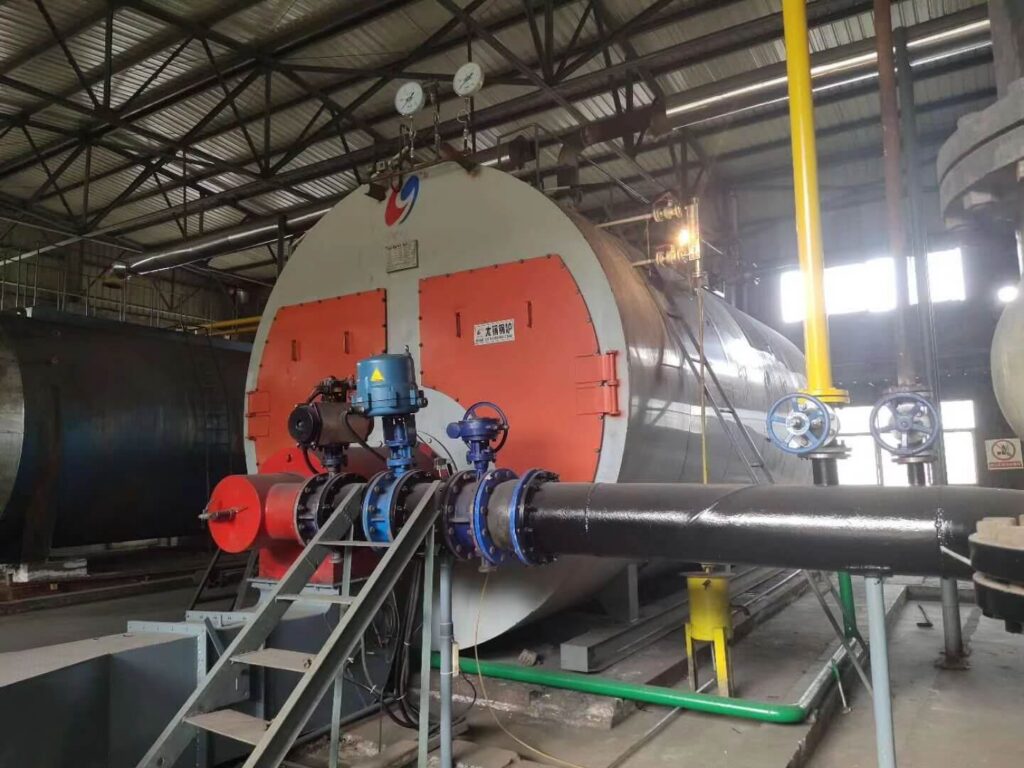
A Taiguo 10-ton steam boiler for a textile factory in Uzbekistan ensuring 100% color consistency.
- The Tashkent & Samarkand Regions (High-End Apparel & Urban Constraints): These areas face the strictest enforcement of Resolution No. 66 (Feb 2026) regarding urban emissions.
- The Challenge: Strict environmental audits in “Green Zones.”
- The Taiguo Solution: Our 2026 models feature Digital Combustion Management (DCM) and Low-NOx Burners (<30mg) of Steam Boiler for Textile Industry in Uzbekistan. We help you secure the Tashkent Eco-Compliance Certificate on the first day of commissioning, avoiding the heavy penalties currently being levied against outdated industrial units.
- The Rural Clusters (Kashkadarya & Jizzakh – The Biomass Opportunity): Located near the primary cotton ginning facilities, these clusters have a “Waste-to-Energy” goldmine.
- The Strategy: Uzbekistan produces over 3 million tons of cotton stalks annually.
- The Taiguo Solution: Our SZL Double-Drum Biomass Steam Boiler for Textile Industry in Uzbekistan(cost-effective biomass boilers for spinning mills) are calibrated for the high-silica content of Central Asian cotton waste. Switching to biomass can reduce your fuel OPEX by 40-60%, making your yarn the most price-competitive in the entire EAEU region.
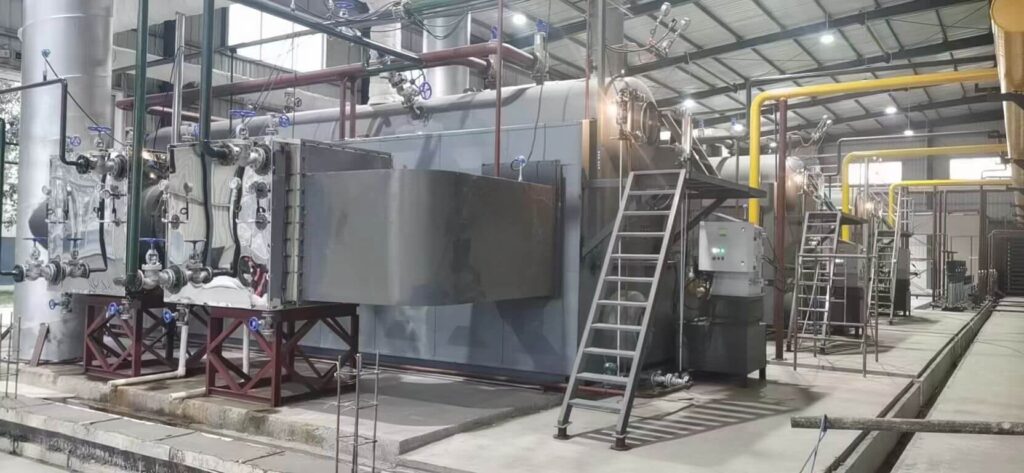
3. Thermal Science in Textile Production: Why “Dryness” of Steam Boiler for Textile Industry in Uzbekistan Matters
To understand why a Taiguo boiler is superior, one must understand the physics of the textile finishing line.
A. The Physics of Sizing & Desizing
In weaving, the sizing process requires a constant temperature to ensure the starch or synthetic size adheres evenly to the yarn.
- The Risk: If steam carries water droplets (“Wet Steam”), it dilutes the sizing agent, leading to weak yarn and frequent breakages on the loom.
- The Taiguo Advantage: Our internal Multi-Stage Steam-Water Separators strip out 99.5% of moisture, providing “Hard Steam” that maintains the precise viscosity needed for high-speed weaving.
B. Dyeing Vat Thermal Stability
Dyeing is a chemical reaction. A 2 degree drop in steam temperature can alter the chemical bonding of the dye to the fiber.
- The Engineering: We utilize Advanced PID Modulation on our burners of Steam Boiler for Textile Industry in Uzbekistan. This clean gas steam solutions for high-end dyeing allows the boiler to track the steam load with 0.1 bar precision. Whether you are running one vat or twenty, the steam enthalpy remains identical, ensuring “Batch-to-Batch” color consistency.
C. Finishing & Stentering
Stenter frames use heat exchangers to dry and set the fabric.
- The Risk: Wet steam causes Water Hammer in the heat exchanger tubes, leading to leaks and expensive downtime.
- The Solution: By delivering pure saturated steam, Taiguo extends the life of your expensive finishing machinery by up to 40%.
4. Taiguo A-Class Standards of Steam Boiler for Textile Industry in Uzbekistan: Metallurgy & 2026 Engineering
A. Premium Metallurgy: Why Q245R Steam Boiler for Textile Industry in Uzbekistan Steel?
The thermal cycles in a 24/7 textile mill are brutal. The Steam Boiler for Textile Industry in Uzbekistan shell expands and contracts thousands of times.
- The Standard: We exclusively use Q245R (GB713) boiler steel. Ordinary carbon steel (Q235) will suffer from “Intergranular Corrosion” and thermal cracking within 5 years.
- The Result: Combined with our Full-Wave Corrugated Furnace , Taiguo Steam Boiler for Textile Industry in Uzbekistan offer a 25-year structural guarantee, even under the high-pressure demands of a Namangan denim plant.
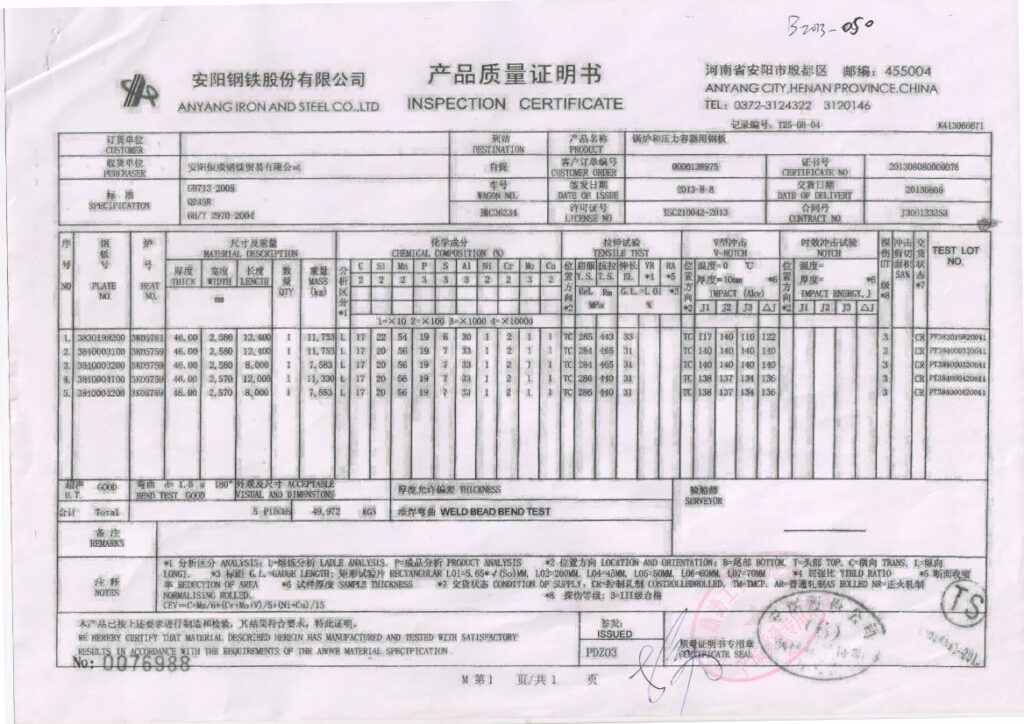
B. Digital Twin & Siemens PLC Integration
In 2026, a boiler room should not be a “black box.”
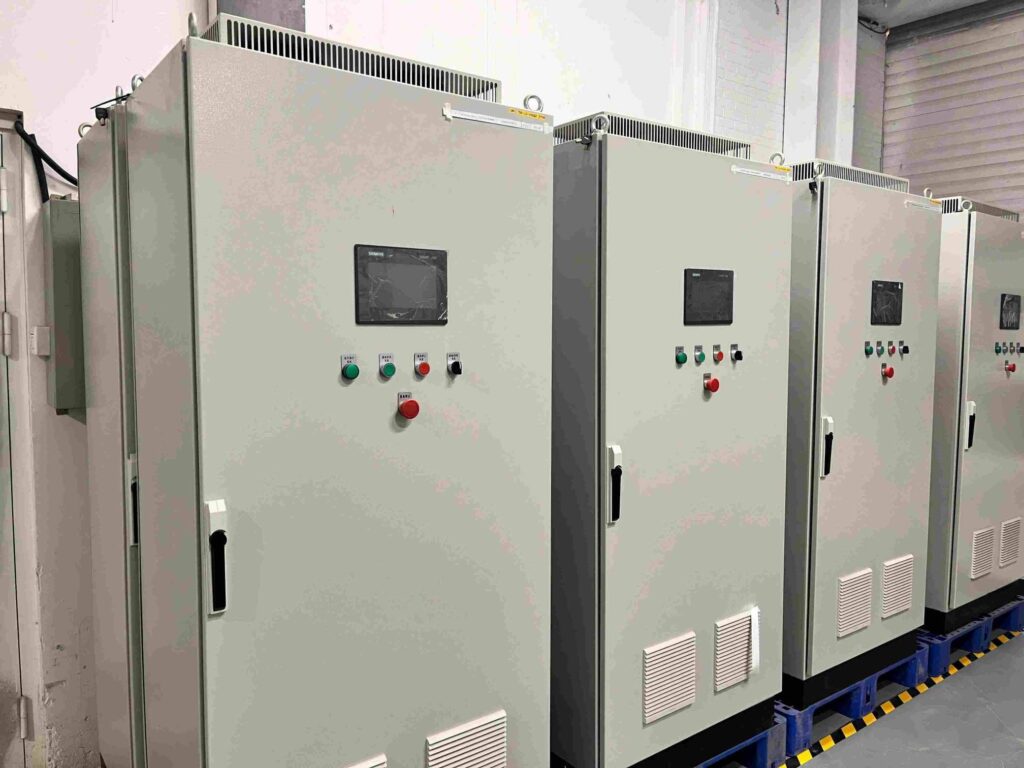
- The Tech: Every Steam Boiler for Textile Industry in Uzbekistan is equipped with a Siemens-based PLC Control Center.
- The Benefit: This system monitors fuel-to-air ratios in real-time, providing an O2 Trim function that reduces fuel waste by 2-3%. Your plant manager in Tashkent can monitor steam output and fuel consumption from a smartphone, ensuring full transparency in energy costs.
5. ROI & Financial Engineering: The Textile Profit Matrix
| Metric | Legacy Soviet Boiler | Taiguo WNS (2026) | Annual Financial Impact |
| Gas Efficiency | 78% | 104% (Condensing) | $22,500 Saved |
| Automation | Manual Control | Siemens PLC (IoT) | $8,000 Labor Savings |
| Product Yield | 93% (due to color shading) | 99% (Stable Quality) | $15,000 Waste Reduction |
| Subsidy | $0 | GEFF II 10% Cashback | $4,000 – $7,000 Grant |
Total Payback Period: For a 10-ton textile plant, the ROI is typically 11.5 months. We assist in preparing the documentation for the Green Economy Financing Facility (GEFF) to unlock these 10% cash-back grants.
6. Uzbekistan Special for Steam Boiler for Textile Industry in Uzbekistan: Winter Maintenance & “Cold-Start” Protocols
Uzbekistan’s extreme continental climate requires specialized “Central Asia Prep.”
A. Anti-Freeze & Standby Circulation
In -20 degree winters, a textile mill shutdown can be catastrophic if the boiler water freezes.
- The Protocol: Our systems include Automatic Standby Circulation. The PLC intermittently activates the primary pumps and a “simmer flame” to maintain an internal temperature of 45 degree, preventing the bursting of pipes, valves, and gauges.
B. Combatting “Fergana Silica” (Water Treatment)
The groundwater in the Fergana Valley is often high in silica and calcium.
- The Solution: We provide Dual-Stage Automatic De-mineralizers. Without this, silica forms a glass-like scale on the boiler tubes that is nearly impossible to remove and reduces heat transfer by 15%. Our system includes a real-time Conductivity Meter that triggers an automatic blowdown before scale can form.
C. 52-Week Maintenance Checklist
- Weekly: Test water hardness (<0.03 mmol/L). Clean gas filters.
- Monthly: Calibrate air-fuel ratio. Check safety interlocks.
- Quarterly: Inspect burner ignition electrodes. Analyze flue gas temperature (T exhaust < 70degree for condensing models).
7: 3D Steam Boiler for Textile Industry in Uzbekistan Boiler Room Spatial Planning for Textile Mills: Engineering for Efficiency
A high-performance Steam Boiler for Textile Industry in Uzbekistan is only as good as the piping network it feeds. In the textile industry, where steam must travel across vast halls to reach dyeing vats and stenters, spatial planning is critical to prevent energy loss.
- Optimizing the Steam Manifold Positioning for Steam Boiler for Textile Industry in Uzbekistan:The steam manifold should be installed as close to the boiler’s main steam outlet as possible to minimize initial pressure drops. In a multi-boiler setup (common in Tashkent’s larger mills), we utilize a centralized 3D layout that ensures balanced steam distribution. The manifold should be elevated and equipped with high-quality insulation to prevent it from becoming a “heat radiator,” ensuring the energy goes to the fabric, not the boiler room air.
- Precision Piping Slope & Condensate Drainage of Steam Boiler for Textile Industry in Uzbekistan:To prevent Water Hammer—a common killer of textile machinery—steam pipes must be installed with a downward slope of at least 1:100 in the direction of steam flow. This ensures that any condensate is naturally guided to the steam traps. Our 3D planning includes strategically placed Drip Legs at every vertical rise to ensure only “Dry Steam” reaches the sensitive sensors of your finishing frames.
- Minimizing Elbows & Bends to Reduce Pressure Drop ofSteam Boiler for Textile Industry in Uzbekistan:Every 90-degree elbow in a steam line is equivalent to adding several meters of straight pipe resistance. In our 3D engineering designs, we prioritize Large-Radius Bends and “Direct-Path” routing. By reducing the number of elbows by just 20%, a Namangan denim plant can lower its required boiler output pressure by 0.5 bar, translating to a 1-2% reduction in annual fuel consumption.
8: Central Asian Natural Gas Analysis & Burner Calibration of Steam Boiler for Textile Industry in Uzbekistan
The natural gas supplied across Uzbekistan is not uniform. Depending on whether your mill is in the Fergana Valley or the Navoi region, the gas composition and calorific value can fluctuate, necessitating precision burner adjustment.
Dynamic Air-Fuel Ratio Adjustment:To compensate for the atmospheric density in high-altitude regions (like Jizzakh) and the specific chemical makeup of Uzbek gas, we utilize Electronic Linkage Control. Instead of mechanical cams, our burners use independent servomotors for the air damper and gas valve. This allows us to “Map” the combustion curve to the local gas profile, maintaining the stoichiometric ratio at all fire rates. This precision is what allows Taiguo boilers to achieve a consistent 104% efficiency even in challenging Central Asian environments.
Understanding the Local Calorific Value (Q):Uzbekistan’s natural gas typically has a Lower Heating Value (LHV) ranging from 33,500 to 36,000 kJ/m3. However, during the transition into winter, the “heavier” components can settle, or the pipeline pressure may drop, altering the effective heat input.
Geographical Contaminants & Impurities:In certain regions, the gas contains traces of sulfur and higher nitrogen content. If the burner is not adjusted for these specific chemical profiles, it can lead to “Sooting” (carbon buildup) on the furnace walls, which acts as an insulator and lowers efficiency. Our engineers utilize Digital Flue Gas Analyzers on-site in Uzbekistan to measure O2 and CO levels, ensuring complete combustion regardless of gas purity.
📋 Textile Industry Project Reference & Technical Nodes
FAQ: The Textile Industry Expert Panel
Can we utilize our own cotton ginning waste in a Taiguo boiler?
Absolutely. Our SZL Biomass series is specifically designed with a wider chain grate and secondary air injection to handle the high-volume, low-density nature of cotton stalks.
How do you handle the high-altitude pressure adjustments in regions like Jizzakh?
We calibrate our burners and air-intake fans at the factory to account for the specific altitude and atmospheric pressure of your site in Uzbekistan, ensuring the rated output is achieved.
What is the maintenance schedule for a 24/7 textile boiler?
We recommend a Weekly Water Test, a Monthly Burner Calibration Check, and a Full Annual Inspection. We provide a “Maintenance Logbook” in Russian to help your team stay compliant with local safety codes.
CTA: Secure Your 2026 Textile Export Advantage
Don’t let legacy energy systems and poor steam quality cap your textile export potential. Join the 60+ Uzbek textile enterprises already powered by Taiguo technology. Request your customized project layout, fuel cost analysis, and GEFF grant eligibility report today.
- Download: Whitepaper – Steam Dryness Standards for Global Fabric Export
- WhatsApp: Chat with our Textile Industry Director Now