
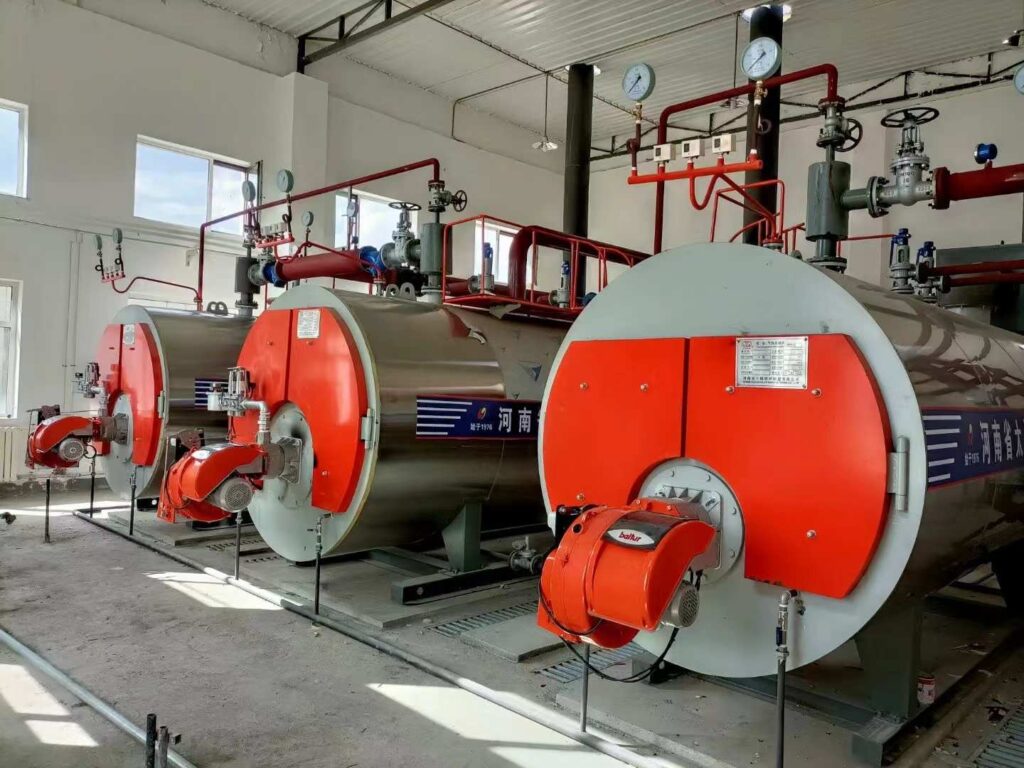
Project Profile & Performance Highlights Of 12 ton Gas Steam Boiler for Cotton Dyeing Factory in Uzbekistan
- Location & Year: Tashkent, Uzbekistan | Project Commissioned in March 2024
- Client Industry: Large-scale Cotton Yarn Dyeing & Fabric Finishing (800+ Employees)
- System Equipment: 3 Sets of WNS4-1.25-Q Gas Steam Boilers 4 t/h per unit)
- Total Capacity: 12t/h Continuous Saturated Steam Supply
- Measured ROI: 18.5% Fuel Savings yielding USD 4,500 – 6,000 monthly savings with an estimated 18-month capital payback period.
- Track Record: 14+ Months of continuous operation with zero unscheduled downtime.
2. Customer Background & Thermal Energy Pain Points
The client operates one of the largest cotton yarn dyeing and fabric finishing mills in the Tashkent region. Textile wet processing requires continuous thermal energy. Fabric dyeing and tentering machines need highly stable steam temperatures to ensure uniform coloring.
Previously, the factory faced severe operational challenges:
- Frequent Color Shading Defect: Their old single large boiler suffered from sudden pressure drops during peak dyeing cycles. These fluctuations caused uneven fabric coloring and led to high rejection rates.
- High Fuel Waste During Low Loads: During night shifts or partial line maintenance, running a single large boiler wasted massive volumes of natural gas.
The client needed a flexible, modular steam plant. The new setup must automatically adjust steam output based on real-time textile production load changes.
3. Why the Customer Chose 3 Units of WNS4 Instead of 1 Large Boiler-Gas Steam Boiler for Cotton Dyeing Factory in Uzbekistan
Our engineering team recommended installing three units of 4t/h WNS gas steam boilers rather than a single 12 t/h boiler. This configuration offers perfect flexibility for textile manufacturing.
- Peak Demand (100% Load): All three boilers run parallelly to deliver full 12 t/h steam capacity.
- Medium Demand (65% Load): Boiler 1 and Boiler 2 run at full capacity. The system automatically puts Boiler 3 into standby mode.
- Low Demand (30% Load): Only Boiler 1 operates to support night-shift dyeing. This eliminates the huge standby energy losses of a large boiler.
- Zero Production Downtime: Textile dyeing machines cannot stop midway. The three independent boilers act as mutual backups. If one unit requires routine water-treatment maintenance, the remaining two units maintain core production.
4. Why WNS Gas Steam Boiler for Cotton Dyeing Factory in Uzbekistan Are So Popular
Uzbekistan is rapidly expanding its textile and garment export capacities. The government actively encourages local mills to upgrade from raw cotton exporting to high-value fabric processing.
Taiguo WNS series Gas Steam Boiler for Cotton Dyeing Factory in Uzbekistan have become the top choice for Uzbekistan textile plants due to critical market factors:
- Abundant Natural Gas Alignment Of Gas Steam Boiler for Cotton Dyeing Factory in Uzbekistan: Uzbekistan possesses rich natural gas reserves. Our WNS series integrates premium Italian low-NOx burners. This combination utilizes local pipeline gas pressure efficiently.
- Strict Environmental Compliance Of Gas Steam Boiler for Cotton Dyeing Factory in Uzbekistan: New industrial zones in Tashkent enforce strict emission standards. Our combustion systems are designed to comply with local emission requirements perfectly.
- Stable Steam Quality Protection Of Gas Steam Boiler for Cotton Dyeing Factory in Uzbekistan: Advanced internal steam-water separators ensure steam dryness above 98%. This premium steam quality completely eliminates fabric staining issues caused by wet steam.
5. Technical Parameters of the Running System Of Gas Steam Boiler for Cotton Dyeing Factory in Uzbekistan
| Item | Value |
| Boiler Model | WNS4-1.25-Q (Three-pass wet-back fire tube) |
| Total Steam Output | 12 t/h(3 Units Total) |
| Thermal Efficiency | > 95.8% |
| Fuel Type | Natural Gas / LNG |
| Actual Operating Pressure | 0.8 MPa –1.25 MPa (Adjustable) |
| Steam Temperature | 170 – 194 ℃ |
6. On-Site Installation and Commissioning Of Gas Steam Boiler for Cotton Dyeing Factory in Uzbekistan
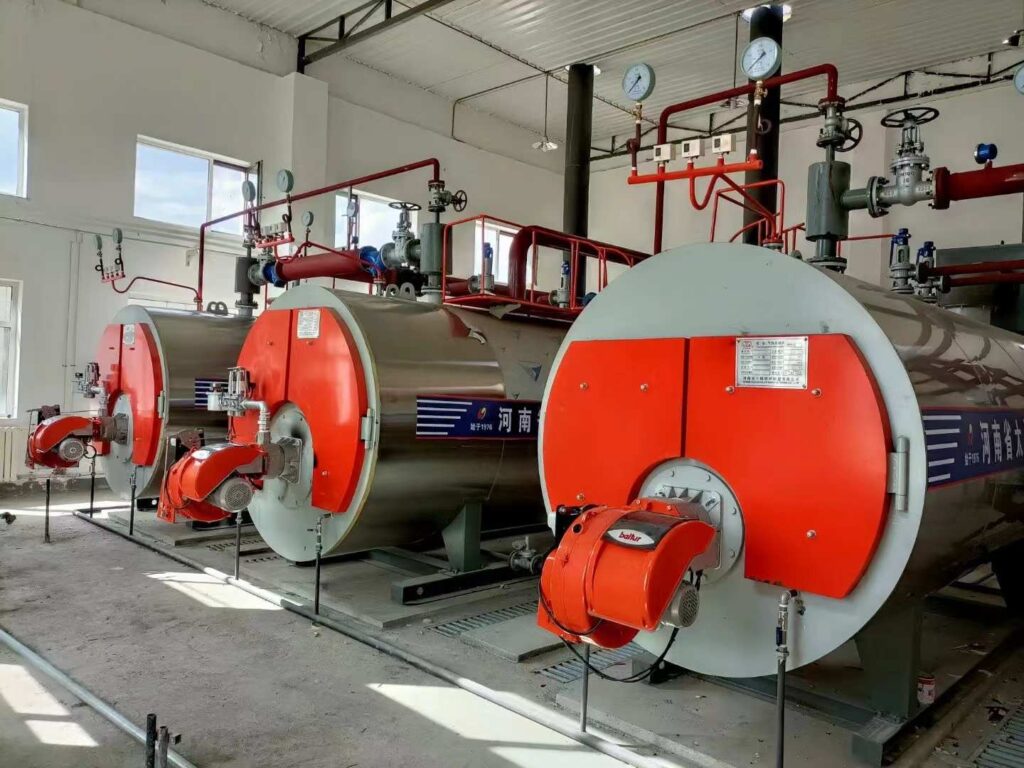
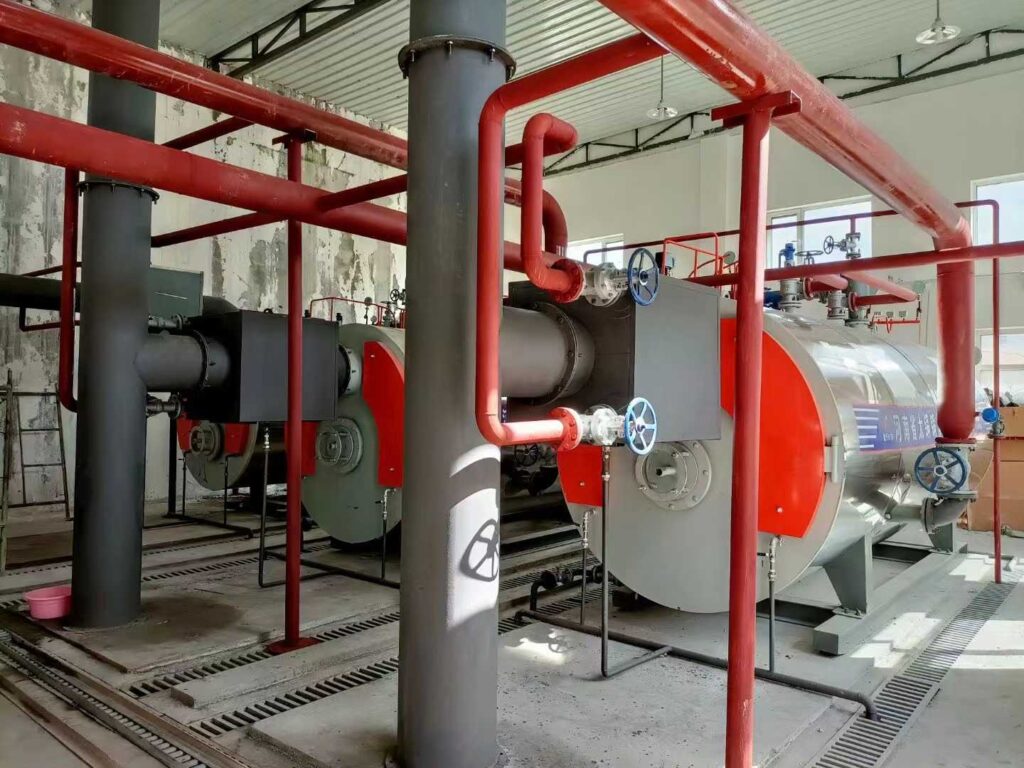
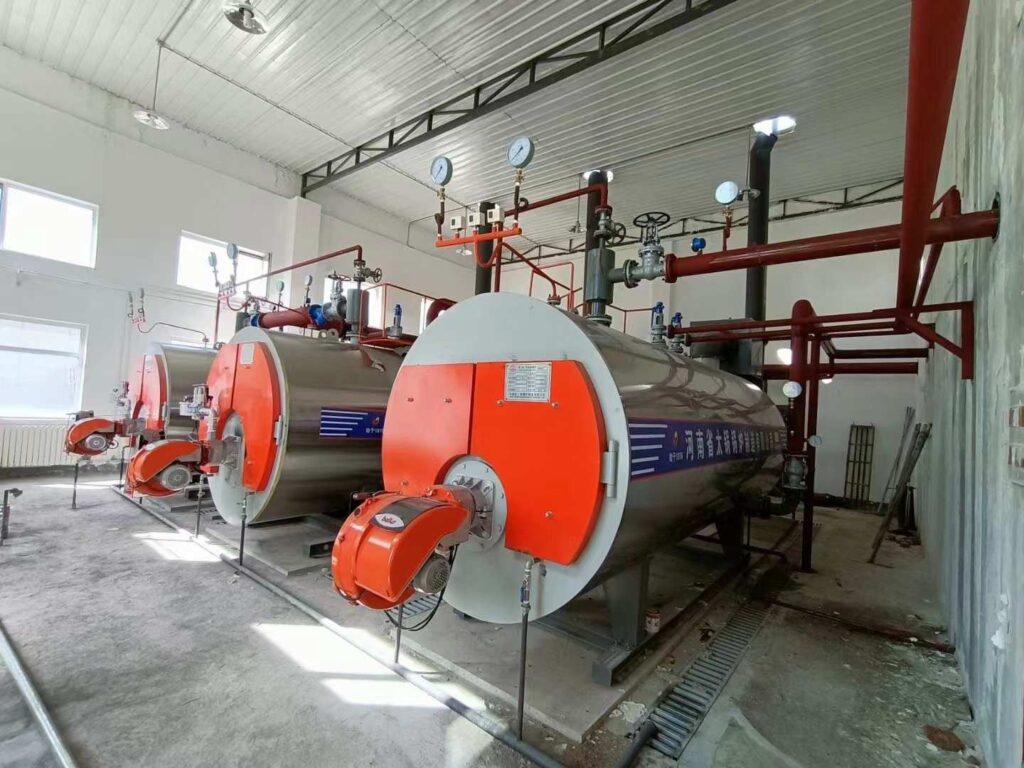
Taiguo Factory dispatched two senior service engineers to Tashkent for comprehensive on-site installation supervision and system commissioning.
- Foundation Alignment: The engineering team calibrated the concrete levels carefully to eliminate operational vibration.
- Burner Synchronization: We fine-tuned the Italian Baltur burners to match the local natural gas supply pressure fluctuations perfectly.
- Water Softener Integration: We installed an automatic multi-stage water softening system. This setup completely prevents scale buildup inside the boiler tubes, maintaining long-term high thermal efficiency. You can review our detailed water-treatment deployment guidelines in our dedicated Boiler Commissioning Service.
7. Operating Performance & ROI Analysis Of Gas Steam Boiler for Cotton Dyeing Factory in Uzbekistan
These three WNS4 gas steam boilers have been running continuously for over 14 months in the Tashkent facility. The client management reported exceptional economic and operational results:
- Zero Fabric Color Shading: Steam pressure fluctuations stay strictly within ±0.03MPa. Stable pressure ensures consistent dyeing temperatures, reducing fabric defects to zero.
- Substantial Fuel Savings: By eliminating low-load fuel waste, the mill cut its monthly natural gas consumption by 18.5%.
- Direct Financial Return (ROI): The factory saves approximately USD 4,500 to USD 6,000 per month in natural gas costs. The entire boiler upgrade project will achieve full capital payback within 18 months.
- Labor Cost Reduction: The fully automated Siemens PLC control system monitors water levels and pressure in real-time, saving the labor costs of two operators per shift.
8. Summary of Engineering Scope For Gas Steam Boiler for Cotton Dyeing Factory in Uzbekistan
To ensure the absolute success of this 12 t/h centralized steam plant, Taiguo Factory delivered a full-lifecycle turnkey engineering service. Our work went far beyond manufacturing, encompassing the following scope:
- Complete Boiler Room Layout & Piping System Design: Engineered the optimal pipeline layout to minimize pressure drop between the boiler room and the dyeing workshop.
- 3 Units of WNS4 High-Efficiency Boiler Body Manufacturing: Built strictly under international manufacturing codes with 100% radiographic testing of welded seams.
- Imported Italian Low-NOx Burner Integration & Tuning: Commissioned the burners to ensure stable combustion under localized gas pressure variants.
- On-Site Installation Supervision & Structural Alignment: Dispatched field engineers to Tashkent to supervise foundation settlement and auxiliary piping assembly.
- Multi-Boiler Automatic Parallel Commissioning Service: Configured the centralized PLC system to allow smooth automated load sharing and mutual backup operation.
- Local Boiler Operators Technical & Safety Training: Conducted on-site technical training covering safety regulations, routine water testing, and emergency shutdown protocols.
9. FAQ For Gas Steam Boiler for Cotton Dyeing Factory in Uzbekistan
How does the multi-boiler control system prevent steam backflow when one boiler is shut down?
Every WNS4 boiler outlet is equipped with a high-grade main steam stop valve and a heavy-duty non-return check valve. When the PLC system puts a boiler into standby mode, the check valve closes automatically due to system header pressure. This layout prevents high-pressure steam from backing up into the idle boiler drum.
What are the water quality requirements for running WNS steam boilers in Uzbekistan textile mills?
To maintain high thermal efficiency and prevent scale corrosion, feed water hardness must stay below 0.03 mmol/L, and dissolved oxygen must be less than 0.1mg/L. We highly recommend reviewing our complete technical blueprint on Industrial Boiler Water Treatment System Layout to safeguard your equipment lifespan.
Can these boilers switch to fuel oil if the natural gas supply becomes unstable?
Yes. Our WNS series boilers support dual-fuel burner integration. By changing the burner nozzle or choosing a dual-fuel burner (Gas & Light Oil), the system can switch alternative fuels smoothly without replacing the main boiler body.
Why should a factory choose multiple smaller boilers instead of one single large boiler?
A multi-boiler setup provides:
Higher Operational Flexibility: Seamlessly scales steam output up or down based on real-time plant demand.
Lower Standby Fuel Consumption: Shuts down unneeded boilers completely during off-peak hours instead of idling a massive unit.
Built-in Redundancy: Avoids total factory closure during routine cleanings or water-side maintenance.
Easier Maintenance: Smaller boilers allow operators to service one unit safely while the others handle the base textile factory loads.
10. Related Solutions & Products
- WNS Series Gas/Oil Steam Boiler (1t/h – 20 t/h)
- Industrial Boiler Manufacturing Capabilities
- Customized Steam Solutions for Uzbekistan Textile Industry
Related Project Case Studies :
- Uzbekistan Textile Mill – WNS10 High-Capacity Steam Boiler Running Performance
- Indonesia Garment Factory – WNS8 Energy-Saving Steam Boiler Operational Report
- Indonesia Food Plant – Plug-and-Play Containerized WNS Boiler Solution
11. Get a Customized Steam Proposal Today
Are you operating a textile, garment, or dyeing facility in Central Asia? Contact Taiguo Factory today. Our industrial steam experts will engineer a high-efficiency, fuel-saving steam boiler system tailored to your production capacity.
📋 Textile Industry Project Reference & Technical Nodes