
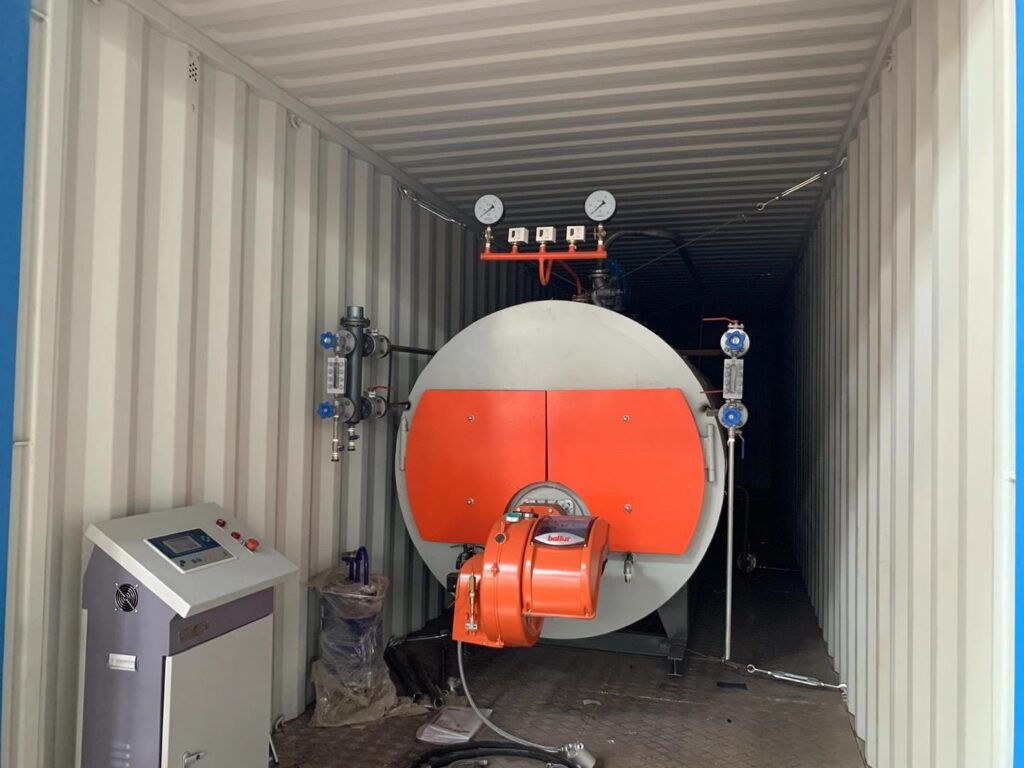
1.Project Profile & Performance Highlights Of Containerized Steam Boiler Indonesia
In August 2024, a seafood processing and food packaging factory in Surabaya, Indonesia commissioned a 2 t/h containerized WNS gas steam boiler to supply process steam for cooking, sterilization and packaging operations.
The project was designed around three practical requirements: limited site construction, rapid commissioning and reliable operation in a humid coastal environment.
Instead of constructing a conventional boiler room, the main boiler and auxiliary equipment were integrated into a modified shipping container and pre-assembled before shipment.
- Location & Year: Surabaya, Indonesia | Project Commissioned in August 2024
- Client Industry: Coastal Seafood Processing & Food Packaging Factory
- System Equipment: 1 Unit of WNS2-1.0-Q Containerized Gas Steam Boiler (2 t/h capacity)
- Core Feature: Heavy-duty weather-proof container shell with specialized anti-corrosion marine coating.
- Measured ROI: 100% On-Site Installation Savings via plug-and-play engineering, yielding 20 days faster production launching and zero civil engineering boiler room costs.
- Track Record: 22+ Months of stable running under high-humidity, high-salinity island tropical conditions.
2. Customer Background & Indonesian Food Industry Challenges
The client operates a rapidly expanding seafood processing and sterilization factory near the port of Surabaya, Indonesia. Food and beverage processing demands massive amounts of high-purity thermal energy. Saturated steam directly powers jacketted cooking kettles, thermal sterilization retorts, and automatic packaging lines.
Operating a standard steam boiler plant in the coastal regions of the Indonesian archipelago introduces three major headaches for factory owners:
- Severe Sea-Salt & Humidity Corrosion: The tropical island climate features extremely high humidity and high-salinity air. Standard industrial boilers and auxiliary electronic control panels rust rapidly, causing electrical short-circuits.
- Complex & Costly Civil Construction: Building a traditional brick-and-mortar boiler room requires long local government permit approvals and heavy investment. This process delays the factory’s production launch timeline significantly.
- Inter-Island Logistics & Relocation Needs: Indonesian food enterprises often need to adjust production sites across different islands based on seasonal fishing harvests. Traditional static boilers cannot migrate easily, turning previous installation investments into sunk costs.
The factory urgent required a ruggedized, mobile, and rapid-deployment steam solution to capitalize on the peak seafood harvesting season.
3.Why Was a Containerized Steam Boiler Selected for This Indonesian Food Factory?
Food processing facilities require reliable steam for sterilization, cooking, and packaging. When planning the utility system for this facility in East Java, the plant engineering team evaluated both a conventional brick-and-mortar boiler room and a modular containerized steam boiler system.
Four operational and regional factors determined the final selection:
1. Limited Boiler Room Construction
Constructing a permanent on-site boiler house requires substantial civil engineering work and sequential field installation:
By integrating the boiler vessel, feed water treatment, burner, and control systems inside a standardized steel container at the factory, the plant bypassed local civil building delays and limited physical construction strictly to a reinforced ground pad.
2. Protection Against a Coastal Marine Environment
The facility is located in the Surabaya industrial corridor, an active coastal area characterized by high ambient humidity and salt-laden air. Operating thermal equipment in this environment introduces continuous corrosion risks to exposed piping, burner mechanics, and electronics.
The containerized housing acts as an engineered environmental barrier:
- Corrosion-Resistant Enclosure: Heavy-duty external coatings protect the main shell against atmospheric salt and moisture degradation.
- Electrical Panel Protection: Sensitive PLC controllers, instrumentation, and motor starters remain sealed inside weather-protected enclosures, shielding delicate contacts from airborne salinity.
- Controlled Ventilation: Engineered intake louvers and forced exhaust systems maintain continuous air circulation for burner combustion without exposing core auxiliaries directly to tropical weather elements.
3. Faster Project Deployment
A primary operational goal was minimizing total installation time on the project site:
- The containerized design reduced the amount of civil construction and on-site piping work required before commissioning.
- All internal mechanical interconnections, cable trays, and valve trains were fully hydro-tested and pre-wired prior to dispatch.
- Reported schedule reduction: Approximately 20 days compared to standard regional on-site construction and piping schedules.
4. Practical Flexibility for Potential Equipment Relocation
Industrial layouts across the Indonesian archipelago frequently evolve around shifting agricultural yields, maritime logistics, or localized processing demands:
- For seasonal or temporary processing facilities—such as regional seafood processing or seasonal agricultural operations—the containerized format can make future relocation significantly easier than a permanently constructed boiler room.
- If production capacities expand or operational needs shift to another regional processing hub, the entire boiler system can be disconnected, crane-lifted, and transported as a standard intermodal freight unit without demolishing permanent concrete structures.
4. Factory Integration and Site Commissioning
To bypass local fabrication risks, the entire thermal system followed a strict off-site manufacturing and testing sequence:
Off-Site Assembly and Pre-Commissioning
At the Taiguo manufacturing facility, engineers positioned the boiler vessel and all auxiliaries onto structural skid beams. Technicians fully welded interconnecting steam, water, and fuel piping. Electricians pulled all motor cables and instrument lines into the main PLC panel.
Before container closure, the entire unit underwent hydraulic pressure testing, electrical sequence simulation, and burner dry-run verification.
Sea Transport and Site Arrival
The complete system was secured inside the shipping container and dispatched via direct sea freight to the port of Tanjung Perak, Surabaya. Because the unit conformed to standard ISO shipping dimensions, road transport from the port to the industrial park required only a single flatbed truck.
Utility Connection and Start-Up
Once lifted onto a flat concrete pad, site preparation required no secondary building construction. The installation scope focused strictly on connecting external utility lines:
- Natural gas fuel supply piping
- Raw softened water feed line
- Main electrical power cabling
- Steam delivery header to the processing plant
- Atmospheric safety valve discharge and flue stack
For this specific project, the customer’s local team completed the external utility connections in approximately four hours, allowing steam generation to begin on the same day.
5. Technical Parameters of the Of Containerized Steam Boiler Indonesia Solution
| Parameter | Project Configuration |
|---|---|
| Application | Seafood processing & food packaging |
| Location | Surabaya, Indonesia |
| Boiler Type | WNS fire-tube steam boiler |
| Capacity | 2 t/h |
| Working Pressure | 1.0 MPa |
| Steam Type | Saturated steam |
| Fuel | Natural gas |
| Installation | Containerized (Outdoor / site-specific) |
| Container | 20-ft / 40-ft, project dependent |
| Water Treatment | Automatic softening system |
| Control | PLC control system |
| Main Applications | Cooking, sterilization, packaging |
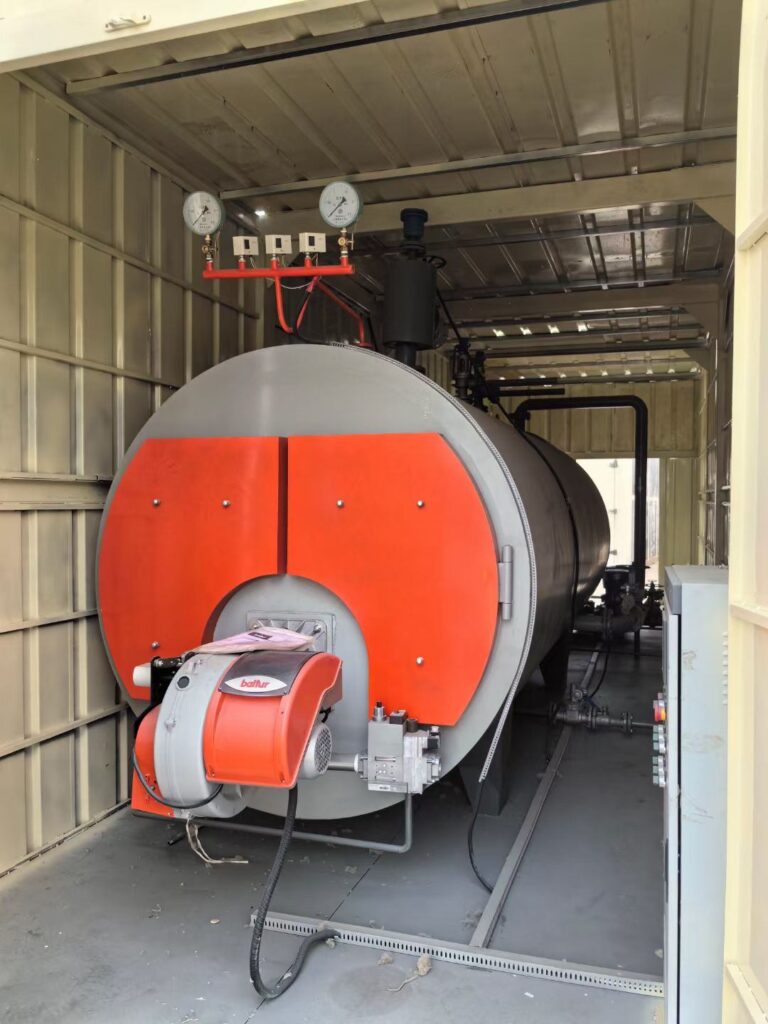
6. Thermal Application in Food Processing
The 2-ton containerized unit supplies stable thermal energy directly to the factory’s batch retort sterilization autoclaves and jacketed cooking kettles.
- Retort Sterilization Support: Batch retort systems demand sudden, high steam volumes during the initial heating stage. The corrugated furnace and large water volume of the WNS boiler buffer thermal shocks effectively.
- Tight Temperature Regulation: The modulating burner responds rapidly to intermittent autoclave cycles, holding saturated steam pressure within ± 0.05MPa. This prevents thermal deviations that could compromise food packaging integrity.
- Corrosion-Free Saturated Steam: The automated dual-tank water softener continuously removes calcium and magnesium ions. This prevents boiler tube scale formation and ensures clean steam purity for process heat exchangers.
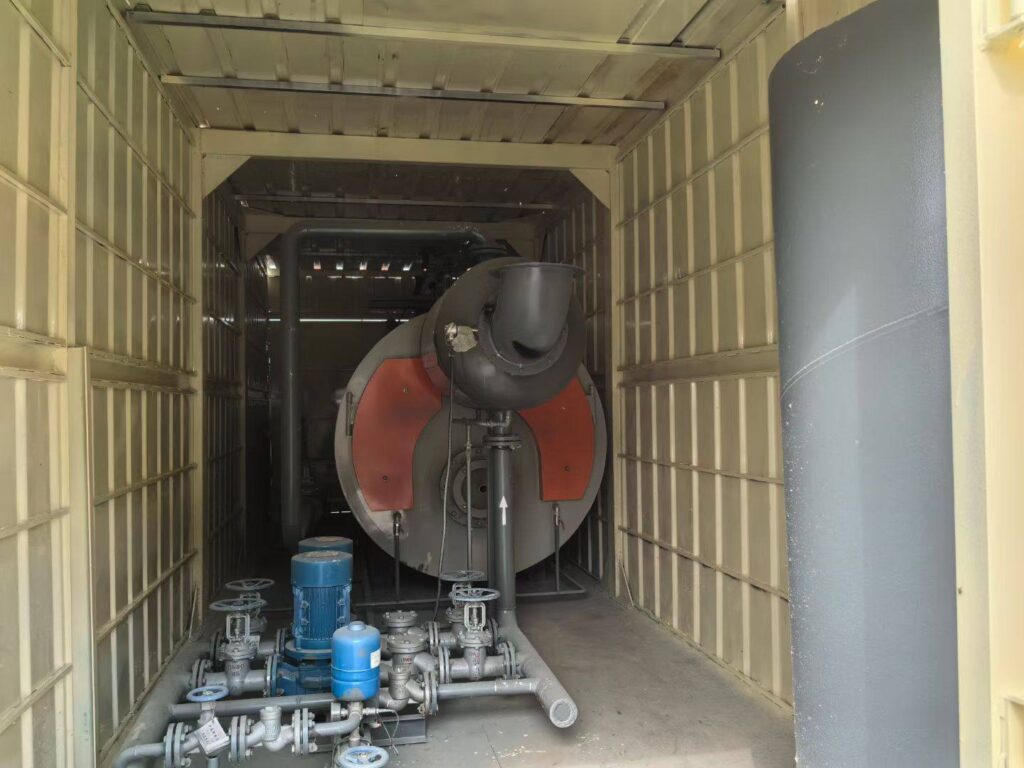
7. Project Results and Operational Performance
Following commercial operation, the containerized boiler delivery demonstrated clear quantifiable benefits for the Indonesian plant:
- Civil Construction Savings: The customer eliminated the cost and planning cycles of a dedicated concrete boiler house, needing only a reinforced level foundation.
- Reported Schedule Reduction: Factory pre-commissioning shortened overall project readiness by approximately 20 days compared to regional field-built installations.
- Operational Simplicity: The automated PLC system regulates continuous water feeding, burner firing, and intermittent blowdown with minimal direct operator intervention.
- Environmental Protection: The sealed, coated enclosure successfully prevents marine salt exposure from degrading electrical switches, burner linkages, and insulation jacketing.
8.Operational Suitability for Indonesian Processing Facilities
This 2-ton project illustrates why containerized steam packages suit decentralized food and agricultural operations throughout Indonesia.
Whether processing seafood in coastal hubs or operating palm and fruit processing lines across different provinces, plants often face limited civil infrastructure and remote logistics. Integrating the boiler, feed system, water treatment, and controls into a pre-tested container solves multiple logistical hurdles simultaneously. It delivers dependable, industrial-grade steam without the project delays associated with traditional on-site construction.
9. Summary of Engineering Scope
Taiguo Factory provided comprehensive factory-side design and integration for this mobile Indonesian project, delivering a true turnkey asset:
- Compact Space Mechanical & Piping Engineering: Designed the internal layout of the 20-foot container to allow safe maintenance access while packing all core boiler auxiliaries securely.
- WNS2 Fire-Tube Boiler Core Manufacturing: Fabricated the high-efficiency boiler shell under rigorous quality inspection controls. You can review our destructive/non-destructive testing equipment on our dedicated Boiler Manufacturing & Quality Inspection Capabilities
- Marine-Grade Container Modification & Coating: Reinforced a standard sea container and applied heavy anti-salinity primers to resist coastal rust.
- Complete Electrical Integration & Wiring: Pre-wired the entire boiler system to a single centralized smart control panel, enabling true one-button startup.
- Pre-Shipment Factory Hydro-Testing: Completed a full 100% operation trial run and pressure leak testing at our facility before loading the container onto the vessel.
- Digital Operator Technical Training: Provided interactive video manuals and detailed English technical schematics to ensure the local team masters routine blowdown and softener checks easily.
10. Related Solutions & Products
- WNS Series Gas/Oil Steam Boiler (1t/h – 20t/h)
- Industrial Boiler Manufacturing Capabilities
- Customized Steam Solutions for Food Processing Industry
Related Project Case Studies:
- Uzbekistan Textile Factory – 12 t/h Gas Steam Boiler Solution Performance Review
- Indonesia Palm Oil Plant – YQW High-Efficiency Vertical Thermal Oil Heater Operational Report
- Philippines Food Factory – SZS15 Large Capacity Gas Steam Boiler Project
11. Project Frequently Asked Questions (FAQ)
Is the temperature inside the container safe for the burner electronic components?
Yes. Our containerized boiler plants incorporate automated industrial ventilation fans. The heavy-duty container walls also feature advanced rock wool thermal insulation layers. This design maintains the internal ambient temperature well below 45℃, protecting all PLC electronics perfectly.
How does the containerized system handle rainwater and harsh outdoor weather?
The modified container features a fully waterproof roof design with integrated drainage channels. All external pipeline openings include weather-proof industrial cowls. The entire unit can sit completely outdoors without requiring any additional roof structures.
Can the container boiler handle fluctuating water quality at temporary remote sites?
We pre-install a dual-stage water treatment softener system along with a chemical dosing pump device inside the container. This layout ensures raw water hardness drops down to safe levels before entering the boiler, even in remote island areas with variable water qualities.
Why is a containerized WNS boiler ideal for seasonal food factories compared to built-in systems?
Seasonal food processing relies heavily on harvest timelines. A containerized unit allows you to start production instantly without wasting weeks building infrastructure. When the harvest season closes, you can shut down, lock up, or easily move the entire unit to another processing hub, avoiding asset idleness.
12. Schedule a Professional Containerized Boiler Consultation
Are you planning to deploy a fast, reliable, and highly mobile steam system for your food factory, chemical processing line, or remote manufacturing site? Contact CN MIRACLE &Taiguo Factory today. Our containerized engineering specialists will design a turnkey mobile steam power station customized to your fuel types and production environment.
📋 Food & Beverage Processing Reference Hub