
Reliable Heat Supply for Cities, Communities, and District Energy Networks
Modern urban district heating systems require stable, continuous, and efficient thermal energy supply. This is especially true in regions with cold winters. Therefore, industrial hot water boiler systems play a critical role in district heating networks. They provide centralized heat distribution for residential buildings, commercial complexes, schools, and hospitals.
Centralized district heating systems offers clear environmental benefits over individual building boilers. It allows municipalities to monitor emissions at a single, controlled location. It also reduces fuel transport logistics inside dense urban zones. Today, global cities actively upgrade aging heating infrastructure to achieve carbon neutrality. Our heavy-duty thermal systems help municipal heating authorities bridge the gap between high performance and environmental compliance.
Modern City Heating Performance Standards
Modern municipal heating networks demand high efficiency and low fuel consumption. They must guarantee stable 24/7 heat output during peak winter periods. Furthermore, strict environmental regulations require low emissions and global compliance. Operators look for flexible fuel adaptability, including gas, oil, and biomass. Fully automated control systems and remote monitoring are now mandatory.
Consequently, our advanced industrial hot water boiler units serve as the core heat source for modern district heating stations worldwide. They feature robust membrane wall structures and optimized flue gas passes to maximize heat recovery.
What We Solve in Urban District Heating Systems Projects
Municipal heating operators face three critical challenges:
- High winter peak load instability
- Excessive fuel consumption in aging boiler systems
- Difficulty in achieving low-carbon compliance
Our district heating systems are designed to solve all three issues through high-efficiency combustion, intelligent control systems, and optimized heat distribution architecture.
Application of Hot Water Boilers in Urban District Heating Systems
Large-capacity hot water boiler systems commonly support the following infrastructures:
Residential Networks
They supply comfortable warmth to thousands of residential apartments simultaneously. The system layout minimizes temperature fluctuations across high-rise residential blocks.
Educational Sites
They maintain optimal temperatures across schools, dormitories, and expansive university campuses. They adjust output quickly based on class schedules.
Public Institutions
They deliver reliable, uninterrupted heat to hospitals and municipal complexes. These sites require 100% operational redundancy to protect public safety.
Commercial Buildings
They power centralized HVAC systems for shopping centers, exhibition halls, and high-rise office towers. They handle highly variable thermal loads efficiently.
Urban Stations
They serve as secondary pressure-isolation stations within massive municipal heating lines. They balance hydraulic pressure across different city sectors.
Municipal Plants
They operate as the primary thermal engine for entire city networks. They process massive volumes of water daily to sustain winter life.
Recommended Boiler Technologies for District Heating Systems
Municipalities require different boiler designs based on local fuel availability, environmental policies, and capacity demands.
Gas-Fired Hot Water Boilers
WNS & SZS SeriesThese units offer high efficiency and clean combustion for urban heating. Our SZS gas boiler lowers NOₓ emissions to <30 mg/m³, while the horizontal WNS series features a compact wet-back design for community stations. Both utilize advanced modulating burners to match real-time heating demands.
Biomass Hot Water Boilers
SZL SeriesBiomass systems significantly lower long-term fuel costs in semi-urban districts. Our SZL biomass boiler runs on wood chips and agricultural waste. The advanced chain grate design with multi-isolated air chambers ensures uniform combustion, backed by high-efficiency baghouse dust collectors.
Oil-Fired Hot Water Boilers
Heavy Oil & DieselThese units deliver exceptionally stable thermal output in regions without natural gas infrastructure. They serve as reliable peak-load or backup units in critical municipal grids. They seamlessly handle heavy oil, diesel, or recycled oils via simple burner nozzle adjustments.
Electric Hot Water Boilers
Zero-EmissionElectric designs achieve zero emissions at the point of use, making them perfect for eco-sensitive zones. They efficiently leverage cheap off-peak electricity at night to heat massive thermal storage tanks, releasing stable hot water during daytime peak heating hours.
Key Engineering Requirements for District Heating Systems
Urban heating deployment demands strict engineering precision to ensure long-term network reliability.
Accurate Heat Load & Thermal Calculation
First, engineers must perform an accurate heat load calculation for the entire district. We analyze local minimum winter temperatures, building insulation values, and pipeline distances. Under-sizing causes community heating failures during blizzards. Over-sizing leads to continuous low-load operations, which ruins boiler efficiency. Our engineering team utilizes advanced thermodynamic simulation software to calculate exact megawatt (MW) requirements.
Redundant Boiler Configuration (N+1 System Design)
We utilize a redundant configuration, specifically an N+1 system design, to prevent emergency shutdowns. If a city requires 30 MW of heat, we deploy three 15 MW boilers rather than a single 30 MW unit. If one boiler requires emergency maintenance, the remaining units sustain critical heating loads for the population.
Hydraulic Balancing and Pressure Control
The system must maintain stable pressure and temperature control across all loops. Huge city grids suffer from uneven heat distribution. Buildings closest to the plant overheat, while distant buildings freeze. We solve this by integrating variable-frequency circulation pumps and smart hydraulic balancing valves. The automated control system monitors return-water temperatures to adjust flow rates instantly.
Pipeline Thermal Loss Optimization
Engineers optimize pipeline layouts to reduce thermal transmission loss. Underground municipal pipelines experience severe thermal stress due to massive temperature differentials. We design customized expansion loops and select high-density polyurethane pre-insulated pipes. This preserves water temperature over distances exceeding 10 kilometers.
Municipal Urban District Heating Systems Architecture
A complete urban heating infrastructure requires deep integration between the central plant and the city distribution network.
1. The Central Heat Source (The Boiler House)
The central boiler house contains the main boilers, water treatment systems, deaerators, and primary circulation pumps. Raw water contains calcium and magnesium ions. These minerals form heavy scale inside boiler tubes, destroying heat transfer rates. Therefore, we deploy automated reverse osmosis water softening plants. Every system also includes a thermal deaerator to remove dissolved oxygen, preventing internal pipeline corrosion.
2. Primary Pipeline Grid
The primary loop carries high-temperature water (typically 115℃ to 130℃) under high pressure from the boiler plant to urban heat exchange stations. This loop remains completely closed to prevent water loss.
3. Regional Heat Exchange Stations
Heat exchange stations isolate the high-pressure primary grid from residential building piping systems. They utilize high-efficiency stainless steel plate heat exchangers. This configuration protects domestic radiators from industrial plant pressures. It also prevents localized residential leaks from draining the main boiler plant.
4. The Secondary Distribution Network
The secondary loop delivers lower-temperature water (60℃to 75℃) directly to home radiators, underfloor heating systems, and commercial air handlers.
Automation, Safety, and PLC Control Systems Of District Heating Systems
Modern urban heating demands full operational visibility. Our district hot water boilers utilize advanced Siemens PLC control systems with color touchscreens.
Automated Oxygen and Combustion Control
The PLC system monitors the oxygen levels in the exhaust flue gas via zirconia sensors. If oxygen levels rise too high, the system reduces the forced draft fan speed automatically. This precise air-fuel ratio control maintains boiler thermal efficiency above 93%, saving thousands of dollars in monthly fuel consumption.
Safety Interlock Protocols
Our safety software contains multi-layered interlock chains. The system triggers an immediate emergency shutdown if it detects any of the following conditions:
- Low Water Flow Rate: Prevents localized overheating and tube cracking.
- Overpressure Status: Protects the structural integrity of the boiler shell.
- Flame Failure: Cuts off fuel gas valves within 1 second to prevent furnace explosions.
- High Return Water Temperature: Signals a blockage or hydraulic failure in the city network.
Remote SCADA Integration
The boiler controls support standard industrial communication protocols, including Modbus and Profibus. This allows municipal operators to integrate the boiler house into a centralized city SCADA network. Engineers monitor real-time fuel consumption, thermal output, and emissions from a central municipal dashboard miles away.
Core Engineering Design Requirements For District Heating Systems
District heating systems require precise engineering design to ensure stability and efficiency:
- Accurate district heat load calculation
- N+1 redundant system configuration
- Hydraulic pressure balancing across networks
- Pipeline thermal loss minimization
- Automated temperature and flow control systems
These parameters ensure stable heating performance even under extreme winter conditions.
Full-Lifecycle Engineering Support for Urban District Heating Systems Projects
We provide full lifecycle engineering services for municipal district heating networks. Our team manages boiler system selection, capacity calculation, and complete boiler room layout design. We provide comprehensive piping system engineering, structural steel analysis, installation support, and commissioning guidance.
Our global service team travels to your site to supervise installation, perform hydro-testing, and train local municipal operators. We ensure your plant passes local environmental and safety inspections smoothly. To explore our technical capabilities further, visit our industrial boiler engineering solutions master hub. You can also review our specific guidelines regarding system efficiency optimization to maximize your plant’s performance.
Thermal Engineering & System Optimization Capability
Our engineering team provides full technical support for district heating system design, including:
- Boiler selection and capacity configuration
- Heat load calculation and simulation
- Boiler room layout design
- Pipeline system optimization
- Commissioning and operational guidance
Verified District Heating Systems Case Study
Kazakhstan Municipal Infrastructure Project
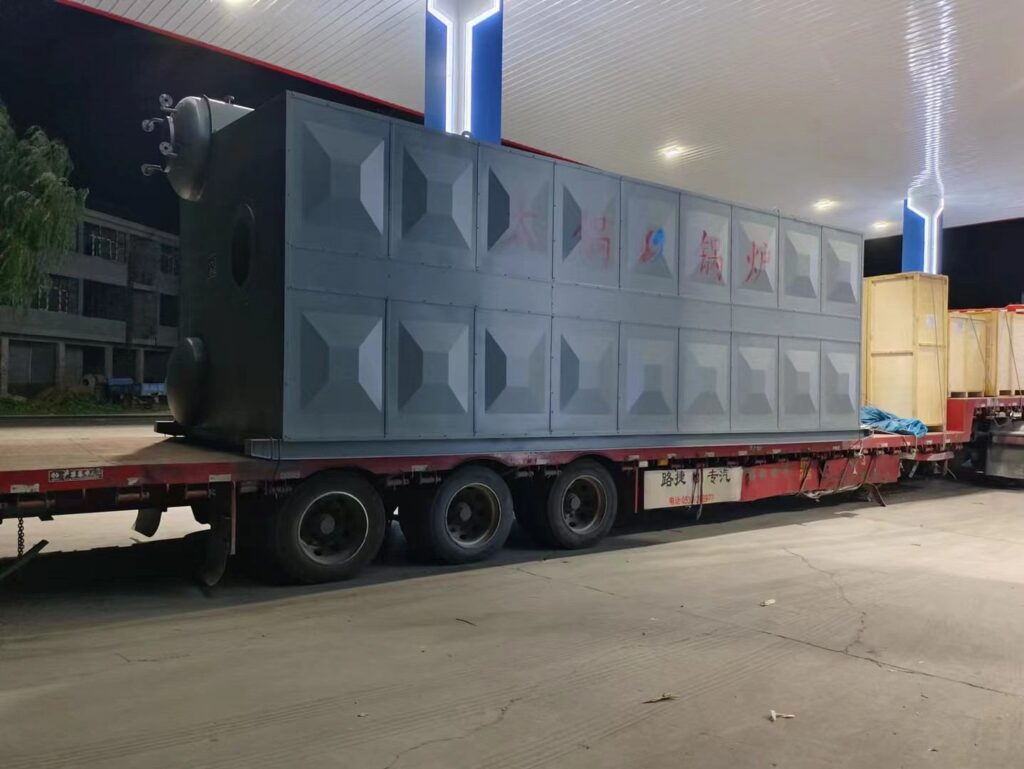
Large-scale municipal networks require highly reliable heat sources to balance hydraulic pressures. We actively prove our engineering capabilities in extreme environments. For example, our team successfully deployed a 15 t/h D-type water tube boiler solution (SZS15) for a critical municipal grid. This heavy-duty system now ensures stable winter comfort for thousands of urban households.
System Architecture Overview
A complete district heating systems typically consists of:
- Central boiler house (heat generation center)
- Primary high-temperature pipeline network
- Heat exchange stations (pressure isolation points)
- Secondary distribution loop (end-user supply)
This layered architecture ensures safe, stable, and efficient heat delivery across large urban areas.
Customized District Heating Systems Solutions
Every city has unique climate conditions, population density, and energy structure. Therefore, we design fully customized hot water boiler systems based on:
- Heating area size
- Peak winter load requirements
- Fuel availability
- Environmental compliance standards
We provide complete engineering packages including technical design, system layout drawings, and ROI-based fuel consumption analysis.
Contact our engineering team to receive a customized district heating solution within 24 hours.