Introduction Of Boiler Technology Insights
Industrial boiler systems are the backbone of global manufacturing energy infrastructure. They are responsible for converting fuel into thermal energy and steam that supports production processes in industries such as textiles, food processing, chemicals, paper production, and building materials.
Unlike general mechanical equipment, industrial boilers operate under high temperature, high pressure, and continuous load conditions. This makes their performance highly dependent on engineering-level design decisions, combustion optimization, heat transfer efficiency, and system-level integration.
From Engineering Principles to Boiler System Types
Engineering principles determine how industrial boiler systems are categorized into different types, based on fuel source, pressure level, and heat transfer design.
These categories form the foundation of industrial boiler selection and include gas-fired, water-tube, biomass, and vertical boiler systems.
👉 The main industrial boiler categories include:
- Gas & Oil Fired Steam Boilers (WNS Series)
Designed for stable operation, high efficiency, and clean combustion, widely used in food, textile, and light industrial applications. - Water Tube Steam Boilers (SZS Series)
Engineered for high-pressure and large-capacity industrial systems, commonly applied in chemical plants, power-intensive industries, and continuous production environments. - Biomass Fired Boilers (SZL / DZH Series)
Suitable for industries with biomass fuel availability, offering cost-effective and sustainable steam generation solutions. - Vertical / Compact Industrial Boilers (LSS Series)
Designed for small-scale industrial applications requiring fast startup and flexible installation. - Integrated Industrial Boiler Systems (System-Level Solutions)
Customized engineering solutions combining combustion systems, control systems, and heat recovery optimization.
The purpose of this Boiler Technology Insights Hub is to provide structured, engineering-based technical knowledge that helps industrial buyers, EPC contractors, and plant engineers make better decisions in:
- Boiler system selection
- Fuel efficiency optimization
- Combustion performance improvement
- Steam system stability control
- Emission reduction compliance
Engineering Knowledge → System Application Link
Each technical principle discussed in this hub directly corresponds to real industrial boiler system designs, including WNS gas steam boiler systems, SZS high-pressure steam systems, and SZL biomass boiler systems.
This ensures that engineering theory is always connected to practical industrial applications, allowing users to move from technical understanding → system selection → real project implementation.
These engineering principles are not theoretical concepts, but are directly implemented in real industrial boiler systems, combustion systems, and complete steam generation solutions used in EPC projects and industrial plants worldwide.
The purpose of this Boiler Technology Insights Hub is to provide structured, engineering-based technical knowledge that helps industrial buyers, EPC contractors, and plant engineers make better decisions in:
- Boiler system selection
- Fuel efficiency optimization
- Combustion performance improvement
- Steam system stability control
- Emission reduction compliance
This Boiler Technology Insights hub is not only a collection of articles, but a centralized engineering knowledge system that connects boiler technology principles with real industrial applications.
Boiler Technology Insights Overview
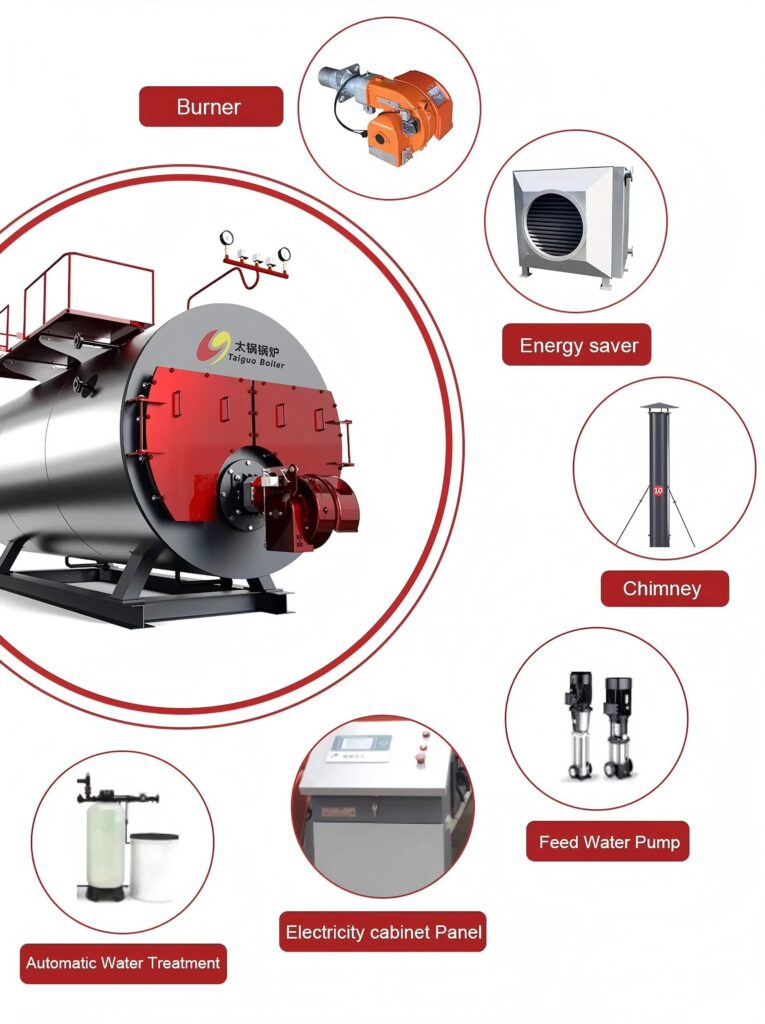
Industrial boiler technology is based on the controlled conversion of chemical energy (fuel combustion) into thermal energy, which is then transferred into water to produce steam.
A complete industrial boiler system is composed of multiple interconnected engineering subsystems:
- Combustion System – fuel burning and energy release
- Heat Transfer System – furnace, tubes, economizer
- Water & Steam System – circulation and phase change
- Control System – automation, safety, and monitoring
- Emission Control System – flue gas treatment and NOx reduction
Each subsystem directly affects overall boiler performance. For example, even if combustion efficiency is high, poor heat transfer design can still lead to significant energy loss.
Modern industrial boiler development focuses on five key engineering directions:
- Higher thermal efficiency (>90%)
- Lower fuel consumption per ton of steam
- Stable steam pressure output under variable load
- Reduced NOx and CO emissions
- Higher automation and remote monitoring capability
Combustion System Technology Engineering
Combustion serves as the core energy conversion process to determine how efficiently fuel transforms into thermal energy.
- • Gas and oil burner modulation
- • Biomass staged combustion technology
- • Automatic air-fuel ratio optimization
- • Flame detection and stability control
- • Low-NOx combustion chamber design
- • Excess fuel consumption hazards
- • Carbon deposition inside furnace
- • Unstable industrial steam output
- • Higher hazardous NOx emissions
Advanced industrial boilers implement intelligent control units to continuously adjust oxygen levels and optimize combustion efficiency.
Steam Generation & Heat Transfer Principles
Steam generation utilizes controlled pressure to transform preheated water into high-energy industrial steam across multiple process stages.
- • Feedwater preheating systems
- • Evaporation in furnace tubes
- • Efficient steam-water separation
- • Advanced superheating distribution
- • Increasing heat exchange areas
- • Installing advanced economizers
- • Improving turbulence inside tubes
- • Reducing fouling and scaling
- • Enhancing high-density insulation
Even a 2% improvement in heat transfer efficiency significantly reduces annual fuel consumption in large manufacturing operations.
Boiler Control & Automation Systems
Modern industrial boiler units rely heavily on continuous automation architectures to guarantee safe, stable, and predictable plant operations.
- • PLC-based control units
- • Pressure and temperature sensors
- • Water level monitoring loops
- • Safety interlock mechanisms
- • Real-time combustion monitoring
- • Load-based fuel adjustment
- • Oxygen trimming optimization
- • Fault detection and alarms
- • Remote monitoring and data logging
- • Predictive maintenance capabilities
Smart automation allows thermal systems to automatically adjust operations based on steam demand, fuel conditions, and environmental factors.
Energy Efficiency & Emission Reduction
Energy efficiency optimization remains a critical engineering goal due to the massive impact of boiler fuel expenses on operational costs.
- • Waste heat recovery systems
- • Flue gas recirculation loops
- • Low-NOx burner technologies
- • High-efficiency insulation materials
- • Intelligent combustion optimization
- • Nitrogen oxides (NOx) reduction
- • Carbon monoxide (CO) mitigation
- • Particulate matter control
- • Flue gas energy loss reduction
Reducing energy loss in flue gas alone successfully improves overall boiler efficiency by 5% to 8% to satisfy strict regulations.
Industrial Applications of Boiler Technology Insights
Boiler technology is widely applied across multiple industrial sectors, each with different process requirements.
Textile & Dyeing Industry Applications
Steam consistency directly affects fabric quality and production efficiency because the textile sector relies on continuous thermal stabilization.
- • Fabric dyeing processes
- • Drying and finishing runs
- • Heat setting operations
- • Stable medium-pressure steam
- • Constant thermal outputs
- • Energy efficiency optimization
Food Processing Industry Compliance
Steam purity and pressure stability remain critical for food safety compliance across all high-temperature cooking and manufacturing lines.
- • Food sterilization lines
- • Industrial cooking systems
- • Baking and packaging runs
- • Clean and pure steam output
- • Precise pressure stability
- • Strict sanitary configurations
Chemical Industry Material Processing
Boiler stability directly affects product quality and final chemical yield during complex material transformations and thermal processing.
- • Chemical reaction heating
- • Distillation columns
- • Material processing loops
- • Precise temperature controls
- • Accurate pressure modulations
- • Explosion-proof safety integrations
Paper & Packaging Industry
High load stability and energy efficiency serve as key requirements because manufacturing facilities run massive continuous runs.
- • Continuous paper drying
- • Industrial pulp processing
- • Corrugated board forming
- • Large-scale continuous steam
- • High peak-load capacities
- • Flue gas energy recovery
AAC Block Production Industry
Steam consistency directly affects final structural strength and curing quality during high-pressure building material manufacturing.
- • Autoclave curing blocks
- • Aerated concrete conditioning
- • High-pressure raw baking
- • High-pressure saturated steam
- • Rapid pressure charging
- • Multi-autoclave synchronization
Laundry & Hotel Industry Operations
Commercial laundry systems and hotel facilities require exceptional boiler reliability and automation control to completely eliminate operational downtime.
- • Industrial washing machines
- • Linen cleaning and pressing
- • Garment finishing systems
- • Continuous steam at peak hours
- • Fast responses to load changes
- • Compact urban system designs
Engineering Support & System Optimization
Beyond theoretical knowledge, real industrial boiler systems require continuous engineering optimization.
We provide technical support in:
- Boiler system selection and sizing
- Combustion efficiency optimization
- Heat recovery system design
- Boiler room layout planning
- Full EPC project technical consultation
Our engineering approach focuses on improving long-term system performance rather than only initial installation parameters.
Internal Knowledge Network Of Boiler Technology Insights
To fully understand industrial boiler systems, this Boiler Technology Insights hub connects to other key engineering pages:
- Boiler System Optimization & Energy Saving Solutions
- Boiler Room Layout Design Guide
- Boiler Piping System Engineering Design
- Boiler Installation & Commissioning Guide
- Boiler Spare Parts & Lifecycle Maintenance
These pages form a complete technical ecosystem covering the full lifecycle of industrial boiler systems.
📋 Related Boiler Technology & Parameter Insights
As part of our central Industrial Boiler Insights platform, technology analysis defines long-term ROI parameters.
Boiler Technology Insights FAQ
What is boiler combustion technology?
Fuel-to-heat energy conversion process.
It controls flame stability, emissions, and thermal efficiency through air-fuel ratio optimization.
What improves boiler efficiency?
Heat recovery and combustion optimization.
Efficiency improvements come from reducing flue gas loss and optimizing combustion conditions under varying loads.
What is low-NOx technology?
A system that reduces emissions.
It controls flame temperature and oxygen distribution to reduce nitrogen oxide formation during combustion.
Are modern boilers automated?
Yes, most use PLC control systems.
Automation ensures real-time adjustment of combustion, pressure, and safety parameters under dynamic load conditions.
Need Advanced Boiler Engineering Support?
If you are planning a boiler project or optimizing an existing system, our engineering team can provide detailed technical analysis and system optimization solutions.