
What Size Steam Boiler Do You Need? Complete Calculation Guide
Contents Hide 1 Introduction 2 Steam Demand in Industrial Applications 3 Key Factors to Determine Boiler Size 3.1 1. Steam Flow Rate 3.2 2. Operating Pressure 3.3 3. Load Factor 3.4 4. Safety Margin 4 What Size Steam Boiler Do You Need?How to Calculate Boiler Capacity 5 Example:What Size Steam Boiler Do You Need? Choosing […]
Get Instant QuoteTechnical Specifications
Introduction
Choosing the correct size for your steam boiler is one of the most critical steps in designing a steam system for your factory. An oversized or undersized boiler can result in increased operating costs, poor steam quality, and frequent maintenance.
What Size Steam Boiler Do You Need ?In this article, we’ll walk you through the key factors you need to consider when selecting the right steam boiler size for your industrial application, and how to perform the necessary calculations to determine your boiler requirements.
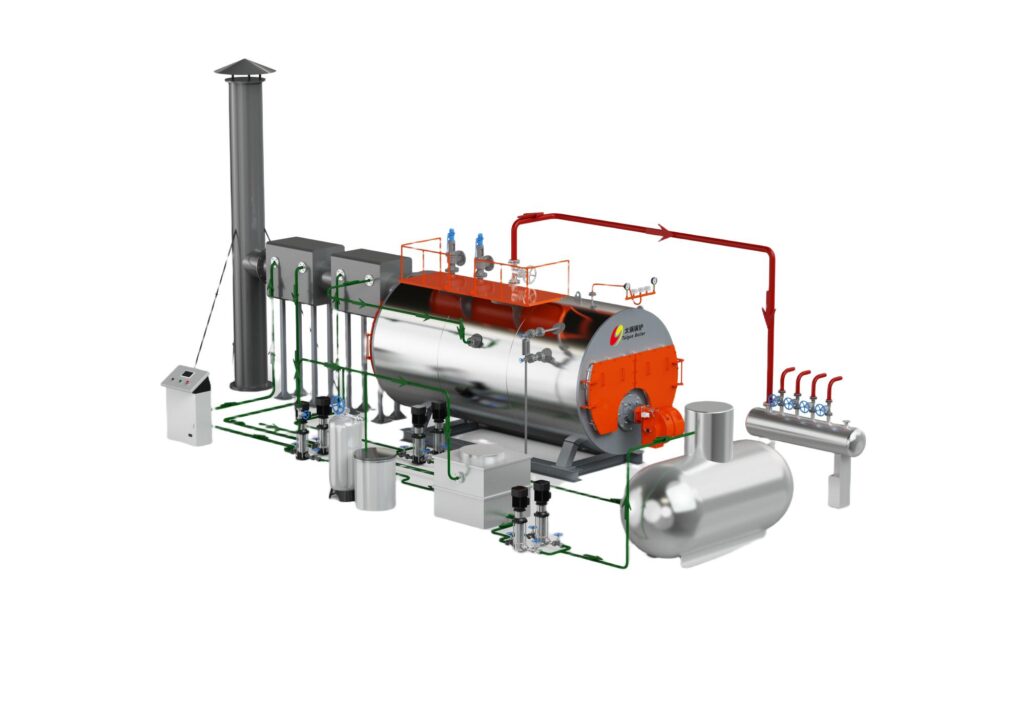
Steam Demand in Industrial Applications
What Size Steam Boiler Do You Need?Before selecting the right size boiler, it’s essential to understand the steam demand of your facility. Steam is used for:
- Heating (for production lines, sterilization, etc.)
- Cleaning and washing (for equipment, containers, etc.)
- Drying (in textile, food, and other industries)
The more demanding your production processes, the larger your steam boiler should be. However, estimating the exact steam consumption can be complex, as it depends on various factors like production capacity, type of fuel, and the operating efficiency of your factory’s steam system.
Key Factors to Determine Boiler Size
1. Steam Flow Rate
The flow rate of steam is one of the key factors in determining the right boiler size. It is usually measured in tons per hour (TPH) or kilograms per hour (kg/h).
Formula to calculate steam flow rate:
Steam Flow Rate = (Heat energy required) / (Enthalpy of steam – Enthalpy of water)
2. Operating Pressure
The pressure at which steam is required will also impact the size of the boiler. Higher pressure steam requires a larger, more powerful boiler.
3. Load Factor
A boiler should be sized to meet peak demand but not necessarily be operating at full load all the time. The load factor takes into account the fluctuation in steam demand during different production times.
4. Safety Margin
It’s always good practice to add a safety margin of 10–20% to ensure that the boiler can handle unexpected increases in demand.
What Size Steam Boiler Do You Need?How to Calculate Boiler Capacity
- Determine Steam Load: Multiply your daily steam demand by your factory’s operating hours.
- Identify Boiler Efficiency: Choose a boiler with high efficiency to minimize waste and maximize performance.
- Add Safety Margin: Ensure the boiler can handle unexpected surges in steam demand.
This calculation will give you a rough estimate of the boiler capacity in tons per hour.
Example:What Size Steam Boiler Do You Need? Choosing the Right Boiler Size for a Textile Factory
Let’s say you need to calculate the boiler size for a textile dyeing factory in Southeast Asia. The steam requirement is calculated based on heat energy required for dyeing, washing, and drying.
- Steam demand: 3 tons per hour
- Operating pressure: 10 bar
- Efficiency: 85%
- Safety margin: 15%
Using the above method, the boiler size required would be 3.45 tons per hour.
FAQ: Critical Sizing Insights
Q1: Should I buy one large boiler or two smaller ones?
A: If your steam load fluctuates significantly (e.g., high during the day, very low at night), two smaller boilers (lead/lag setup) are often more Efficient This prevents a large boiler from “short-cycling” during low-demand periods, which saves fuel and extends equipment life.
Q2: Does operating pressure affect the size I need?
A: Yes. Steam occupies less volume at higher pressures. If your process requires high-pressure steam (above 10 bar), the physical size of the boiler and piping may be smaller, but the energy (BTU/hr) required remains the same. Always size for your maximum required operating pressure.
Q3: How do I account for future expansion?
A: If you plan to add a new production line within 24 months, add that projected load to your “Safety Margin.” However, do not oversize by more than 30%, as a boiler running at 40% capacity is significantly less Reliableand efficient than one running at 75-85% load.
Would you like me to perform a specific calculation for your current equipment list to determine the exact TPH or BHP required for your facility?
Conclusion
Selecting the right boiler size is critical for both cost efficiency and reliable steam supply. Always consult with an expert to ensure that your boiler system is sized correctly for your specific needs.
👉 Get a Free Steam Boiler Sizing Proposal
If you need assistance in selecting the right steam boiler for your facility, contact us for a free sizing proposal and comprehensive steam system design.
any need for hot water boiler please ?
Formulate your precise plant thermal expansion targets utilizing our industrial boiler selection guide spreadsheet.
Avoid expensive system over-sizing mistakes by consulting our How Choose a Gas Steam Boiler for Small and Medium Factories manual.
Evaluate long-term chemical process loading changes inside the Gas Steam Boiler vs Biomass Boiler: Cost Comparison for Emerging Markets.