Increasing Production Efficiency in the Textile Industry with Our Gas Steam Boiler
CE CertifiedISO 900199% Efficient
Contents Hide 1 Client Background 2 Challenges Faced by the Textile Manufacturer 3 Our Tailored Solution of Gas steam boiler for textile industry 3.1 ✔ Key Features Selected for the Textile Plant-Gas steam boiler for textile industry 4 Results After Implementation the Gas steam boiler for textile industry 5 Customer Feedback of the Gas steam […]
A large textile manufacturer in the Middle East specializes in fabric dyeing, finishing, and processing for international brands. Their production lines require a stable and consistent supply of high-quality steam to ensure accurate dye penetration, color stability, and fabric softness. However, the company’s old boiler system struggled to meet production demands.Gas steam boiler for textile industry is best choice.
Steam instability resulted in uneven dyeing and color variation, leading to increased product defects and higher fabric waste rates.
❌ High Fuel Consumption
Their outdated boiler consumed excessive natural gas due to low thermal efficiency, significantly increasing operating costs.
❌ Low Production Output
Slow steam generation often delayed dyeing and finishing cycles, reducing factory productivity and on-time delivery performance.
❌ Environmental Pressure
The factory needed to comply with increasingly strict emissions standards to maintain export qualification and meet customer sustainability requirements..
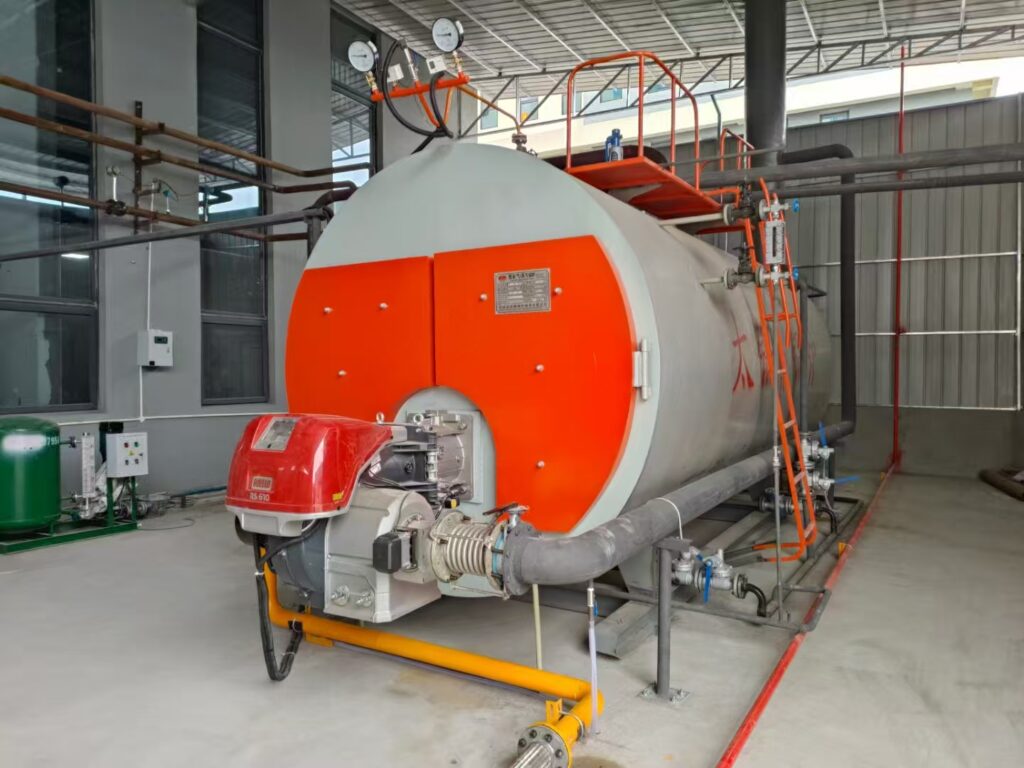
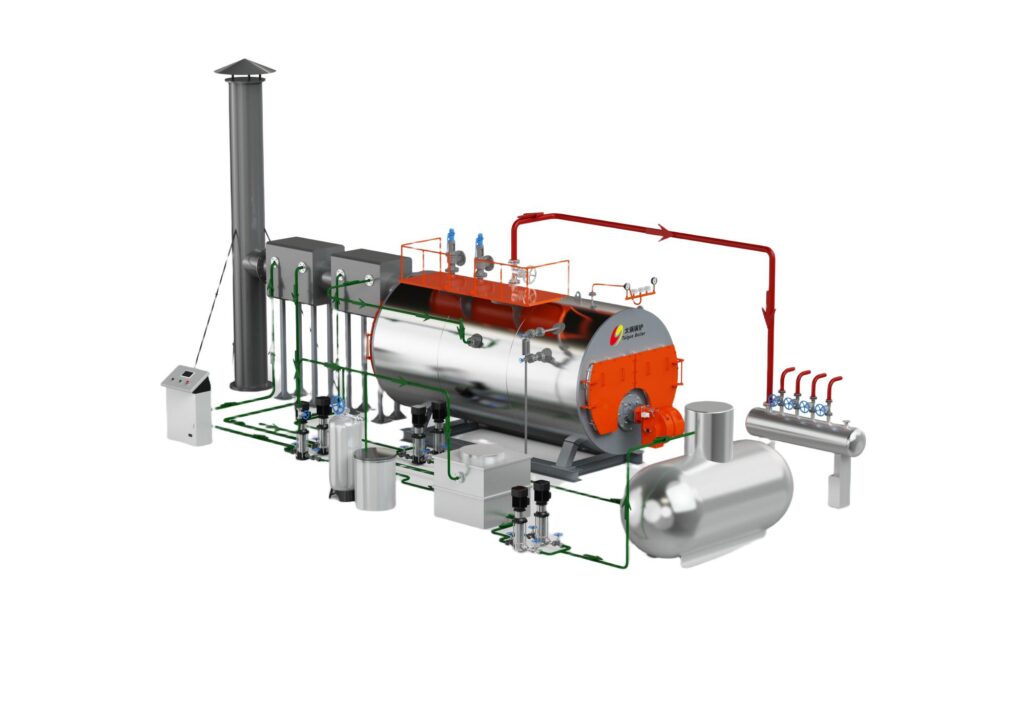
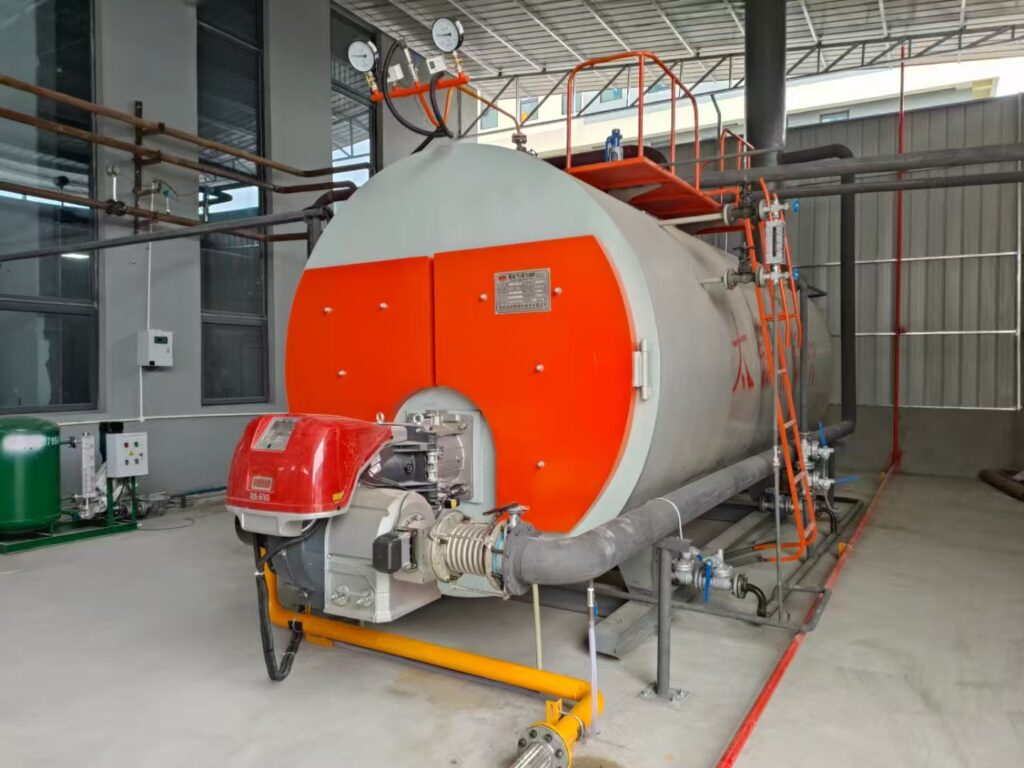
To help the customer overcome these production bottlenecks, we installed our High-Efficiency Gas steam boiler for textile industry, specifically designed for textile applications requiring continuous and stable steam output.
✔ Key Features Selected for the Textile Plant-Gas steam boiler for textile industry
Gas steam boiler for textile industry Rapid steam generation to meet fast-paced dyeing and finishing cycles
Gas steam boiler for textile industry Stable steam pressure to guarantee consistent fabric color and quality
Gas steam boiler for textile industry High thermal efficiency design to minimize natural gas consumption
Gas steam boiler for textile industry Fully automatic control system for safe and easy operation
Gas steam boiler for textile industry Multi-pass heat exchange ensuring maximum heat recovery and energy savings
Precision Pressure Stability: The Key to Color Consistency “In a high-capacity textile mill, the simultaneous startup of multiple dyeing vats creates a massive ‘Steam Surge’ that can drop header pressure by over 0.2MPa in seconds. This pressure instability is the leading cause of uneven dye penetration and ‘color shadows.’ Taiguo’s WNS series is engineered with a Large Steam Space, which acts as a thermal buffer. Combined with our High-Sensitivity Modulating Burners, the system anticipates load changes and maintains a constant pressure profile. This ensures that every batch of fabric, from cotton to synthetics, achieves 100% color uniformity, reducing re-dyeing costs by up to 15%.
Optimizing Fabric Quality: Dry Saturated Steam for Stenter Frames “For the drying and heat-setting (stentering) process, the ‘Quality’ of steam—its dryness fraction—is as important as its temperature. Wet steam carries less energy and can leave water spots on delicate fabrics. Taiguo boilers integrate Multi-Stage Internal Steam Separators that guarantee a steam dryness of >99%. This dry saturated steam transfers its latent heat more efficiently to the fabric surface, allowing for faster line speeds in the stenter frame. For mills in Indonesia and Vietnam, this translates into a 10-12% increase in daily finishing output without increasing energy consumption.
ESG Compliance: The Secondary Condensing Recovery Loop “Textile processing is energy-intensive, but much of that heat is traditionally wasted in the blowdown or stack. Taiguo’s 2026 textile-spec solutions include an Integrated Stainless Steel Condenser that pre-heats the boiler feedwater using waste flue gas. Furthermore, we can integrate a Blowdown Heat Exchanger to recover thermal energy from continuous surface blowdown. By recycling this ‘lost’ heat to pre-wash the grey fabrics, mills can reduce their total gas bill by 8-10%, fulfilling the carbon-reduction mandates required by global fashion brands and international retailers.
Our engineering team also assisted with steam pipeline optimization to further improve overall plant efficiency.
Results After Implementation the Gas steam boiler for textile industry
🌟 Improved Fabric Dyeing Quality
Stable steam pressure ensured uniform heating during dyeing, resulting in fewer color variations and significantly higher product consistency.
🌟 Energy Costs Reduced by 28%
Thanks to the high-efficiency burner and optimized heat recovery design, the customer experienced a major drop in fuel consumption.
🌟 Shorter Production Cycle Time
Rapid steam generation allowed the dyeing and finishing lines to operate continuously without delays, increasing total daily output.
🌟 Compliance With Environmental Standards
The low-emission burner system enabled the factory to easily meet strict environmental regulations, supporting eco-friendly production goals.
🌟 Lower Maintenance Costs
Fewer moving parts and automated control drastically reduced downtime and extended equipment lifespan.
Customer Feedback of the Gas steam boiler for textile industry
“This boiler helped us reduce fuel costs and improve the quality of our dyed fabrics. The stability and efficiency have made a noticeable difference in our production workflow.” — Technical Director, Textile Factory
Deep Dive: The Strategic Impact of High-Performance Steam in Textiles
In the competitive landscape of 2026, where fashion brands demand shorter lead times and zero-defect sustainability, your steam system is either a bottleneck or a competitive advantage. Here is why Taiguo’s gas steam solutions are the “preferred choice” for export-oriented mills:
The Issue: Low-grade boilers or solid-fuel systems often suffer from intermittent smoke or particulate carryover. For high-end fabrics (like silk or performance synthetics), even microscopic soot particles can ruin a batch.
The Taiguo Advantage: Our gas combustion is “Molecular-Level Clean.” Because there are no particulates in the flue gas, the risk of ambient fabric contamination is zero. Furthermore, the dry saturated steam produced ensures that in the “Stentering” (heat-setting) process, the fabric fibers are treated with pure thermal energy, maintaining the hand-feel and tensile strength that premium buyers demand.
2. Precision Thermal Logic: Reducing the “Re-Dyeing” Tax
The Issue: Dyeing is a temperature-sensitive chemical reaction. A $2^{\circ}C$ fluctuation in the dye-vat can lead to “Shade Variation” .
The Taiguo Advantage: Our PLC-controlled burners provide Rapid Load Response. When multiple vats start their heating cycle simultaneously, our boiler’s large steam volume prevents the pressure “dip” that causes temperature drops. By keeping the thermal profile within± 1℃, we help factories eliminate the “Re-Dyeing Tax”—the massive cost of labor and chemicals wasted on fixing unevenly colored batches.
3. The “Export Passport”: Meeting 2026 ESG Compliance
The Issue: Major retailers in Europe and the US now require Carbon Footprint Tracking from their suppliers. A coal or oil-heavy mill is a “Red Flag.”
The Taiguo Advantage: Switching to gas isn’t just about efficiency; it’s about market access. Our Low-NOx (<30mg/Nm3) performance ensures your factory passes every environmental audit. By integrating our Secondary Condensing Heat Recovery, you can prove a 10-15% reduction in Carbon Intensity per ton of fabric, making your mill the preferred partner for global brands like Nike, Inditex, or H&M.
The Issue: Modern textile orders are moving toward “Small Batch, High Frequency.” Traditional boilers take hours to reach pressure, wasting fuel and time.
The Taiguo Advantage: Our WNS series features a Quick-Start geometry. We can reach full operational pressure from a warm standby in under 15 minutes. This allows your production manager to respond instantly to “Express Orders,” improving your delivery performance and allowing you to charge a premium for faster lead times.
Technical Checklist: Gas steam boiler for textile industry
Modulation Ratio (Turndown Ratio)
Action: Ensure the burner has a minimum 1:5 or 1:7 turndown ratio.
Technical Why: Textile plants run at low loads during shift changes or sample dyeing. A high turndown ratio prevents “Short-Cycling,” which can save you 3,000-7,000 USD in fuel per year on a 10-ton unit.
Steam Accumulator Compatibility
Action: Evaluate if your “Dyeing Peak” requires a steam accumulator.
Technical Why: If you have more than 10 large vats starting at once, a Taiguo boiler paired with an accumulator ensures Zero Pressure Drop, protecting your color consistency during maximum production surges.
Feedwater Deaeration Level
Action: Verify the use of a Thermal Deaerator (104℃).
Technical Why: High-pressure textile boilers are prone to internal oxygen corrosion. By removing 99.9% of dissolved oxygen, we ensure your boiler survives the 24/7 high-humidity environment of a textile mill for 20+ years.
Recommended Gas steam boiler for textile industry Capacity
Textile Factory Size
Recommended Capacity
Sample dyeing room
1–2 TPH
Small dyeing line
2–4 TPH
Medium textile plant
4–6 TPH
Large dyeing mill
6–10 TPH
Industrial textile park
10–20 TPH
Typical textile Gas steam boiler for textile industry commonly operate within 1–20 TPH depending on line scale.
Technical Checklist: Gas steam boiler for textile industry Audit (2026 Edition)
Turndown Ratio for Low-Load Shifts
Action: Ensure the burner has a turndown ratio of at least 1:5.
Technical Why: During night shifts or partial production, the boiler must “throttle down” without short-cycling. A high turndown ratio prevents the wear and tear of frequent ignitions and saves fuel during idle periods.
Corrosion Resistance for High-Condensate Environments
Action: Check for Aluminum or Stainless Steel Cladding on the boiler shell.
Technical Why: Textile mills are humid environments. Standard carbon steel casings will rust within 3 years. Taiguo’s 2026 specs use premium cladding to ensure the boiler remains an asset, not a liability, for 20+ years.
Softener Capacity vs. Dyeing Water Requirements
Action: Coordinate the boiler water treatment with your dyeing water filtration.
Technical Why: Any mineral carryover from the boiler will react with dye chemicals. We recommend a Mixed-Bed Deionizer for premium mills to ensure zero-ion steam quality.
FAQ: Essential 2026 Textile Insights
How does a Gas steam boiler for textile industry handle the strict 2026 environmental audits in the textile zones?
Compliance is Authoritative with our latest series. Equipped with Superior low-nitrogen burners and FGR (Flue Gas Recirculation) technology, our boilers maintain NOx emissions well below 30mg/m³, ensuring your facility remains a Validated green manufacturer.
Can this Gas steam boiler for textile industry be integrated with my existing dyeing line’s automation?
Absolutely. Our Strategic 2026 design features Seamless Modbus and Ethernet connectivity. This allows the Gas steam boiler for textile industry to communicate directly with your factory’s centralized control system, providing Reliable and Critical steam management during peak production hours.
Is the ROI fast enough for small garment factories?
Yes. Given the Validated 42% reduction in fuel compared to older biomass or coal units, most small-to-mid textile plants achieve a full ROI within 14 to 22 months. The Essential savings in fuel and water treatment make it a Superior long-term asset.
How does steam dryness of Gas steam boiler for textile industry affect dyeing quality?
Wet steam contains water droplets that can carry impurities into the dyeing vat, leading to uneven color distribution or spotting. Taiguo boilers ensure 99% steam dryness for perfect color consistency.
Can your Gas steam boiler for textile industry handle the fluctuating loads of a garment factory?
Yes. Our WNS series Gas steam boiler for textile industry features a large water capacity, which acts as a thermal battery to handle the sudden “on-off” steam demands of stenters and industrial irons without pressure drops.
Do you provide on-site installation support of Gas steam boiler for textile industry in Uzbekistan or Indonesia?
Absolutely. We provide comprehensive installation supervision, commissioning, and operator training specifically for textile mill environments to ensure long-term efficiency.
Conclusion
Why High-Dryness Steam is the Secret to Textile Quality
In textile manufacturing—from fiber processing to garment finishing—steam is more than just heat; it is a critical raw material. Inconsistent steam pressure or “wet steam” can lead to uneven dyeing, fabric spotting, and excessive energy waste. At Taiguo Boiler, we provide the textile hubs of Fergana and Bandung with high-efficiency WNS Gas Steam Boilers engineered to deliver 99% dryness saturated steam, ensuring your stenter frames and dyeing vats operate at peak performance.
Eliminating “Dyeing Spots” with Large Steam Space
The Problem: When multiple dyeing vats open their steam valves at once, “prime carryover” occurs, pulling water droplets into the steam line. This causes water spots on delicate fabrics.
The Taiguo Solution: Our WNS boilers feature an extra-large steam drum and water volume.
The Benefit: This provides a massive thermal buffer. Even during peak load spikes, the steam velocity remains low, allowing water droplets to separate naturally. You get high-purity steam that protects your fabric quality and prevents water hammer in your heat exchangers.
Fuel Synergy – The “10% Savings” with Condensing Tech
Textile mills run 24/7, making fuel costs the largest OPEX.
The Tech: We integrate a dual-stage finned-tube economizer and condenser .
The ROI: By recovering heat from the flue gas to pre-heat the feed water, we boost efficiency to 99-104%. For a mid-sized mill in Namangan, this translates to a 10-12% reduction in monthly gas bills, often saving enough to cover the boiler’s maintenance costs for the entire year.
Solving the “Condensate Waste” Problem
The Efficiency Gap: Many textile plants dump their hot condensate water, wasting thousands of joules of energy.
The Integration: We offer Closed-Loop Condensate Recovery Systems.
The Impact: By returning high-temperature condensate (up to 90 degree) directly to the boiler feed tank, you reduce water treatment chemicals and fuel consumption simultaneously. Our Siemens PLC systemmanages the water balance automatically, ensuring zero-stress operation for your boiler team.
Global Standards: Fully certified with EAC (TR CU) Passports for the Eurasian market and SNI for Indonesia.
Rapid Maintenance: Our front and rear smoke-box doors are hinged for 10-minute access. In the fast-paced textile industry, we ensure your cleaning and inspection windows are kept to an absolute minimum, maximizing your “Up-Time.”
By implementing our High-Efficiency Gas steam boiler for textile industry, the textile manufacturer improved fabric quality, reduced fuel consumption, and increased overall factory productivity. This case highlights the value of modern steam systems in supporting textile factories’ quality, efficiency, and sustainability goals.
Need a Gas Steam Boiler for Your Textile Factory?
If your textile plant needs stable steam, lower gas cost, and faster dyeing cycles, we can help design the most profitable steam solution.
We Support
steam load calculation
dyeing line capacity matching
gas consumption analysis
condensate recovery design
low NOx burner selection
Uzbekistan textile project support
overseas installation guidance
Contact us now for a textile steam boiler proposal and ROI analysis.