
2–6 TPH Gas Steam Boilers Selection Guide for Uzbekistan
Selecting the correct boiler capacity is one of the most critical decisions for any manufacturing plant in Uzbekistan. An undersized boiler causes steam starvation, pressure sags, and interrupted production lines. Conversely, an oversized unit leads to burner short-cycling, excessive fuel loss, and inflated initial capital expenditure. This technical guide focuses on practical capacity selection across […]
Get Instant Quote
Technical Specifications
Selecting the correct boiler capacity is one of the most critical decisions for any manufacturing plant in Uzbekistan. An undersized boiler causes steam starvation, pressure sags, and interrupted production lines. Conversely, an oversized unit leads to burner short-cycling, excessive fuel loss, and inflated initial capital expenditure.
This technical guide focuses on practical capacity selection across the most common industrial capacities: 2 TPH, 4 TPH, and 6 TPH gas-fired steam boilers.
For an overarching assessment of equipment models and regional fuel infrastructure, see our comprehensive guide to industrial steam boiler solutions in Uzbekistan.
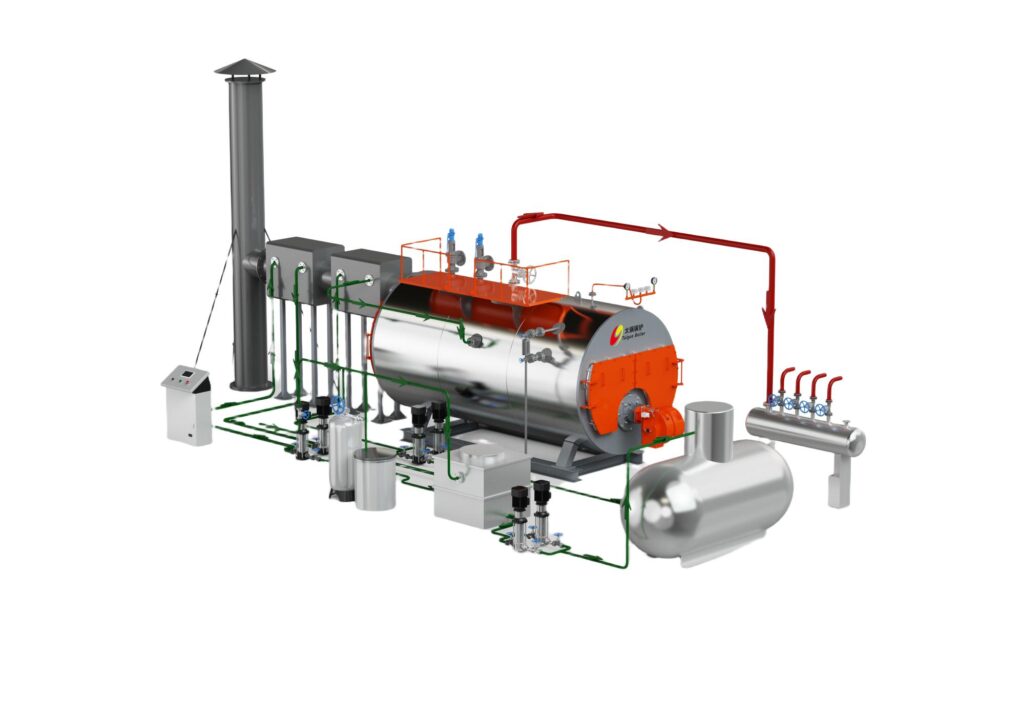
How to Choose a Gas Steam Boilers Capacity for a Factory in Uzbekistan
Boiler sizing requires calculating total connected loads, operational diversity, and piping heat losses. Plant managers must calculate operational demands step-by-step:
Industrial gas boilers do not run efficiently at extreme minimum loads. Sizing must balance peak coverage against standard operating intervals.
2 Ton Gas Steam Boilers: The Ideal Entry-Level Solution
Perfect for Smaller Industries with Lower Steam Demand
A 2 Ton Gas Steam Boilers is a compact, cost-effective choice for industries that need consistent but smaller amounts of steam. This is ideal for:
- Textile workshops focusing on small-scale dyeing and finishing
- Food processing units with limited steam demands
- Pharmaceutical labs requiring sterilization and heating
Key Advantages:
- Quick Response Time: Rapid startup and steady steam output help maintain continuous production without downtime.
- Energy Efficient: High-efficiency burners and heat exchangers maximize fuel utilization, reducing running costs.
- Space-Saving Design: Its compact size is suitable for factories with limited installation space.
Typical Applications in Uzbekistan:
- Textile Dyeing: Gas steam boilers provide the necessary steam for dyeing fabrics quickly and efficiently, crucial for meeting tight production deadlines.
- Food & Beverage Processing: Steaming vegetables, sterilizing containers, and pasteurizing products require low to medium steam output.
- Pharmaceutical Industry: Gas boilers are used in laboratories for heating and sterilization, essential for maintaining hygiene standards.
Considerations:
- Production Scale: 2-ton boilers are best for businesses with low or medium steam consumption.
- Pressure Requirements: This boiler type usually operates at lower pressure, making it suitable for light-duty applications.
When 2 TPH Is Too Small
A 2 TPH boiler will struggle when simultaneous steam draws occur. If a plant operates an industrial dyeing bath alongside washing machines, pressure will drop rapidly. Facilities anticipating near-term line expansion should avoid selecting a 2 TPH unit at its upper limit.
For detailed market pricing on entry-capacity packages, review our guide on the 2 ton gas steam boiler.
4 Ton Gas Steam Boilers: Ideal for Growing Industrial Operations
Perfect for Medium-Sized Factories with Moderate Steam Demand
The 4 Ton Gas Steam Boilers is an ideal solution for medium-sized factories that need higher steam output. It serves industries that require consistent, higher volumes of steam throughout the day.
Key Advantages:
- Enhanced Flexibility: Ideal for industries like textile factories, food processing units, and small chemical plants that need more steam for extended periods.
- Longer Operational Hours: This model is built to handle higher steam loads and long shifts.
- Lower Operational Costs: Its advanced burner technology ensures fuel efficiency, helping you cut energy costs.
Common Applications in Uzbekistan:
- Textile Factories: Handling large batches of fabric dyeing, finishing, and other steam-based processes.
- Food & Beverage Processing: The 4-ton boiler supports large-scale canning, pasteurization, and distillation processes.
- Chemical & Pharmaceutical Plants: Requires higher pressure steam for reactions, sterilization, and distillation.
Considerations:
- Energy Management: Medium-sized plants may benefit from energy management systems, which optimize fuel consumption based on the boiler’s load and operational hours.
- Maintenance: With increased output, the 4-ton boiler may require more frequent maintenance compared to smaller units, so investing in service contracts is advisable.
4 TPH vs 2 TPH
Choose 4 TPH over 2 TPH when production involves multiple parallel processes. If starting a second production line drops main steam header pressure below 0.6 MPa, 2 TPH capacity is insufficient. The 4 TPH threshold buffers load spikes without stalling ongoing batches.
6 Ton Gas Steam Boilers: Powering Large-Scale Industrial Production
The Ultimate Solution for High-Demand Industries in Uzbekistan
The 6 Ton Gas Steam Boilers is designed for larger factories with high steam demands and continuous production. Industries like textile manufacturing, food & beverage production, and chemical processing plants rely on these robust units for uninterrupted steam supply.
Key Advantages:
- High Capacity for Large Operations: A 6-ton boiler can support the continuous, heavy steam demands of large-scale operations.
- Advanced Control Systems: Equipped with smart control systems, it ensures precise steam pressure and temperature regulation for optimal production processes.
- Long-Term Savings: Despite a higher initial cost, the efficiency and long service life of 6-ton boilers contribute to lower overall operating costs in the long run.
Typical Applications in Uzbekistan:
- Textile Manufacturing: Large-scale garment and textile plants requiring high steam output for dyeing, finishing, and steaming fabrics.
- Food & Beverage Industry: Large-scale breweries, dairy, and canning operations that need consistent, high-temperature steam.
- Chemical Manufacturing: For applications such as reaction heating or sterilization, high steam pressure is often needed, which the 6-ton boiler can easily provide.
Considerations:
- Installation Space: Due to its larger size, the 6-ton boiler requires a larger installation area, so it’s important to ensure adequate space is available in your factory.
- Fuel Consumption: Larger boilers consume more fuel, but their high efficiency ensures lower overall energy costs compared to outdated or smaller models.
6 TPH vs 4 TPH Gas Steam Boilers
Upgrade to 6 TPH when continuous base demand exceeds 3.5 t/h. Running a 4 TPH boiler at near 100% capacity continuously accelerates tube fatigue and shortens service life. A 6 TPH unit operates comfortably within the optimal 65–85% burner modulation window.
Capacity Selection Comparison:2 TPH vs 4 TPH vs 6 TPH Gas Steam Boilers
The following matrix compares primary operational parameters across the three capacity ratings:
Packaged Gas Boiler Sizing Matrix: 2 TPH vs. 4 TPH vs. 6 TPH
Thermodynamic boundaries, utility requirements, and cross-industry application matching.
| Selection Variable | 2 TPH Gas Boiler 2,000 kg/h Rated | 4 TPH Gas Boiler 4,000 kg/h Rated | 6 TPH Gas Boiler 6,000 kg/h Rated |
|---|---|---|---|
| Rated Steam Capacity | 2,000 kg/h | 4,000 kg/h | 6,000 kg/h |
| Heat Output Equivalent | ~1.4 MW (1.2 Gcal/h) | ~2.8 MW (2.4 Gcal/h) | ~4.2 MW (3.6 Gcal/h) |
| Typical Factory Size | Small workshops | Medium industrial facilities | Medium-to-large multi-line plants |
| Operating Profile | Single-shift / batch mode | Double-shift / continuous | 24/7 continuous operation |
| Textile Mill Scope | Small garment washhouse | Fabric dyeing & washing lines | Continuous dyeing & stenter frames |
| Food Processing Scope | Small dairy / packaging | Multi-line cannery / bottling | High-volume juice evaporation |
| Boiler Room Footprint | Compact (~35 m2) | Moderate (~55 m2) | Larger (~75 m2) |
| Natural Gas Demand | ~150–160 Nm3/h | ~300–320 Nm3/h | ~450–480 Nm3/h |
| Initial Investment | Entry-level CAPEX | Moderate CAPEX | Comprehensive investment |
| Selection Basis | Actual calculated steam load | Actual calculated steam load | Actual calculated steam load |
How Much Steam Does Your Factory Actually Need?
Accurate boiler sizing prevents operational failure. To calculate real requirements, utilize our structured steam demand calculation workflow.
Current Steam Demand
Sum the nominal steam consumption (kg/h) of every machine operating on your plant floor. Include manufacturer ratings for heat exchangers, dryers, boiling vessels, and steam injection points.
Peak Steam Demand
Processes rarely draw steam in a smooth line. Batch startups and morning line warmups trigger severe consumption peaks. Identify the maximum concurrent steam draw across your plant to ensure your boiler handles these cycles without pressure collapse.
Operating Hours
- Single Shift (8–10 hours): Rapid cold startup capability is critical.
- Continuous Multi-Shift (16–24 hours): Durable burner design, steady heat transfer surfaces, and water treatment safeguards take priority over cold-start speeds.
Future Expansion
Plan for factory growth over a 3- to 5-year timeline. If production output will expand by 30% within 24 months, sizing a boiler to handle both current and planned lines avoids purchasing a second unit later.
Avoiding Oversizing
Never arbitrarily double calculated steam demands. An oversized gas boiler cycles on and off repeatedly during low-demand periods. This short-cycling wastes natural gas, purges unburned air through hot tubes, and causes burner switchgear wear.
What Else Should Be Considered Before Ordering?
Selecting tonnage forms only one part of plant specification. Complete boiler room execution requires assessing peripheral engineering constraints. For comprehensive system integration, review our turnkey boiler engineering services.
Steam Pressure
Higher pressure delivers higher steam temperatures. Standard saturated steam models provide 1.0 MPa (10 bar / 184℃), 1.25 MPa (12.5 bar / 193℃), or 1.6 MPa (16 bar / 204℃). Sizing must account for internal friction losses through pipes, valves, and headers.
Fuel Supply
Verify regional pipeline gas pressures before equipment configuration. Low pipeline pressure requires specialized low-pressure gas burner trains, while high-pressure mains require dual-stage pressure reducing stations.
Boiler Room Space
Account for clearance around the pressure vessel. Technicians require clear forward clearance to pull fire tubes during inspection cycles.
Water Treatment
Hard water causes rapid limescale accumulation on fire tubes. Limescale insulates metal surfaces, increases fuel consumption, and triggers tube failures. Automated duplex water softeners are mandatory.
Chimney and Auxiliary Equipment
Proper natural stack draft guarantees stable furnace negative pressure. Integrate automated feed pumps, a blowdown expansion tank, and a balance-of-plant distribution header.
Recommended WNS Configuration
For 2–6 TPH gas-fired steam applications, the horizontal fire-tube configuration serves as an established standard. The WNS gas and oil fired steam boiler features a classic three-pass wet-back layout.
This arrangement encloses the rear turnaround chamber entirely in water. It eliminates fragile rear refractory baffles and lowers maintenance costs.
For full thermal calculations and structural drawings, consult our WNS boiler technical guide.
Key Factors to Consider When Choosing Gas Steam Boilers for Your Factory
- Steam Output vs. Factory Demand:
Understand your factory’s steam needs and choose the correct boiler size. Over-sizing or under-sizing can lead to inefficiencies and increased costs. - Pressure & Temperature Requirements:
Different industries need different pressures and temperatures. Higher steam pressures are required for processes like sterilization and chemical reactions, so choose a model that can meet these needs. - Space for Installation:
The larger the boiler, the more space it will require. Ensure that the installation area can accommodate the 6-ton boiler, while smaller plants can benefit from the compact 2-ton and 4-ton models. - Maintenance and Service Support:
Ensure you have access to reliable service and maintenance options. Regular maintenance ensures optimal performance and extends the lifespan of your boiler. - Working Hours: Heavy continuous operation requires a highly durable boiler design with adequate capacity reserves.
- Future Expansion: We highly recommend reserving extra capacity to accommodate your future factory growth.
- Installation Conditions: Ensure your facility has sufficient boiler room space, proper gas connections, and quality water treatment systems.
- Operating Cost: Carefully evaluate daily fuel consumption, routine maintenance costs, and local technical service support.
Complete Gas Steam Boilers Solutions for Uzbekistan Factories
A successful industrial boiler project requires more than just equipment delivery. CN MIRACLE&TAIGUO supports our international clients through every single step of the process.
We provide a comprehensive service suite to ensure your system runs perfectly:
- Precise steam demand and thermal calculations
- Professional boiler model and capacity selection
- Customized system and pipeline technical design
- Complete boiler room structural planning
- On-site or remote installation guidance
- Professional commissioning and local operator training
Our ultimate goal is to deliver a safe, reliable, and highly efficient steam system. We match every configuration to your exact production requirements.
- Discover Our Complete Engineering Capabilities
- Read the Boiler Installation Requirements for Uzbekistan
Recommended Gas Steam Boilers Solutions
Depending on your specific capacity and pressure needs, you can choose from our highly rated equipment configurations:
- WNS Series Gas Fired Steam Boiler: Our premium horizontal three-pass wet-back boiler. It delivers up to 98% thermal efficiency with ultra-low NOx emissions.
- Automatic Control Steam Boiler System: A fully integrated smart boiler package. It features automated water feeding, pressure control, and safety alarms.
- Customized Industrial Steam Solutions: Bespoke boiler systems tailored for unique steam temperatures and space constraints.
FAQ: Industrial Steam in Uzbekistan
Are there specific water treatment requirements for boilers in 2026?
Yes. Under the 2026 Work Plan for the Protocol on Water and Health, Uzbekistan is tightening industrial water safety architecture. A Superior water softening system is Essential to prevent scale buildup, which is the leading cause of efficiency loss and GOSSAN safety violations.
How do the Middle East tensions affect boiler parts in Uzbekistan?
Due to recent logistics reviews, the government has advised businesses to maintain a Critical 6-month stock of essential spare parts (burners, sensors). Our Authoritative service center in Tashkent ensures that Reliable parts are available locally to prevent production downtime.
Can I upgrade my old boiler to meet the 2026 efficiency standards?
Absolutely. Retrofitting older units with Superior economizers and digitized combustion controls is a Validated strategy that qualifies for the new $12.5 million subsidy pool for social and industrial facilities.
What size gas steam boilers does a small factory need?
Many small factories use 2 ton/hour steam boilers, but final selection
depends on actual steam consumption.
Is a 4 ton gas steam boiler suitable for textile factories?
Yes. Medium-sized textile factories commonly require 4 ton/hour or similar
steam capacity depending on production scale.
When should a factory choose a 6 ton steam boiler?
Factories with continuous production and higher steam demand may require
6 ton/hour capacity.
Can boiler capacity be customized?
Yes. Boiler systems can be customized according to production requirements.
How to Select the Right Gas Steam Boilers Capacity
2 TPH: Fits small batch setups, single shifts, and light processing facilities with low baseline demand.
4 TPH: Serves medium factories with parallel production lines and regular load spikes.
6 TPH: Designed for multi-shift facilities requiring large, uninterrupted steam output.
Steam demand, required working pressure, daily operating hours, and peak concurrent loads—not factory size alone—must determine your final boiler capacity.
Conclusion: Tailored Gas Steam Boilers Solutions for Every Industry in Uzbekistan
Whether you are a small textile workshop or a large food processing plant, there is a gas steam boiler to meet your needs in Uzbekistan. By choosing the right model – whether 2 Ton, 4 Ton, or 6 Ton – you can optimize steam production, reduce operational costs, and ensure the reliability of your factory operations.
👉 Get a Quote for Your Ideal Gas Steam Boilers
Need help selecting the right gas steam boiler for your factory?
Contact us today for:
- A free steam demand assessment
- Pricing options and delivery details
- Installation and after-sales support
We are here to help you choose the best solution for your business!
As A class boiler manufacture in China,what we can provide you not only quality goods,but also easy work
Prevent critical under-sizing processing safety problems via our online industrial boiler selection guide.
Inspect detailed fuel consumption advantages within gas steam boiler for uzbekistan features fuel cost.
Obtain factory-direct commercial price estimates through how much does gas steam boiler cost uzbekistan.