
Reclaiming thermal energy from manufacturing exhaust pathways requires advanced thermodynamic integration. A professional boiler efficiency optimization program is vital for cutting daily fuel expenses, lowering stack carbon emissions, and maximizing thermal plant returns.
As an established industrial boiler manufacturer, our overseas infrastructure division specializes in advanced energy reclamation. We engineer high-efficiency finned-tube economizers, deploy automated electronic air-to-fuel oxygen trimming networks, and insulate fluid boundaries to unlock up to 15% extra performance from your thermal assets.
Industrial Applications & Industry Scenarios
Our energy engineering division customizes waste heat recovery matrices and combustion controls based on distinct industrial processing load profiles:
- Jordan Chemical Factory: Implemented high-pressure condensate closed recovery loops to return pressurized boiler feed liquid directly without flashing losses.
- Thailand Food Manufacturer: Upgraded a standard burner array to an O2-trim automated configuration to cut emission profiles.
- Turkey Textile Hub: Integrated an automated blowdown heat recovery system to pre-heat deaerator inlet water tanks.
- Vietnam Packing Plant: Deployed variable frequency drives (VFD) on high-capacity draft fans to lower seasonal electrical loads.
- Indonesia Oil Refinery: Implemented continuous automated boiler surface blowdown flash tanks to generate low-pressure process steam loops.
Key Principles of Industrial Boiler Efficiency Optimization
Our engineering team executes every energy modernization project based on four foundational parameters:
Flue Gas Waste Heat Recovery For Boiler Efficiency Optimization
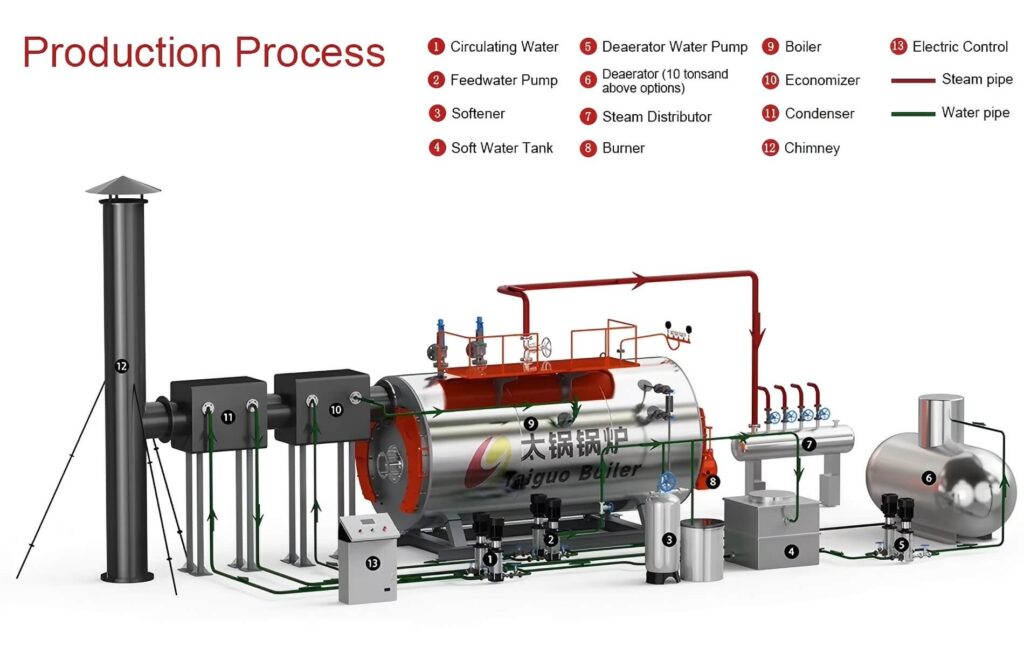
Exhaust gas leaving an unoptimized boiler carries massive amounts of usable thermal energy directly up the stack. We design custom-sized economizers and condensing heat exchangers to intercept these high-temperature thermal streams. This recovery hardware preheats cold incoming feedwater, lowering the fuel energy required to generate steam.
Automated Oxygen Trim Balancing For Boiler Efficiency Optimization
Excessive combustion air cools down the furnace space, while insufficient air causes hazardous incomplete fuel firing. We integrate real-time zirconium oxide sensors inside the exhaust stack to measure active excess oxygen metrics continuously. The PLC modifies fan speeds automatically to maintain a tight, high-efficiency combustion ratio line.
Condensate Flash Steam Reclamation For Boiler Efficiency Optimization
High-pressure condensate contains significant latent heat energy that usually vents away wastefully inside raw water pits. We build dedicated flash steam recovery systems to capture this expanding low-pressure thermal media. This reclaimed steam redirects smoothly to fuel preheating loops or deaerator tank inputs, saving fuel.
Safety Escape Routes For Boiler Efficiency Optimization
Our blueprints incorporate a dual-exit architecture into every facility design. We guarantee completely unblocked emergency egress routes. These dedicated pathways allow operators to evacuate the thermal plant instantly during critical plant emergencies.
Technical Performance Parameters & Sizing Standards
We strictly adhere to international thermal engineering benchmarks to ensure absolute operational safety and maximum fuel tracking savings:
- Stack Temperature Limit: We lower standard exhaust stack temperatures down to a tight range of 120 to 140℃
- Excess Oxygen Target: Our automated trimming networks maintain an optimal flue gas excess oxygen zone of 2% to 3%.
- Radiation Heat Loss: We apply premium insulation wraps to restrict external surface heat loss factors to < 0.5%.
- Compliance Standards: Every efficiency upgrade protocol complies fully with international ASME PTC 4.1 (Boiler Efficiency) codes.
Finned-Tube Economizer Integration Strategies-Boiler Efficiency Optimization
Adding structural heat exchange surfaces inside the flue gas path delivers immediate, verifiable combustion fuel reduction benefits:
- Finned-Tube Geometry Construction: We utilize high-density helical finned tubes to expand the active thermal surface area up to 10 times.
- Counter-Flow Fluid Dynamics: Our designs route cold water opposite to the hot exhaust gas directional tracking path to maximize heat transfer.
- Corrosion Resistance Cladding: We utilize premium alloy steel materials for low-temperature zones to protect against acidic flue gas condensation.
Mechanical Energy Flow & Flash Vessel Layout-Boiler Efficiency Optimization
Our thermal engineers treat efficiency system planning as a balanced mass-energy conversion loop, avoiding simple component hardware add-ons:
- Blowdown Flash Separation Tank: We position expanding flash tanks adjacent to the primary structural blowdown lines. This location ensures immediate flash steam generation.
- Low-Load Burner Recirculation: Our systems integrate hot combustion air recirculation ducts back into the burner throat assembly to capture residual ambient heat.
- Deaerator Vent Condensers: We install compact shell-and-tube exchangers directly onto deaerator steam venting ports to recover escaping moisture mass.
Efficiency Validation & Combustion Baseline Testing Protocols-Boiler Efficiency Optimization
During active on-site equipment performance modifications and automated loop tuning, our engineers execute strict tracking metrics:
- Flue Gas Hydrocarbon Auditing: We check stack gases using portable multi-gas instruments to ensure zero unburned fuel loss markers remain.
- Shell Surface Infrared Scanning: Our technicians map the boiler shell using high-resolution thermal imaging cameras to identify insulation air leaks.
- Hydrostatic Economizer Tube Checks: We execute standalone pressure testing on secondary heat exchanger coils before running hot exhaust loops.
Standard Energy Reclamation Modular Skid Blueprint-Boiler Efficiency Optimization
For rapid international deployment, our factory pre-assembles complex heat recovery hardware onto unified structural platforms:
- Compact Pre-Piped Economizers: We build complete economizers with integrated bypass gas dampers onto structural steel box sub-frames.
- Integrated VFD Drive Banks: All burner forced-draft fan variable frequency controllers mount inside a single, fan-cooled electrical switchgear panel.
- Automated Flow Balancing Valves: Our skids incorporate modulated control valves linked to delta-temperature sensors to prevent thermal shock cycling.
Global Project References
Our overseas engineering division possesses extensive real-world experience executing complex thermal optimization projects worldwide:
- Bangladesh Garment Compound: Retrofitted a high-efficiency finned-tube economizer, slicing total factory fuel usage by $4.5\%$.
- Thailand Food Manufacturer: Upgraded a standard burner array to an O2-trim automated configuration to cut emission profiles.
- Turkey Textile Hub: Integrated an automated blowdown heat recovery system to pre-heat deaerator inlet water tanks.
Common Boiler Efficiency Optimization Pitfalls to Avoid
Improper pipeline planning creates long-term operational liabilities. Our engineering audits frequently eliminate these common factory errors:
- Lowering flue gas exhaust stack temperatures below the acid dew point, causing catastrophic sulfuric acid metal corrosion.
- Installing high-capacity economizers without building an exhaust gas bypass damper line, causing total burner shutdowns during maintenance.
- Modulating burner firing rates rapidly without linking variable speed fan controls, causing smoky combustion imbalances.
- Neglecting water-side scale removal programs before upgrading combustion systems, neutralizing any potential fuel tracking savings.
Related Engineering Capabilities
Discover how our comprehensive factory services support your infrastructure development through our dedicated hub network:
- Boiler Room Layout Design – Comprehensive system planning and civil foundation thermal footprint optimization.
- Boiler Piping System Design – High-pressure steam line calculation and routing optimization.
- Boiler System Integration – Turn-key skid modularization and centralized PLC electrical automation.
- Boiler Installation Guide – On-site technical field engineering supervision and contractor weld auditing.
- Boiler Water Treatment System – Advanced softeners and reverse osmosis solutions to prevent piping scale accumulation.
- Boiler Commissioning Procedure – Strict hydrostatic testing workflows and safety interlock validation protocols.
Customer Frequently Asked Questions (FAQ)
How much fuel can a factory expect to save by installing an economizer?
A properly sized finned-tube economizer typically lowers fuel usage by 4% to 6%. Every 20℃ drop in stack gas temperature increases overall thermal efficiency by approximately 1%.
What is the main cause of high excess air, and why does it drop efficiency?
High excess air occurs when leaky boiler casings or loose dampers draw extra air inside. This cold air steals valuable furnace heat and carries it straight out the stack.
Why do rotating draft fans require variable frequency drives (VFD)?
Standard fans regulate air volume using restrictive mechanical dampers while running at full speed. VFD networks reduce motor rotation speeds smoothly, cutting electrical energy usage by up to 40%.
Can older existing boilers retrofit with your automated O2-trim networks?
Yes. We install universal stack sensors, mechanical fuel-to-air linkages, and programmable PLC control panels to bring legacy machinery up to modern eco-efficiency standards.
Need Professional Boiler Efficiency Optimization Support?
We provide complete, project-based engineering support for industrial boiler efficiency optimization, including:
- Comprehensive stack emissions thermodynamic auditing and fuel-savings mapping.
- Custom-engineered finned-tube economizers and condensing heat exchangers.
- Pre-wired PLC automation panels with integrated electronic O2-trim loops.
- Total boiler system insulation audits and waste heat recovery balancing.
Contact our engineering team today to consult with a senior thermal energy specialist and receive a professional Boiler Efficiency Optimization evaluation for your project.