
Thermal Oil Boiler for Asphalt Heating | High Temperature Industrial Heating Solution
Contents Hide 1 Thermal Oil Boiler for Asphalt Heating Applications 2 What Is a Thermal Oil Boiler? 2.1 Core Components of a Hot Oil Heater System 3 Why Asphalt Plants Need Thermal Oil Heating Systems 3.1 Key Operational Challenges in Asphalt Facilities 4 Thermal Oil Boiler vs Steam Boiler for Asphalt Heating 5 Heating Challenges […]
Get Instant Quote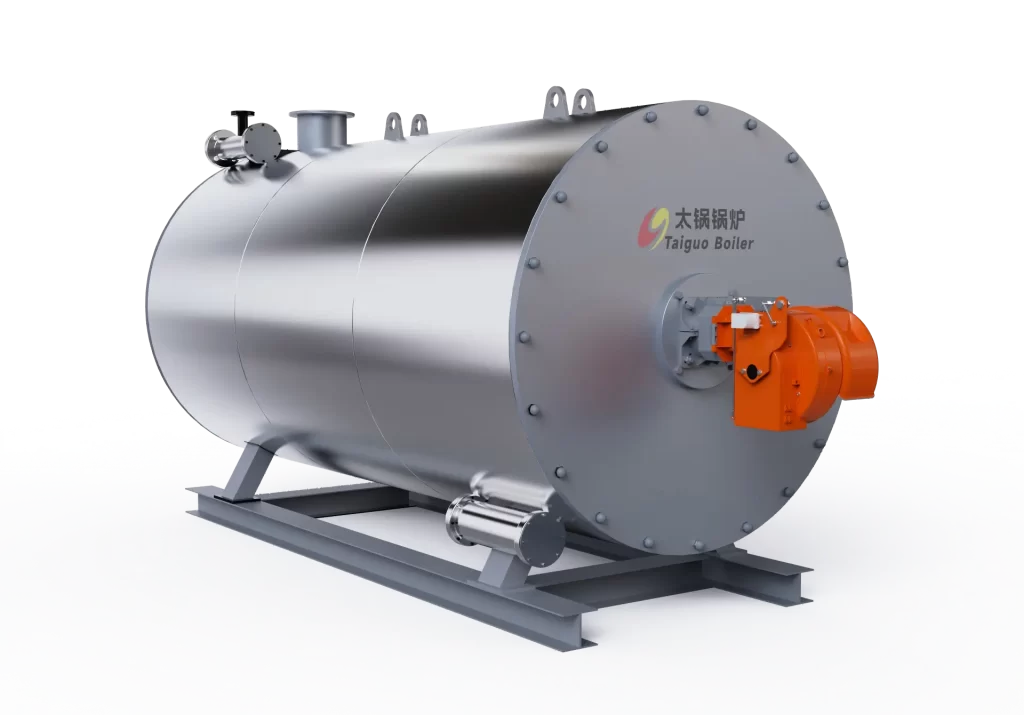
Technical Specifications
Thermal Oil Boiler for Asphalt Heating Applications
A Thermal Oil Boiler (also known as a thermal fluid heater or hot oil heater) is a closed-loop, high-temperature industrial heating system engineered to transfer thermal energy through liquid organic fluids instead of high-pressure steam.
In the asphalt and bitumen sectors, thermal oil boiler systems deliver steady heat transfer to prevent bitumen hardening, optimize viscosity during transit, and support heavy industrial operations including asphalt mixing plants, bitumen storage terminals, polymer-modified bitumen (PMB) production, and jacketed piping systems.
Compared to conventional steam heating setups, a thermal oil heater operates at high fluid temperatures—up to 350℃—under minimal system pressure (0.3 – 0.8MPa). This low-pressure, high-temperature dynamic enhances plant safety, prevents internal pipe corrosion, and drastically reduces annual fuel and maintenance costs.
What Is a Thermal Oil Boiler?
A Thermal Oil Boiler is an indirect thermal energy system that uses a specialized synthetic or mineral-based heat transfer fluid to carry heat to connected processes.
Instead of evaporating water into high-pressure steam, a circulation pump forces liquid thermal oil through a closed combustion coil, heating the fluid before directing it to process heat exchangers, jackets, or internal tank coils.
Core Components of a Hot Oil Heater System
- Heater Body / Furnace Coil: High-efficiency multi-pass tubular coils engineered for maximum radiant and convective heat absorption.
- Circulation Pump: High-temperature pumps that keep thermal fluid moving continuously to avoid fluid degradation and hotspot formation.
- Expansion Tank: Compensates for thermal fluid volumetric expansion during temperature rises and vents entrained air or moisture.
- Automation Control Panel: Manages burner modulation, fuel feed, pressure differentials, and automatic safety shutdowns.
Why Asphalt Plants Need Thermal Oil Heating Systems
Bitumen is highly viscous at room temperature and solidifies into a semi-solid state if allowed to cool. Continuous, precise thermal regulation is essential to maintain liquid fluidity across storage, blending, and pumping operations.
Key Operational Challenges in Asphalt Facilities
- Strict Temperature Tolerances: Standard paving bitumen requires steady thermal maintenance between 150℃ and 180℃, while Polymer Modified Bitumen (PMB) demands temperatures reaching 190℃ – 210℃.
- Avoidance of Thermal Cracking: Direct flame heating scorches bitumen against container walls, breaking down chemical binders and degrading product performance.
- High Thermal Demand During Cold Starts: Bulk bitumen storage tanks require reliable thermal energy to break cold-start viscosity without creating system backpressure spikes.
Thermal oil boilers resolve these issues by circulating uniform, indirect heat through internal coil networks, maintaining precise batch temperatures without scorching product or causing thermal shock.
Thermal Oil Boiler vs Steam Boiler for Asphalt Heating
While steam boilers have historically provided energy across process manufacturing, thermal oil heating systems offer clear technical and financial advantages for high-temperature applications like asphalt processing.
| Selection Factor | Thermal Oil Boiler System | High-Pressure Steam Boiler |
|---|---|---|
| Operating Pressure | Low Pressure (0.3 – 0.8 MPa) at 300°C+ | High Pressure (8.5 – 10 MPa) required for 300°C |
| Maximum Operating Temp | Up to 350°C without pressure buildup | Restricted by pressure limits (180°C – 210°C typ.) |
| Corrosion & Freezing | Non-corrosive oil; no freeze risk in cold climates | High corrosion risk; requires water treatment & antifreeze |
| System Thermal Efficiency | High (88% – 95% with closed-loop fluid return) | Lower (70% – 80% lost to blowdown & flash steam) |
| Water Treatment Needs | None (Closed oil loop) | High (Requires deaerators, softeners, chemical dosing) |
| Maintenance Overhead | Low (No blowdown valves, scale buildup, or steam traps) | High (Frequent inspection of valves, traps, and scaling) |
Heating Challenges in Asphalt Production
Asphalt mixing plant engineers and road construction operators consistently deal with several severe heating challenges:
- Bitumen Temperature Control
- Bitumen must remain within a strict temperature window to maintain proper viscosity. If the temperature drops, the material solidifies and clogs equipment. If it overheats, the bitumen degrades and loses its structural quality.
- Continuous Operation
- Large asphalt plants operate on tight construction schedules and require continuous, uninterrupted heating during intensive paving seasons. Unexpected downtime can ruin active batches and halt paving crews.
- Energy Efficiency
- Heating raw bitumen and aggregate aggregates demands massive amounts of energy. Plant operators need highly efficient thermal designs to minimize daily fuel consumption.
- Equipment Reliability
- High-temperature systems suffer from rapid thermal expansion and contraction. Consequently, heaters must feature robust engineering to prevent structural fatigue and oil cracking.
Core Thermal Oil Boiler Applications in the Asphalt Industry
Thermal oil boilers serve as the central heat source for heavy road construction, bitumen refining, and paving production plants.
1) Thermal Oil Boiler for Bitumen Storage Tank Heating
This is the most common use case.
Thermal oil circulates through internal tank heating coils, maintaining the bitumen at a constant pumpable temperature.
Key Benefits
- prevents solidification
- avoids localized overheating
- reduces tank bottom sludge
- improves transfer pump life
- supports night holding mode
- reduces reheating time
For tank farms and bitumen terminals, this is critical for 24/7 dispatch operations.
2) Thermal Oil Boiler for Jacketed Piping & Pump Tracing
One of the biggest risks in asphalt plants is pipeline blockage.
Bitumen hardens rapidly if the line temperature drops.
Thermal oil systems solve this through:
- jacketed pipelines
- valve tracing
- pump casing heating
- loading arm tracing
- truck unloading stations
- transfer manifolds
This ensures continuous flow from storage tank to mixing drum.
This is especially important for export terminals and large infrastructure projects.
3) Thermal Oil Boiler for Asphalt Mixing Plant Heating
Inside the asphalt batching plant, thermal oil supports:
- mixing drum jacket heating
- filler heating
- additive tank heating
- asphalt weighing systems
- emulsion heating modules
- recycled asphalt softening
Stable heat ensures the final mix meets road performance specifications.
4) Thermal Oil Boiler for PMB (Polymer Modified Bitumen) Production
This is one of the highest-value buyer intents.
PMB production requires:
- precise heat
- stable viscosity
- no temperature overshoot
- long holding stability
- polymer dispersion consistency
Thermal oil systems are ideal because they avoid flame contact and maintain tight temperature uniformity for polymer blending.
This directly improves:
cold weather flexibility
rut resistance
cracking resistance
highway durability
Complete Thermal Oil Heating System for Asphalt Plants
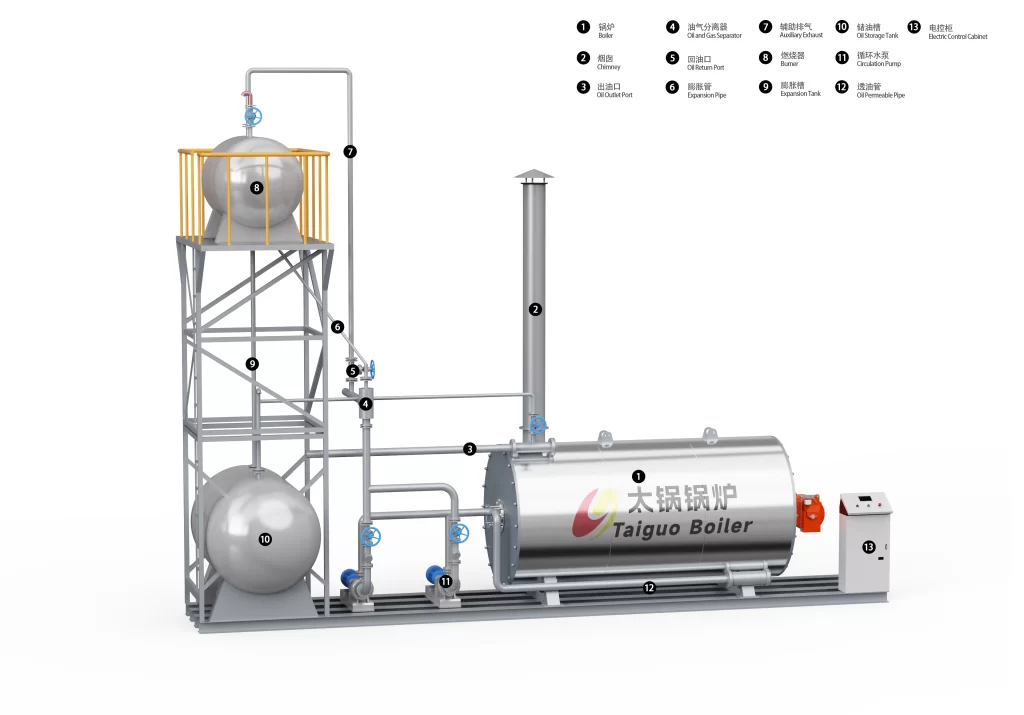
A professional industrial heating layout is a closed-loop engineering system designed for safety and thermal efficiency. The system consists of five primary components:
1. Thermal Oil Heater
The core energy source, available in vertical or horizontal configurations. It burns natural gas, light diesel, heavy oil, or biomass to heat the organic fluid.
2. Circulation Pump
The heart of the closed loop. High-temperature centrifugal pumps continuously circulate the heat transfer fluid through the heater and production terminal.
3. Expansion Tank
Installed at the highest point of the piping layout. It accommodates the thermal expansion of the oil (which expands in volume as temperature increases) and seals the system from oxygen to prevent oil degradation.
4. Auxiliary Equipment & Piping
Includes the oil storage tank, oil-gas separators, high-efficiency filters, and insulated distribution manifolds.
5. Automatic Control System
A smart control panel tracks and manages critical operating parameters:
- Inlet and outlet oil temperatures
- Fluid flow rates and differential pressure
- Burner firing rates and fuel-to-air ratios
- Multi-layered safety alarms for low flow or high temperature
Thermal Oil Boiler Applications Across Industries
Beyond the asphalt and road infrastructure sector, hot oil heaters are used across manufacturing industries requiring high-temperature, low-pressure process heat.
- Wood Processing & Plywood Production: Supplies high-temperature heat for multi-opening hydraulic presses, veneer drying lines, and particleboard curing.
- Chemical & Petrochemical Processing: Heats jacketed chemical reactors, distillation columns, reboilers, and resin production units.
- Food Processing Manufacturing: Drives continuous commercial frying systems, spray drying towers, and edible oil deodorization lines.
- Textile & Dyeing Industry: Powers high-temperature stenter machines, fabric setting units, and textile drying ranges requiring temperatures above200℃.
How to Select the Right Thermal Oil Boiler
Selecting an industrial thermal oil boiler requires evaluating heat output, temperature demand, fuel access, and plant layout.
Step 1: Determine Required Operating Temperature
- Standard Bitumen Maintenance (150℃ – 180℃): Mineral thermal oils are ideal and cost-effective.
- PMB & Chemical Reactors (200℃ – 320℃): Synthetic heat transfer fluids are recommended to prevent fluid oxidation and thermal breakdown.
Step 2: Calculate Required Thermal Capacity
Workplace heating demand is measured in Kilocalories per hour (kcal/h) or Megawatts (MW):
- Small Asphalt Plants / Single Storage Tanks: 300,000 – 600,000kcal/h(0.35 – 0.7MW)
- Medium Mixing Plants / Regional Terminals: 1,000,000 – 2,000,000kcal/h (1.16 – 2.3MW)
- Heavy Refineries / Integrated Industrial Hubs: 3,000,000 – 6,000,000+kcal/h (3.5 – 7.0+MW)
Step 3: Match Available Fuel Sources
- Natural Gas / LPG: Highest combustion efficiency (> 92%), ultra-low emissions, rapid thermal response.
- Light Oil / Heavy Diesel: Reliable choice for remote roadwork sites lacking pipeline natural gas access.
- Biomass / Agricultural Waste: Burns wood chips or palm shells, offering lower fuel costs in forest or agricultural regions.
Step 4: Choose Structural Orientation
- Horizontal Thermal Oil Boiler (YYW / YQW Series): Fits facilities with generous floor space; offers easier coil inspection and maintenance access.
- Vertical Thermal Oil Boiler (YYL / YQL Series): Compact footprint; ideal for space-constrained skid-mounted plants or modular asphalt mixing sites.
Specialized Thermal Oil Boiler Products
We supply complete thermal fluid heating systems tailored for asphalt facilities, chemical plants, and heavy manufacturing sites worldwide.
1. YY(Q)W Series Gas/Oil Fired Thermal Oil Boiler
- Capacity: 300,000 – 12,000,000kcal/h (0.35 – 14MW)
- Fuel Type: Natural gas, diesel, LPG, heavy fuel oil (HFO)
- Key Features: Three-pass coil structure, integrated air preheaters/economizers, rapid thermal circulation. Offers high thermal efficiency (> 93%) and automatic burner modulation.
- Primary Applications: Asphalt mixing plants, bitumen terminals, chemical processing lines.
2. YGL / YGW Series Biomass Fired Thermal Oil Boiler
- Capacity: 600,000 – 6,000,000kcal/h (0.7 – 7MW)
- Fuel Type: Wood chips, wood pellets, palm kernel shells, biomass waste
- Key Features: Heavy-duty chain grate or fixed grate structure, anti-slagging combustion chamber design, reduced operational fuel costs.
- Primary Applications: Biomass-rich regions, off-grid road construction projects, wood panel pressing.
Technical Advantages of Thermal Oil Heating Systems
- Low System Operating Pressure: Operates under hydraulic head pressure (0.3 – 0.8MPa), eliminating the safety risks and high-pressure inspection mandates associated with steam boilers.
- No Heat Transfer Fluid Loss: Closed-loop circulation recycles thermal fluid without evaporation, eliminating blowdown losses and water consumption.
- Precise Temperature Control: PLC automation systems adjust burner outputs to maintain working temperatures within ± 1℃.
- Zero Scaling and Corrosion: Thermal oil contains no oxygen or mineral salts, protecting inner pipe walls from scaling, pitting, and internal rust.
- Cold Weather Performance: Heat transfer fluids do not freeze, allowing seamless operation in freezing climates without anti-freeze additives or heat tracing.
Thermal Oil Boiler Best Project Scenarios
Road Construction EPC Projects
Perfect for:
- highway construction
- airport runway paving
- bridge deck waterproofing
- municipal road maintenance
- mobile asphalt plants
Bitumen Tank Farms
Excellent for:
- port storage depots
- oil terminals
- PMB depots
- tanker loading stations
- road maintenance material hubs
Modified Asphalt Plants
Best for:
- SBS modified bitumen
- rubber asphalt
- emulsion lines
- polymer additive blending
- RAP recycling
Technical Customization Options of Thermal Oil Boiler
Heat Output
- 300,000 kcal/h
- 600,000 kcal/h
- 1,200,000 kcal/h
- 2,400,000 kcal/h
- 6,000,000 kcal/h
Fuel
- natural gas
- diesel
- heavy oil
- LPG
- dual fuel
Temperature
- 180°C
- 220°C
- 260°C
- 300°C
Loop Design
- single tank
- multi-tank manifold
- PMB dedicated loop
- jacket tracing loop
- mobile skid-mounted module
Overseas EPC & Export Support of Thermal Oil Boiler
We support global projects with:
- tank coil design
- tracing loop design
- PMB heating calculation
- burner matching
- expansion tank sizing
- export documentation
- skid-mounted modular solutions
- remote commissioning
- engineer dispatch
Maintenance & Safety Protocols of Thermal Oil Boiler
To ensure your Thermal Oil Boiler Applications in the Asphalt Heating Industry remains Reliable , follow these 2026 best practices:
- Fluid Analysis: Test the thermal oil annually for “flash point” and “carbon residue.” Degraded oil can cause “sludging,” which reduces heat transfer.
- Pump Seals: High-temperature centrifugal pumps are the heart of the system. In 2026, many plants are upgrading to magnetically coupled pumps to eliminate seal leaks entirely.
- Low-Flow Protection: Ensure your system has an Essential flow switch. If oil stops circulating while the burner is on, the oil inside the coils will crack and destroy the heater.
Asphalt Plant Thermal Engineering Solutions
A successful asphalt heating project requires full lifecycle engineering support rather than just equipment supply. At CN MIRACLE &TAIGUO, our structured approach ensures a seamless transition from design to field commissioning:
Asphalt Plant Thermal Engineering Solutions
A successful asphalt heating project requires full lifecycle engineering support rather than just equipment supply. At TAIGUO, our structured approach ensures a seamless transition from design to field commissioning:
- 01: Load Calculation
- We analyze your asphalt production capacity and storage requirements to calculate precise thermal load demands.
- 02: System Design
- Our team develops complete boiler room layout blueprints and double-jacketed pipeline distribution designs.
- 03: Installation Support
- We provide remote and on-site technical support to supervise mechanical assembly and certified welding.
- 04: Commission & Training
- Our specialists handle hot oil testing, calibrate the burner controls, and train your local plant operators.
For more detailed information regarding our end-to-end technical services, please visit our Engineering Hub. You can also explore our dedicated System Optimization Services or review our comprehensive Installation Engineering Guidelines
Recommended Thermal Oil Heating Solutions
At TAIGUO, we manufacture tailored industrial heating equipment specifically engineered for asphalt plant environments:
- Gas & Oil Fired Thermal Oil Heaters: Automatic vertical and horizontal systems featuring high-efficiency combustion configurations. Learn more about our Industrial Thermal Oil Heater Product lines.
- Packaged Hot Oil Systems: Skid-mounted setups including circulation pumps, expansion vessels, control systems, and heaters integrated into a single layout for easy on-site installation. Review our Thermal Oil Heating System structural designs.
Asphalt Heating Project Considerations
Designing a high-performance heating layout requires customizing the system to match your site-specific conditions:
- Regional Fuel Economics: We adjust the burner design to match local fuel accessibility, whether using natural gas, diesel, heavy oils, or biomass fuels.
- Storage Capacity Integration: We scale the heating coils to accommodate your exact bitumen tank farm capacities to prevent temperature bottlenecks.
- Climatic Site Adaptation: For extreme cold climates, we supply enhanced structural insulation packages for both the heater body and the pipeline networks.
A properly tailored heating plant dramatically reduces daily operational costs while guaranteeing the consistent high temperatures your road-building projects require.
Thermal Oil Boiler Project Examples
Thermal Oil Boiler for Asphalt Mixing Plant
- Location: Central Asia
- Boiler Model: YQW Series Oil/Gas Thermal Oil Boiler
- Capacity: 3.5 Million kcal/h
- Fuel: Natural Gas / Diesel
- Application: Bitumen storage tank heating & asphalt mixing plant pipelines.
- Result: Maintained stable 180°C heat under extreme winter conditions.
360,000 Kcal YLW Coal/Biomass Thermal Oil Boiler
- Location: Nigeria
- Boiler Model: YLW-360MA Thermal Oil Boiler
- Capacity: 360,000 kcal/h
- Fuel: Biomass / Solid Fuel
- Application: Industrial process heating and asphalt storage tanks.
- Result: Drastically lowered daily fuel overhead using regional solid fuel.
3 Million Kcal YLW Biomass Thermal Oil Boiler
- Location: Indonesia
- Boiler Model: YLW-3500MA Chain Grate Thermal Oil Boiler
- Capacity: 3 Million kcal/h
- Fuel: Palm Shell / Wood Pellets
- Application: Industrial high-temperature process heating & manufacturing.
- Result: Saved over 30% in annual fuel costs with clean biomass combustion.
2 Million Kcal YQW Gas Thermal Oil Heater
- Location: Indonesia
- Boiler Model: YQW-2400Q Gas/Oil Thermal Oil Heater
- Capacity: 2 Million kcal/h
- Fuel: Natural Gas / Light Oil
- Application: High-temperature chemical processing & bitumen heating.
- Result: Fully automated thermal control with high heat exchange efficiency.
Asphalt Heating Efficiency & Safety Checklist
To ensure your thermal oil system operates at peak efficiency while maintaining the quality of your asphalt, Taiguo’s engineering team recommends performing the following technical checks:
- Check 1: Expansion Tank Venting & Oxidation Prevention
- Action: Verify that the expansion tank is properly vented and, if possible, maintained with a nitrogen blanket.
- Technical Why: Thermal oil oxidizes when in contact with air at high temperatures. Proper venting prevents the formation of sludge and acidic compounds that can corrode the system and reduce heat transfer efficiency.
- Check 2: Pump Flow Rate vs. Boiler Heat Output
- Action: Ensure the oil circulation pump’s flow rate maintains a velocity of at least 2.0 m/s within the furnace tubes.
- Technical Why: If the flow rate is too low relative to the burner’s heat output, the oil film temperature will rise excessively. This leads to thermal cracking and carbon deposits (coking) inside the tubes, which is a leading cause of boiler failure.
- Check 3: Heating Coil Inspection for Sediment Buildup
- Action: Periodically inspect and clean the heating coils inside the asphalt storage tanks.
- Technical Why: Over time, heavy asphalt components and sediments can settle on the coils, acting as an insulator. This forces the boiler to run hotter and longer to achieve the same temperature, significantly increasing your fuel consumption.
- Check 4: Thermal Oil Quality Analysis
- Action: Conduct a lab analysis of your thermal oil every 6 months to check for flash point, viscosity, and carbon residue.
- Technical Why: Degraded oil loses its ability to carry heat efficiently and poses a fire hazard if the flash point drops significantly due to thermal cracking.
FAQ: Industry Strategic Insights
Can I use an Electric Thermal Oil Heater for asphalt?
Yes. In 2026, Electric Thermal Fluid Heaters are gaining traction in regions with high renewable energy subsidies. They offer Validated 100% efficiency and zero on-site emissions, helping plants meet “Net Zero” carbon targets.
How long does thermal oil last in an asphalt plant?
With a well-designed system and proper Superior maintenance, high-quality synthetic thermal oil can last 8 to 10 years. Mineral oils typically require replacement every 3 to 5 years.
Is it safe to leave the heater running overnight?
Yes, and it is often more efficient. Most 2026 systems feature Authoritative automated “night mode” settings that maintain a lower “holding temperature” to prevent the bitumen from solidifying, which is much cheaper than reheating from a cold state.
What temperature should bitumen be maintained at?
Most standard bitumen storage tanks operate between 160–200°C, while PMB may require 180–220°C.
Why is thermal oil safer than steam?
Because it delivers the same temperature range at much lower system pressure, reducing steam-related risks.
Is this suitable for mobile asphalt plants?
Yes. Skid-mounted thermal oil heaters are ideal for portable road construction projects.
What is a Thermal Oil Boiler used for?
A thermal oil boiler is used to deliver high process temperatures (up to 350℃) under low operating pressures (< 1.0MPa). Common applications include bitumen/asphalt heating, chemical reaction vessel heating, plywood pressing, continuous food frying, and textile finishing.
What temperature can a Thermal Oil Boiler reach?
Standard thermal oil boilers reach operating temperatures between 250℃ and 320℃ using mineral-based thermal fluids. Specialized synthetic thermal oils can operate continuously up to 350℃ – 400℃ without system over-pressurization.
Is a Thermal Oil Boiler better than a steam boiler for asphalt heating?
Yes. Asphalt heating requires high temperatures (150℃ – 210℃). Steam boilers must operate under extremely high pressures (1.5 – 2.5MPa) to reach these temperatures, raising equipment and safety costs. Thermal oil boilers deliver the same heat under low pressure (0.3 – 0.5MPa) with zero internal pipe corrosion or water consumption.
How often should thermal oil be replaced in a hot oil boiler?
High-quality thermal oil typically lasts between 3 to 5 years under normal operating conditions. Performing annual fluid sampling to check viscosity, flash point, and carbon residue helps detect thermal degradation early and extends fluid life.
Which fuel options can a Thermal Oil Boiler use?
Thermal oil boilers can burn natural gas, LPG, diesel, light oil, heavy fuel oil (HFO), or solid biomass fuels (e.g., wood chips, pellet fuel, palm kernel shells), allowing plants to choose the most cost-effective local energy source.
Conclusion
CN MIRACLE &Taiguo Boiler provides reliable Thermal Oil Boiler Applications in the Asphalt Heating Industry . Our systems combine safety with high performance. We help you increase output while lowering expenses.
Get Your Asphalt Heating System Proposal
If your project needs stable bitumen heating, PMB precision control, and lower operating risk, our thermal oil boiler systems for asphalt plants provide the most reliable long-term solution.
We help with:
- bitumen tank heating design
- PMB temperature control
- loop sizing
- fuel cost analysis
- export packaging
- EPC technical support
Request a Free Asphalt Heating Plan in 24 Hours
Send your tank volume, plant type, fuel, and project country today.
👉 Get drawings, pricing, and ROI analysis now.
Contact us for your heating system plan please
also recommend you DZL/SZL biomass fired steam boiler for your reference
Plan long-term road building bitumen refinery layouts utilizing our insights industrial boiler applications by industry.
Review actual international container packaging shipping data across Overseas Asphalt Heating Project Case Study: Thermal Oil Heater Solution for a Bitumen Production Plant.
Inspect detailed automated safety air-oil ratio trim layouts inside Case Study: High-Efficiency Thermal Oil Boiler Solution for the Asphalt Heating Industry.