Form E for Chinese Boilers: A Practical Guide for ASEAN Importers
When importing industrial boilers from China, the purchase price is only one part of the total landed cost. Import duties, customs procedures, certificates of origin, and other documentation requirements can significantly affect the final cost of a boiler project. For importers in Southeast Asia, Form E may play an important role in determining whether preferential […]
Get Instant QuoteTechnical Specifications
When importing industrial boilers from China, the purchase price is only one part of the total landed cost. Import duties, customs procedures, certificates of origin, and other documentation requirements can significantly affect the final cost of a boiler project.
For importers in Southeast Asia, Form E may play an important role in determining whether preferential tariff treatment is available for eligible goods imported from China. However, the actual duty treatment depends on the importing country, product classification, applicable trade rules, and origin requirements.
For industrial boiler buyers, understanding how Form E works can help improve import cost planning and reduce documentation risks when purchasing equipment from China.
This guide explains what Form E is, how it may affect the import of Chinese boilers, what information is generally required, and how international boiler buyers can better coordinate export documentation before shipment.
What is Form E?
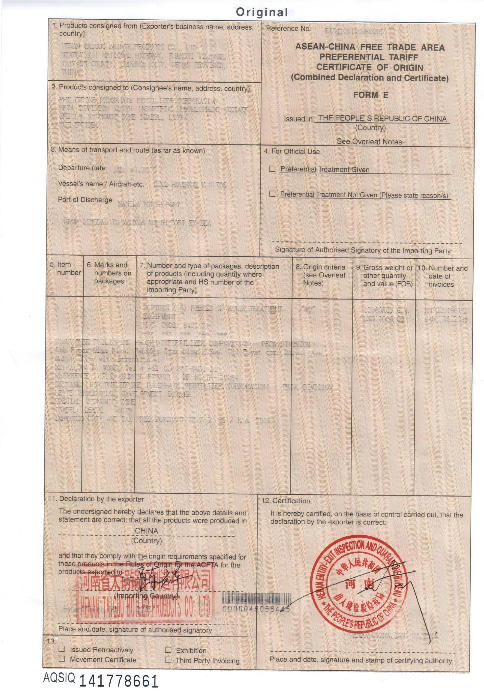
Form E is a preferential certificate of origin used in the context of eligible trade between China and certain participating countries. It is used to certify that goods meet applicable origin requirements under the relevant trade arrangement.
For importers, the certificate may support an application for preferential tariff treatment when the imported goods satisfy the applicable rules.
For Chinese boiler imports, Form E should not be viewed as an automatic guarantee of lower import duties. The actual treatment depends on the importing country, the applicable tariff classification, origin requirements, and customs procedures.
Why Form E Matters When Importing Boilers from China
Industrial boilers are high-value equipment, and import-related costs can have a significant impact on the total project budget.
Depending on the importing country and applicable trade rules, Form E may help eligible importers apply for preferential tariff treatment. For a boiler project, even a difference in applicable import duty can affect the total landed cost of the equipment.
This is why importers should evaluate the following before shipment:
- The correct HS Code for the boiler and related equipment
- The applicable tariff rate in the destination country
- Whether preferential tariff treatment is available
- Whether the product meets the applicable origin requirements
- Whether the required certificate and export documents are correctly prepared
A properly coordinated documentation process can help reduce unnecessary customs delays and improve cost visibility before the boiler is shipped.
How Form E Works in a Chinese Boiler Import Process
Boiler specification confirmed
HS Code reviewed
Manufacturing origin verified
Export documentation prepared
Form E application coordinated
Boiler shipped to Southeast Asia
Importer submits documents to customs
For a Chinese boiler project, the documentation process usually begins after the technical specification and commercial structure of the equipment have been confirmed. The exporter and importer should then review the product classification, origin-related information, commercial invoice, packing list, and other documents required for the shipment.
The availability and acceptance of Form E depend on the applicable trade arrangement and destination-country customs requirements. Importers should therefore confirm the specific requirements with their customs broker or relevant authorities before relying on preferential tariff treatment.
Form E and Boiler HS Code Classification
HS Codes dictate applicable duty rates under regional trade agreements. Industrial boilers and auxiliary equipment generally fall under Chapter 84.
Equipment Type Typical HS Code Common Standard Duty ASEAN Preferential Duty (with Form E) Industrial Steam Boilers 8402.11 / 8402.12 5% – 15% 0% – 5% Hot Water Boilers 8402.19 5% – 10% 0% – 5% Thermal Oil Heaters 8402.20 / 8419.89 6% – 12% 0% – 5% Boiler Auxiliary Parts 8402.90 3% – 8% 0% Note: Tariff rates vary by country and year. Always re-confirm local tax tables before finalizing order contracts.
First six digits of the HS code must match across all trade documentation. Discrepancies between Chinese export entries and import declarations create clearance delays.
How Much Could Form E Save on a Chinese Boiler Import?
The potential savings from Form E depend on the importing country, HS Code classification, and the preferential tariff treatment available for the specific product.
To illustrate how the calculation works, consider a hypothetical 10-ton biomass boiler imported into the Philippines:
Boiler Value: US$80,000
Illustrative Standard Import Duty: 10%
Estimated Duty Without Preferential Treatment: US$8,000If the boiler qualifies for preferential tariff treatment and the applicable duty rate is reduced to 0% under the relevant trade rules:
Estimated Duty With Preferential Treatment: US$0
Illustrative Potential Saving: US$8,000This is an example for illustration only. The actual import duty and potential savings must be confirmed based on the destination country, applicable HS Code, product origin, and customs regulations in force at the time of import.
For high-value industrial equipment, verifying the applicable tariff treatment before shipment can help importers estimate their total landed cost more accurately.
Common Mistakes When Applying for Form E
Mistakes on origin certificates cost both time and money. Below are frequent errors importers should avoid:
- HS Code Mismatches: Using different HS codes on export declarations and Form E filings.
- Inconsistent Company Names: Differences between the invoice recipient and the Form E consignee.
- Delayed Application: Requesting Form E long after vessel departure (requiring special retroactive stamps).
- Incorrect Origin Criteria: Failing to prove required manufacturing origin rules for complex industrial units.
- Third-Party Billing Errors: Incorrect handling of third-country invoicing details on origin certificates.
Working with an experienced exporter prevents these compliance mistakes.
Form E for Boiler Importers in Southeast Asia
While Form E is recognized across ASEAN member states, customs execution and documentation scrutiny can vary by destination country. Importers should confirm the applicable tariff treatment with local customs authorities or a qualified customs broker before shipment.
Malaysia
Boiler importers in Malaysia must ensure that the HS Code on the Form E matches the Royal Malaysian Customs Department (RMCD) tariff classification.
- Focus Areas: Boiler HS Code accuracy, Certificate of Origin validity, comprehensive customs documentation, and verifying specific preferential tariff eligibility under AFTA.
Indonesia
Indonesian customs (DJBC) enforces strict verification procedures for imported machinery. Any minor discrepancy in product description or invoice details can trigger manual inspections or temporary document queries.
- Focus Areas: Importer identification requirements (such as NIB), exact HS Code classification, smooth customs clearance protocols, and complete local import documentation.
Thailand
Importing industrial pressure vessels into Thailand requires close coordination between product classification and import entry systems. Thai Customs cross-checks the origin criteria against physical shipping marks.
- Focus Areas: Technical product classification, origin documentation consistency, and compliance with Thai import customs requirements for industrial heating equipment.
Philippines
The Bureau of Customs (BOC) in the Philippines requires clear correlation between the Form E, Bill of Lading, and Commercial Invoice. Proper documentation prevents delays in applying preferential tariff rates.
- Focus Areas: Import documentation completeness, precise tariff classification, and alignment with Philippine customs clearance procedures.
Vietnam
Customs authorities in Vietnam strictly audit the Form E origin criteria boxes and shipping routes. Transshipment details must be clearly documented if cargo passes through intermediate ports.
- Focus Areas: Certificate of origin formatting requirements, preferential tariff eligibility verification, and full import documentation compliance.
How CNMIRACLE Supports Chinese Boiler Export Documentation
Navigating international trade compliance requires technical equipment expertise and precision in documentation handling. Missteps in origin applications can cause unnecessary port delays or lead to forfeited duty savings.
At CNMIRACLE, as the overseas export division of Taiguo Boiler Group, we bring extensive industrial experience to every global project. We do not just manufacture high-efficiency industrial boilers — we manage the complete export compliance workflow to protect your investment.
Our Comprehensive Export Services Include:
- Precise Origin Application: We handle Form E registration directly through official China Customs and CCPIT systems to ensure early document availability.
- HS Code Alignment: Our engineering and trade teams verify technical specifications to ensure tariff classifications match destination customs expectations.
- Flawless Shipping Documentation: We prepare zero-error commercial invoices, packing lists, quality inspection certificates, and origin filings to guarantee smooth clearance.
- End-to-End Logistics Coordination: We synchronize with international freight forwarders to ensure transport routes and Bill of Lading details align perfectly with your Form E.
For importers in Southeast Asia, documentation requirements should be reviewed before shipment. CNMIRACLE can coordinate with the manufacturing and export teams to help prepare the documentation package required for the project.
If you are importing a gas steam boiler, biomass boiler, thermal oil boiler, or other industrial boiler from China, contact our team with your boiler capacity, fuel type, working pressure, and destination country. We can help you evaluate the equipment configuration and coordinate the export documentation process for your project.
Why Work with Kim on Your Next ASEAN Project?
With 10 years of experience in the Southeast Asian market, I don’t just manufacture boilers; I manage the entire regulatory loop.
- I am intimately familiar with the requirements of the Philippines Bureau of Customs (BOC) and Indonesia’s Bea Cukai.
- I provide pre-clearance document sets to your broker for a “dry run” to ensure no surprises at the port.
Technical Checklist: Form E Verification for Boiler Buyers (2026)
“FOB Value” Disclosure Requirement
- Action: Confirm if your specific destination country (e.g., Indonesia) still requires the FOB value to be printed in Box 9.
- Technical Why: Since the 2019 revision, FOB is not mandatory for all, but some local ASEAN customs still demand it for boilers. Incorrectly omitting this can lead to a “Manual Rejection.”
Product Description vs. Invoice
- Action: Ensure the product description in Box 7 matches the commercial invoice word-for-word, including the model number (e.g., WNS6-1.25-YQ).
- Technical Why: Any discrepancy in the model designation can lead to an “Origin Verification” query, which could stall your boiler at the port for weeks.
The “Over-leaf Notes” Compliance
- Action: Check that the back of the Form E contains the correct 2026 version of the “Over-leaf Notes.”
- Technical Why: Using an outdated certificate template is the #1 reason for automatic system rejection in the ASEAN Single Window.
Critical Compliance: Aligning HS Code 8402 for Zero-Duty Entry
The NO1 reason Form E certificates are rejected by customs in Indonesia, Thailand, or Vietnam is a mismatch in HS Code classification. For industrial boilers, the primary heading is 84.02 (Steam or other vapor generating boilers). However, many components, such as burners (84.16) or water treatment systems (84.21), carry different codes. At Taiguo, we ensure that your Form E lists the boiler as a ‘Complete Set’ under 84.02, while providing a detailed packing list that matches the FOB value declared on the certificate. This consistency prevents customs officers from reassessing duties on individual components at a higher tariff rate.
The 40% Rule: Why Taiguo Boilers Qualify for ASEAN Tax Exemption
To benefit from zero import duties under the China-ASEAN Free Trade Agreement, the product must satisfy the Regional Value Content (RVC) of at least 40%. In 2026, with the integration of complex electronic controls, some manufacturers rely heavily on imported components, risking disqualification. Taiguo’s WNS and DZL series are manufactured with over 85% local content, including the high-pressure steel drums, corrugated furnaces, and structural frames. We provide a transparent Cost Statement to the China Council for the Promotion of International Trade (CCPIT), ensuring your Form E is legally bulletproof and ready for any origin audit.
In many international trade scenarios, the exporter on the Form E might be different from the party issuing the commercial invoice. This is a common trigger for customs delays in the Philippines or Malaysia. Our logistics team is expert in the ‘Third Party Invoicing’ protocol. We ensure that Box 13 of your Form E is correctly ticked and that the third-party company’s name and country are clearly stated. This alignment between the shipping documents, the Form E, and the financial invoice ensures a seamless ‘Green Channel’ clearance, potentially saving you $5,000 to $50,000 in import duties per boiler unit.
FAQ
Which countries accept Form E to save import duties on Chinese boilers?
Form E is valid under the ASEAN-China Free Trade Area (ACFTA). It is accepted by Brunei, Cambodia, Indonesia, Laos, Malaysia, Myanmar, Philippines, Singapore, Thailand, and Vietnam. Using it can reduce boiler import duties from the standard MFN rate (often 10-20%) to zero or 5%.
Can I apply for Form E after the boiler has already been shipped?
Yes. If not issued at the time of shipment, a Form E can be issued retroactively within 1 year from the date of shipment. In this case, the “Issued Retroactively” box (Box 13) must be ticked.
What happens if the HS Code on Form E differs from the local customs’ classification?
This is a common reason for Form E rejection. Always confirm the HS Code with your local customs broker in the destination country before the Henan Taiguo Boiler team issues the final document.
What is Form E?
Form E is a preferential Certificate of Origin used for eligible goods exported from China to participating ASEAN markets under applicable trade arrangements.
Can Form E reduce import duties on Chinese boilers?
A valid Form E may allow eligible importers to apply for preferential tariff treatment. The actual duty rate depends on the destination country, HS Code, origin requirements, and applicable customs rules.
Can Form E be used for industrial boilers?
Industrial boilers may qualify for preferential tariff treatment if the product meets the applicable origin rules and customs requirements. The importer should verify the applicable HS Code and destination-country requirements before shipment.
What information must be checked on Form E?
Important information may include the exporter, consignee, product description, HS Code, invoice details, vessel information, and other data required by the applicable customs procedures.
Does CNMIRACLE help with Form E documentation?
CNMIRACLE coordinates international boiler projects and works with the manufacturing and export teams to coordinate technical, commercial, and export documentation for overseas industrial boiler shipments.
💰 Stop Overpaying Import Taxes!
Ready to import high-efficiency boilers with zero duty? Our International Division at Henan Taiguo Boiler provides full support for Form E to save import duties. Contact our documentation experts today for a pre-shipment document audit.
Ready to start your duty-free boiler project?
Contact me today. Let’s check your local HS code and see how much you can save!
Kim
WhatsApp: 8615093412637
How our Form E saved a client in Jakarta $30,000 in import taxes
Maximize your international freight tariff cost reductions through our industrial boiler market regional insights.
Review strict Southeast Asian safety certificate parameters inside Boiler Regulations in Philippines: Navigating DOLE Rule 1160 & Import Compliance.
Verify mandatory local maritime border landing documents via Boiler Import Regulations in Indonesia: A Complete Guide for Industrial Buyers.