
TG-WDR Series Fully Automatic Electric Steam Boiler
The TG-WDR Series Fully Automatic Electric Steam Boiler is a high-efficiency industrial steam generation system. We design this system for factories requiring clean energy, stable steam output, and automatic operation. Unlike conventional fuel-fired boilers, the WDR series electric steam boiler uses advanced electric heating technology. It generates high-quality steam without combustion. This clean process completely […]
Get Instant Quote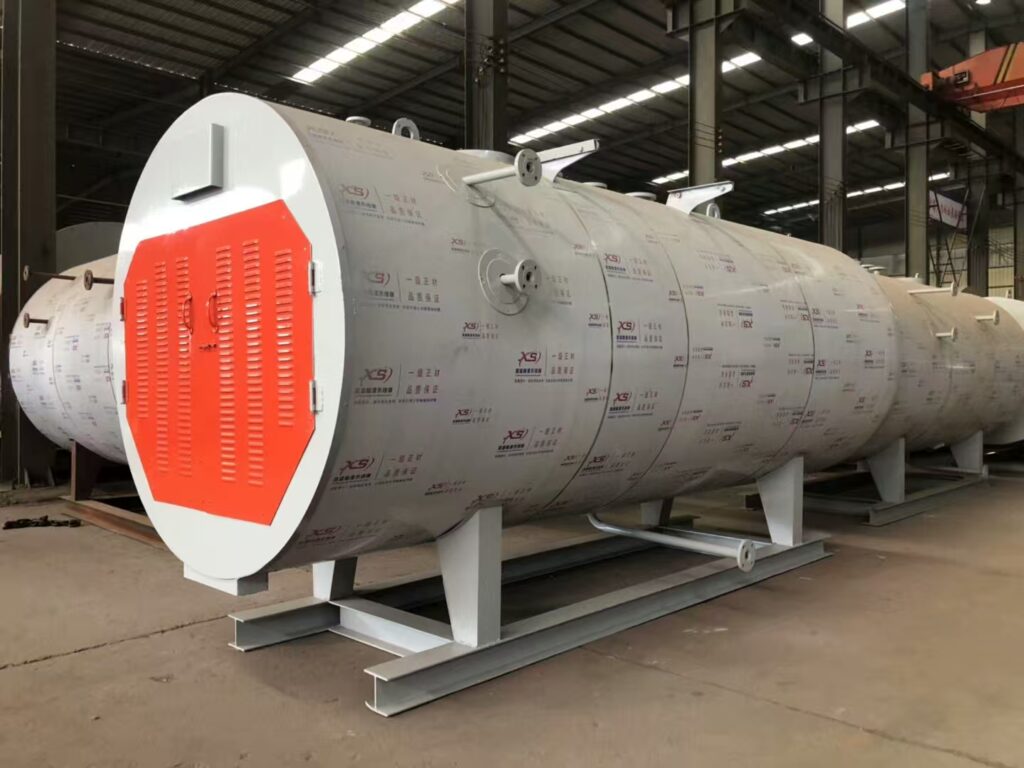
Technical Specifications
The TG-WDR Series Fully Automatic Electric Steam Boiler is a high-efficiency industrial steam generation system. We design this system for factories requiring clean energy, stable steam output, and automatic operation.
Unlike conventional fuel-fired boilers, the WDR series electric steam boiler uses advanced electric heating technology. It generates high-quality steam without combustion. This clean process completely eliminates on-site fuel burning and reduces direct emissions. Therefore, this zero-emission steam boiler helps factories meet strict local environmental laws.
The system is highly suitable for industries requiring clean steam production. These include food processing, pharmaceutical manufacturing, textile production, and high-tech laboratories.
What Is High-Efficiency Electric Steam Generation?
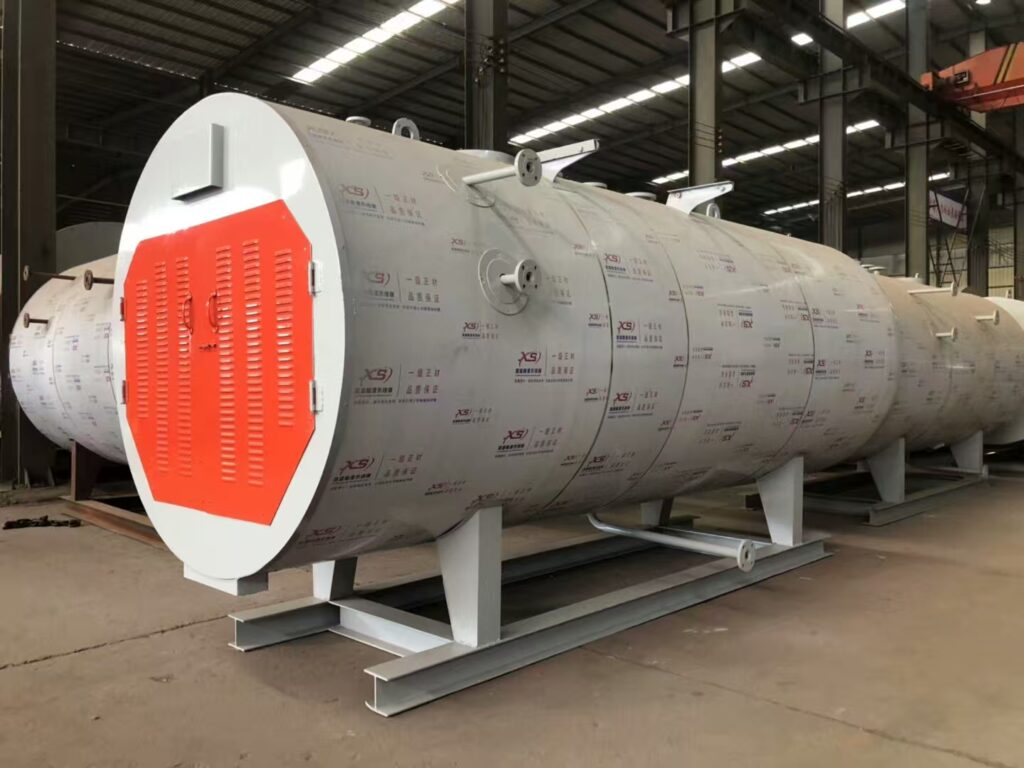
High-efficiency electric steam generation converts electrical energy directly into thermal energy. This process uses high-performance immersion heating elements submerged in treated water.
Conventional boilers rely on chemical combustion. They burn fossil fuels like natural gas, diesel, or coal. Combustion always produces flue gas and environmental pollutants. Furthermore, fuel combustion requires complex burners and exhaust draft systems.
An industrial electric steam boiler eliminates these auxiliary combustion systems. The heating elements transfer heat directly to the water with minimal thermal resistance. Consequently, the boiler achieves high energy conversion rates. It also maintains a highly compact physical footprint inside your factory.
Why Choose the TG-WDR Electric Steam Boiler?
Modern factories must reduce carbon emissions. They also need simpler operation and better environmental performance. The TG-WDR series electric steam boiler provides several critical benefits for modern manufacturing.
Clean Steam Generation
Electric heating eliminates combustion processes entirely. This clean operation avoids fuel-related emissions at your installation site. Your factory can easily meet zero-emission targets.
Fully Automatic PLC Operation
Our intelligent PLC system manages everything automatically. It controls steam pressure, water level, heating stages, and safety protection. Operators do not need to monitor the system constantly.
High Thermal Efficiency
The heating elements convert electrical energy directly into thermal energy. This direct conversion minimizes energy loss during daily operation. Our electric boilers reach up to $99\%$ thermal efficiency.
Compact Installation Footprint
The design eliminates burner systems, fuel storage tanks, and chimney networks. Consequently, it reduces your boiler room space requirements significantly. This design saves valuable floor space for production lines.
Rapid Steam Pressure Build-up
Electric heating elements react to demand instantly. The boiler can reach full operating pressure within minutes from a cold start. This rapid start-up reduces waiting times and fuel waste.
How Does the TG-WDR Electric Steam Boiler Work?
The working principle of the TG-WDR industrial electric steam boiler is simple and highly efficient. It relies on a continuous loop of water, electricity, and heat.
Step 1: Water Softening and Feeding
Raw water contains minerals that cause scaling. First, the water treatment system removes calcium and magnesium ions. Then, the feed water pump transfers softened water into the boiler shell automatically.
Step 2: Power Distribution
The PLC system receives signals from pressure and water level sensors. It safely distributes electric current to specific heating element groups.
Step 3: Direct Immersion Heating
The electric heating elements are fully submerged in water. Electricity passes through the resistance wires, generating intense heat. The metal alloy sheaths transfer this heat directly to the water.
Step 4: Steam Accumulation and Separation
The heated water reaches its evaporation temperature rapidly. Water molecules transform into steam. The steam rises to the steam space at the top of the vessel. Internal separators remove water droplets, ensuring dry saturated steam.
Step 5: Automatic Output Regulation
The boiler releases steam through the main steam valve. If steam demand drops, the PLC system turns off some heating elements. This modular control maintains a stable pressure level.
Engineering Specifications of the TG-WDR Series
Our engineers design the WDR series electric steam boiler to meet strict international standards. The table below outlines the core technical specifications.
| Technical Parameter | Specification Range | Engineering Notes |
| Rated Steam Capacity | 0.1 t/h to 4t/h | Supports multiple parallel modular configurations |
| Rated Working Pressure | 0.4MPa to 1.6 MPa | Custom high-pressure designs available on request |
| Rated Steam Temperature | 151℃ to 204℃ | Saturated steam temperature matches working pressure |
| Thermal Efficiency | 99% | Minimal radiation losses due to rock wool insulation |
| Power Source Requirements | 380V / 415V/ 440V | 3-Phase, 50Hz / 60Hz industrial grid |
| Heating Element Type | Nichrome wire with Incoloy sheath | Low surface heat load design increases lifetime |
| Control Interface | Siemens PLC Touch Screen | Supports Modbus RTU / Profibus communication protocols |
| Boiler Structure | Horizontal Cylindrical Design | Packaged skid-mounted delivery for fast onsite setup |
Key Design Features of the TG-WDR Boiler
The TG-WDR series electric heating steam boiler incorporates advanced design elements to ensure long-term reliability.
1. Ultra-Low Surface Heat Load Elements
High thermal concentration damages heating elements quickly. We design our heating elements with low surface heat loads. This low watt-density design prevents mineral scaling on the tube surfaces. It also extends the service life of the heating elements.
2. Modular Heating Control
The boiler groups heating elements into multiple independent stages. The PLC controller steps the heating elements on and off sequentially. This stepped control avoids electrical surges on your factory power grid. It also allows the boiler to operate efficiently at partial loads.
3. High-Grade Vessel Construction
We manufacture the boiler pressure vessel using specialized boiler-grade carbon steel. Every weld undergoes $100\%$ non-destructive testing (NDT). We also perform hydrostatic pressure tests before the boiler leaves our factory.
4. Dual-Layer Thermal Insulation
The boiler shell is wrapped in high-density aluminum silicate fiberboard. This insulation layer is $100\text{ mm}$ thick. It is protected by a polished stainless steel jacket. This design reduces thermal radiation losses to less than 1%.
Comprehensive Safety Systems
Industrial boilers operate under high temperatures and pressures. Therefore, safety is our top engineering priority. The TG-WDR electric boiler includes multiple active and passive safety systems.
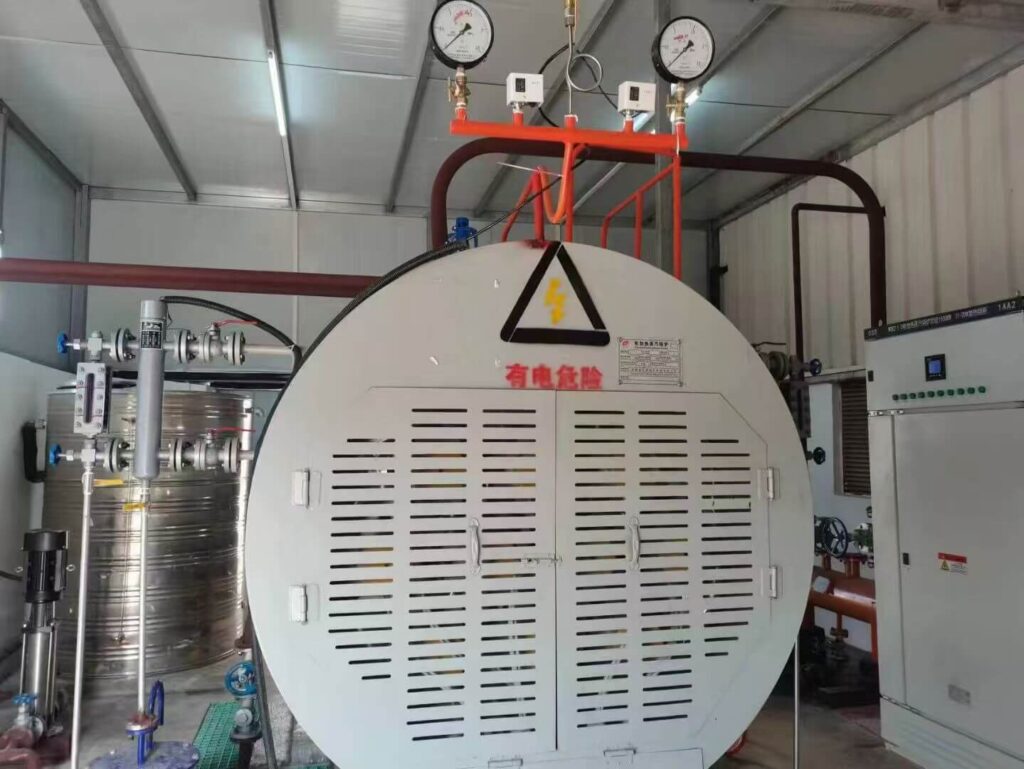
Overpressure Protection
- Dual Pressure Controllers: One controller manages normal operation. The second controller acts as a high-limit cut-off.
- Safety Valves: Two spring-loaded safety valves relieve excess pressure automatically if pressure limits are exceeded.
Water Level Protection
- Water Level Sensors: Multiple stainless steel probes monitor water levels inside the shell.
- Low Water Cut-off: If the water level drops below the safe limit, the system shuts down the heating elements instantly. This protection prevents dry-firing damage.
Electrical Safety Systems
- Leakage Protection: Ground-fault circuit interrupters detect electrical leakage immediately.
- Short Circuit Protection: High-capacity fuses protect the power circuit from sudden electrical spikes.
- Overcurrent Protection: Thermal overload relays protect feed water pump motors and electrical contacts.
Electric Steam Boiler vs. Gas Steam Boiler
Choosing between electricity and natural gas is a major decision for factory owners. The table below compares these two popular steam technologies.
| Operational Metric | TG-WDR Electric Steam Boiler | WNS Gas Steam Boiler |
| Primary Energy Source | Industrial Electricity | Natural Gas / LNG / LPG |
| Thermal Efficiency | $99\%$ | $92\%$ to $98\%$ (with economizer) |
| On-Site Emissions | Absolute Zero (no combustion) | Low NOx emissions ($< 30\text{ mg/m}^3$) |
| Boiler Room Footprint | Extremely Compact (no chimney) | Medium to Large (requires gas pipes) |
| Initial Installation Cost | Lower (simpler piping layout) | Higher (requires gas permit and flue) |
| Maintenance Requirements | Low (replace elements periodically) | Medium (clean burner and exhaust tubes) |
| Start-up Response Time | Rapid (typically $10$ to $15$ minutes) | Moderate (typically $25$ to $40$ minutes) |
| Operating Cost Factor | High (depends heavily on local grid rates) | Low to Medium (depends on gas market) |
When to Select the TG-WDR Electric Boiler
- Your factory is located in an urban area with strict environmental emission bans.
- You have access to cheap electricity, solar energy, or off-peak power rates.
- You have limited space and cannot build a tall steel chimney.
- Your process requires high-purity steam without any risk of fuel contamination.
Real-World Applications
Our industrial electric steam boilers serve critical manufacturing sectors globally.
Food and Beverage Processing
- Sterilization: Supplies clean steam to autoclave chambers for canning lines.
- Cooking & Boiling: Powers jacketed kettles to prepare syrups, sauces, and soups.
- Packaging Lines: Provides steam for shrink-tunnel labeling machines.
Pharmaceutical & Biotech Manufacturing
- Clean Room Humidification: Maintains humidity levels using pure, chemical-free steam.
- Equipment Sterilization: Powers clean-steam autoclaves to sterilize surgical instruments and chemical reactors.
- Distillation: Supplies heat for clean-water distillation columns.
Textile and Garment Finishing
- Dyeing Vats: Heats liquid dyes to precise temperatures for consistent coloring.
- Fabric Setting: Powers stenter frames and fabric pre-shrinking machines.
- Industrial Ironing: Supplies continuous steam to laundry presses and steam irons.
Chemical and Rubber Industries
- Curing Presses: Supplies heat to vulcanizing presses for automotive tire production.
- Reactor Jacket Heating: Maintains precise reaction temperatures for polymers.
- Molding Equipment: Heats complex plastic injection molds.
Crucial Engineering Calculations for Boiler Selection
Selecting the correct boiler capacity prevents production bottlenecks. It also prevents the waste of investment capital. Instead of dealing with complex thermodynamic equations during your planning phase, you can use these simple engineering guidelines to estimate your equipment needs.
Estimating Your Required Heating Power
To determine how much electrical power your factory needs to generate a specific amount of steam, you must look at the energy difference between your incoming feed water and your final steam.
In practical industrial engineering, we use a reliable rule of thumb to estimate this:
The 700 kW Rule:
As a standard baseline, producing 1 ton of steam per hour (1,000 kg/h) at a typical industrial pressure of 0.8MPa requires approximately 700 kWto 720 kW of electrical power.
If your process requires 0.5 tons of steam per hour, you will need a boiler rated at approximately 350kW. If you require 2 tons of steam per hour, your power supply must support at least 1,400 kW.
Four key factors will affect this estimation in real-world applications:
- The target steam pressure: Higher operating pressures require slightly more energy.
- The feed water temperature: If you preheat your incoming water using a waste heat recovery system, you will significantly reduce the electrical power required to reach boiling point.
- Boiler thermal efficiency: The TG-WDR series operates at an outstanding $99\%$ efficiency, meaning almost $100\%$ of the electrical energy converts directly into steam heat with virtually zero waste.
Electrical Capacity Planning
An industrial electric steam boiler requires a highly robust factory power supply system. Before purchasing your equipment, your factory engineers must ensure that your local power transformer can handle the continuous electrical current.
To estimate the electric current load for a standard 3-phase industrial power supply, you can use these direct engineering conversions:
- For 380V Grid Systems: Every 1 kW of heating power draws approximately 1.52 Amperes of electrical current.
- For 415V Grid Systems: Every 1 kW of heating power draws approximately 1.39 Amperes of electrical current.
- For 440V Grid Systems: Every 1 kW of heating power draws approximately 1.31 Amperes of electrical current.
A Practical Selection Example:
If you install a 720kW electric steam boiler (which produces about 1 ton of steam per hour) on a standard 380V factory grid, the boiler will draw a continuous current of approximately 1,100 Amperes during peak operation.
Your engineering team must use this amperage value to size your main incoming copper cables, choose the correct molded case circuit breakers (MCCB), and verify that your local power transformer has enough spare kVA capacity.
Water Quality Requirements for Electric Boilers
Mineral scale acts as an insulator. Even a thin layer of scale reduces boiler efficiency. More importantly, it can cause heating elements to overheat and burn out. Therefore, feed water must meet strict quality standards.
We highly recommend installing an automatic water softener and an oxygen deaerator. These accessories protect your thermal equipment investment.
Maintenance Guidelines for Industrial Electric Boilers
Regular maintenance ensures safety and extends the lifetime of your boiler. Follow this simple schedule to keep your boiler running smoothly.
Daily Blowdown Procedures
Water evaporates, leaving minerals behind. Conduct a manual blowdown once per shift. This action removes accumulated sludge from the bottom of the boiler shell.
Monthly Electrical Inspections
High currents cause thermal expansion in electrical terminals. Tighten all electrical connections in the control cabinet monthly. Also, check AC contactors for arc damage or pitting.
Annual Element Descaling
Drain the boiler completely once a year. Remove the heating element flange groups. Carefully clean away any scale buildup using mild descaling solutions. Inspect the metal sheaths for pitting or cracks.
Complete Boiler System Layout Considerations
A successful boiler installation requires a well-designed system integration. When planning your layout, consider the following layout tips:
- Ventilation: Although electric boilers do not produce exhaust, the electrical cabinet still generates heat. Ensure your boiler room has adequate ventilation.
- Access Space: Leave at least 1.5 meters of clear space in front of the boiler. This space is necessary for pulling out heating elements during maintenance.
- Blowdown Tank: Install a blowdown expansion tank. Hot water from the boiler blowdown must be cooled before discharging into public sewage.
- Piping Insulation: Insulate your entire steam distribution line. Proper insulation prevents steam condensation and energy loss.
Technical Resources:
- Explore our Engineering Hub for complete AutoCAD layout templates.
- Read our guide on Boiler Room Piping Design to optimize steam quality.
Customized Project Proposals
We understand that every manufacturing plant has unique process requirements. Our team designs customized industrial steam solutions based on your production goals.
To develop your system proposal, our engineers evaluate:
- Your total average and peak steam mass flow demands.
- Your local power grid characteristics (voltage, frequency, and transformer capacity limit).
- Your water supply quality and treatment room space.
- Your preferred control integration level (DCS or standalone PLC).
Our factory engineers will guide you from initial system calculations to final onsite commissioning.
Technical Checklist: WDR Electric Boiler Procurement Audit (2026)
Heating Element Metallurgy (Incoloy 800/840)
- Action: Confirm the heating tubes are made of high-grade Incoloy alloy, not standard stainless steel.
- Technical Why: Industrial water treatment chemicals and high temperatures cause ‘Chlorine Pitting’ in standard 304 or 316 steel. Incoloy 800 provides superior oxidation and carbonization resistance at temperatures up to 600℃.
Surface Heat Load Density (W/cm²)
- Action: Check that the surface heat load is below 10W/cm².
- Technical Why: High power density causes ‘Film Boiling’ on the tube surface, leading to rapid scale buildup and localized overheating. Taiguo’s low-density design ensures smooth heat transfer and prevents scale formation.
EMI/EMC Shielding for PLC Controls
- Action: Ensure the control cabinet is shielded against Electromagnetic Interference.
- Technical Why: High-power electric switching creates significant noise. Without proper shielding and filtering, your PLC sensors may provide ‘Ghost Readings,’ leading to unnecessary safety trips.
FAQ: Essential 2026 Industrial Insights
Is the TG-WDR Series Fully Automatic Electric Steam Boiler cost-effective compared to gas alternatives?
Yes. While electricity costs vary, the 99% efficiency of the TG-WDR series eliminates the 10-15% flue-gas heat loss found in gas boilers. When you factor in the elimination of chimney construction, fuel storage, and carbon tax penalties, the Total Cost of Ownership (TCO) is often superior for high-compliance facilities.
Does this boiler meet 2027 safety and environmental mandates?
Absolutely. The TG-WDR series is fully compliant with ASME Section I and CE standards. It also integrates GOSSAN digital safety logs, a critical prerequisite for the 2027 safety audits expected in the global manufacturing industry.
Can the TG-WDR series operate in unattended 24/7 production lines?
Yes. The system is designed for Fully Automatic operation. With its IoT-integrated digital twinning and automated water-level/pressure safety interlocks, the unit can be monitored remotely, ensuring it meets the operational requirements of modern “Smart Factories.”
What is the expected service life of the Incoloy heating elements?
With standard water treatment and regular maintenance, our high-grade Incoloy heating elements typically provide 10,000 to 20,000 hours of reliable service. The modular design ensures that servicing them is a quick, straightforward process.
Need a Clean Steam Boiler for Your Factory?
If your factory requires zero-emission clean steam with full automation, the TG-WDR electric steam boiler is one of the most efficient choices.
We Support
- capacity sizing
- power load calculation
- steam pipe design
- skid-mounted systems
- overseas voltage customization
- CE / EAC export documents
- installation guidance
Contact us now for model selection and quotation.
Our engineers will provide sizing analysis and pricing within 24 hours.
Contact:8615093412637
Email:kimjin2018@cnmiracletrade.com
See more about Fully Automatic Electric Steam Boilers
Study modern zero-emission boiler room engineering frameworks inside our boiler technology insights.
Compare automated diagnostic control panel integrations against TG-WNS6-1.25-YQ Ultra-Low-NOx Smart Steam Boiler.
Analyze complete lifecycle system performance returns via Improving Energy Efficiency and Productivity with Our Industrial Gas Steam Boiler.