
How to Select Gas Fired Steam Boilers for Industrial Production: A Complete Guide
Selecting Gas Fired Steam Boilers for industrial production is not simply a matter of choosing the largest boiler or the model with the highest rated efficiency. The right boiler must match your plant’s actual steam demand, operating pressure, fuel conditions, operating profile, water quality, and long-term operating cost. An undersized unit causes production downtime and […]
Get Instant Quote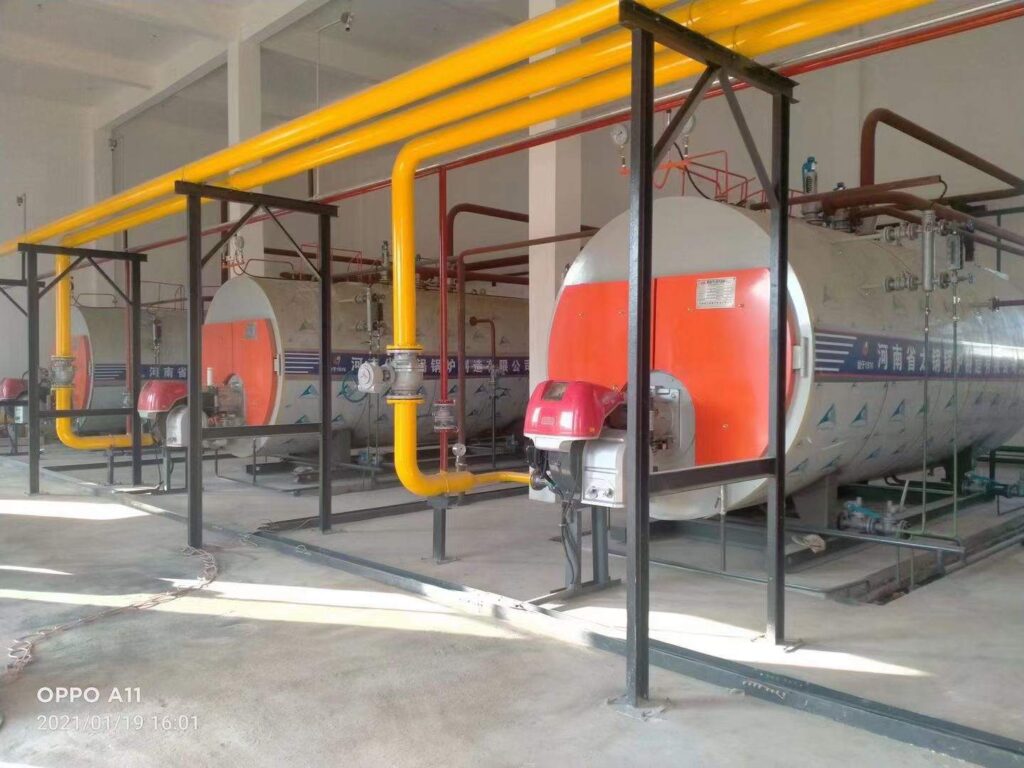
Technical Specifications
Selecting Gas Fired Steam Boilers for industrial production is not simply a matter of choosing the largest boiler or the model with the highest rated efficiency. The right boiler must match your plant’s actual steam demand, operating pressure, fuel conditions, operating profile, water quality, and long-term operating cost. An undersized unit causes production downtime and pressure drops. An oversized boiler increases fuel consumption, cycling losses, and initial capital expenditure.
This engineering guide explains how to evaluate, size, and select an industrial gas steam boiler step by step. We cover everything from steam load calculations and burner dynamics to lifecycle operating costs and utility requirements.
Quick Answer The right industrial gas steam boiler must satisfy five primary criteria:
- Steam Capacity: Sized for peak and continuous loads with process diversity factors.
- Operating Pressure: Matched to demand while accounting for pipeline pressure drops.
- Fuel Supply Parameters: Aligned with gas composition, inlet pressure, and calorific value.
- Factory Load Profile: Evaluated for burner turndown ratio and system redundancy.
- TCO Focus: Fuel consumption drives over 80% of total lifecycle costs.
1. What Should You Consider When Selecting Gas Fired Steam Boilers?
Industrial boiler sizing requires a comprehensive review of thermal, mechanical, and economic parameters. Evaluating these parameters early prevents costly field modifications and operational inefficiencies.
| Selection Factor | Engineering Impact | Primary Risk of Mismatch |
|---|---|---|
| Steam Capacity | Determines pressure vessel sizing and evaporation area | Production bottlenecks or severe short-cycling |
| Working Pressure | Sets vessel design pressure and heat transfer delta | Equipment starvation or unnecessary capital/piping costs |
| Gas Fuel Conditions | Dictates burner selection, gas train sizing, and valve train | Incomplete combustion, burner lockout, or derated capacity |
| Steam Quality | Governs steam separator design and internal baffling | Moisture carryover, water hammer, and product contamination |
| Operating Hours | Drives the financial value of high-efficiency economizers | Prolonged payback periods or excessive operational overhead |
| Boiler Efficiency | Directly determines hourly and annual fuel expenditures | High operating expense ($10,000s in wasted fuel per year) |
| Water Quality | Establishes blowdown rates and pre-treatment specs | Scale formation, localized overheating, and tube failure |
| Installation Space | Sets footprint, tube pull clearance, and stack routing | Regulatory clearance violations and costly building retrofits |
| Automation Level | Dictates PLC integration, monitoring, and safety shutoffs | Increased labor overhead, slow response to load swings |
| Lifecycle TCO | Quantifies 10-to-20-year total investment value | Choosing low upfront cost over long-term fuel economy |
2. Determine the Required Steam Capacity
The first step in selecting Gas Fired Steam Boilers is determining the actual mass flow of steam required across all operating cycles. Sizing by guesswork or simply replacing an old unit “like-for-like” often locks a facility into years of fuel inefficiency.
Add Appropriate Design Margin
Never size a boiler to match your base calculation exactly. Real-world industrial piping incurs thermal radiation losses, pipe wall condensation, and startup loads.
- Distribution Line Losses: Typically add 5% to 10% to account for insulation loss, pipe friction, and thermodynamic drops across manifolds.
- Safety & Intermittent Peak Margin: Add 10% to 15% to absorb rapid valve openings without causing boiler pressure collapse or water level surging.
- Future Expansion Factor: Account for planned processing lines over a 3-to-5-year horizon (commonly 10% to 20%).
Applying a combined diversity and contingency factor of 1.25 to the 2,700 kg/h baseline yields a design target of 3,375 kg/h. For detailed step-by-step sizing methods across batch processes, read our companion engineering guide: How to Calculate Steam Boiler Capacity for an Industrial Plant.
3. Choose the Correct Steam Pressure
Specifying the operating pressure of your Gas Fired Steam Boilers requires balancing process temperature requirements against installation and distribution economics.
Common Industrial Steam Pressure Requirements
Steam pressure directly dictates saturation temperature. Your equipment requires a specific pressure to transfer heat at the necessary rate:
| Application | Typical Operating Range* | Key Process Objective |
|---|---|---|
| Food & Beverage Processing | 6–10 bar (0.6–1.0 MPa) | Retort cooking, pasteurization, and evaporation |
| Textile Finishing & Dyeing | 8–12 bar (0.8–1.2 MPa) | High-temperature drying cylinders and setting ovens |
| Commercial Laundry Systems | 8–10 bar (0.8–1.0 MPa) | Flatwork ironers, continuous batch tunnels |
| Chemical Synthesis & Refining | 10–16 bar (1.0–1.6 MPa) | Jacket heating, high-temperature distillation |
| Paper & Corrugated Packaging | 12–18 bar (1.2–1.8 MPa) | Corrugator corrugating rolls and heating plates |
*Note: Typical ranges vary by process engineering specs and heat exchanger sizing.
Why Higher Pressure Is Not Always Better
Plant managers frequently assume that purchasing a higher-pressure boiler is an easy way to build safety margin into the facility. In practice, running a boiler at significantly higher pressure than your process demands introduces tangible penalties:
- Higher Capital & Valve Trim Costs: Boiler shells, valves, flanges, and piping wall thicknesses scale up in price with ASME / EN pressure class ratings.
- Elevated Flue Gas Temperature: Higher saturation pressure means higher water temperature inside the pressure vessel, which increases radiant losses and raises the baseline stack temperature before heat recovery.
- Higher Blowdown Heat Loss: High-pressure operations purge water at higher enthalpies, losing more heat energy unless advanced blowdown heat recovery flash tanks are installed.
Engineering Rule of Thumb:
Specify your boiler design pressure approximately 1.5 to 2.0 bar above the highest process demand. This margin accommodates piping friction, control valve drops, and header distribution without over-specifying vessel wall thicknesses. For deeper mechanical analyses, review our Steam Boiler Pressure Guide.
4. Check the Gas Fuel Conditions
Gas Fired Steam Boilers is only as reliable as its burner integration and incoming gas supply. Two identical 4-ton boilers will use entirely different burner assemblies and gas trains depending on the incoming fuel chemistry and pressure profile.
Evaluate Fuel Type and Gas Chemistry
Clarify the exact fuel specification before requesting equipment quotes:
- Pipeline Natural Gas (Methane-dominated): The global standard, but regional Wobbe Index and lower heating values (LHV) vary widely.
- Liquefied Natural Gas (LNG): Stored cryogenically, vaporized on site, and delivered at stable high calorific values.
- Liquefied Petroleum Gas (LPG – Propane/Butane): Higher density and volumetric energy content require customized burner nozzles and tight air-fuel ratio management.
- Industrial Biogas / Agricultural Gas: High moisture and hydrogen sulfide (H2S) concentrations demand stainless steel components, low-NOx pre-mix modifications, and corrosion-resistant gas trains.
Gas Supply Parameters to Confirm with Your Utility Provider
- Dynamic Inlet Gas Pressure: Normal pipeline pressures range from 20 mbar to 300 mbar for low-pressure supply, and 1 to 3 bar for high-pressure industrial lines. If local supply pressure is low, your boiler requires an oversized gas train and burner booster fan.
- Net Calorific Value (NCV / LHV): Natural gas typically averages between 34.0 to 38.5MJ/Nm3 (8,100 to 9,200kcal/Nm3). Lower heating values require higher volumetric gas throughput to hit nominal boiler evaporation capacity.
- Pipeline Diameter and Supply Continuity: Sudden burner ramping causes localized pressure drops. Verify that upstream regulators and gas pipe diameters maintain dynamic stability when the boiler fires from low fire to 100% maximum continuous rating (MCR).
5. Select the Right Gas Fired Steam Boilers Configuration
Industrial gas-fired steam boilers are divided into two fundamental mechanical configurations: fire-tube (shell) boilers and water-tube boilers.
| Industrial Gas Steam Boiler Selection | |
|---|---|
| FIRE-TUBE (WNS SERIES) | WATER-TUBE (SZS SERIES) |
| •Hot combustion gases inside tubes | •Water circulates inside tubes |
| •1 ton/h to 20 ton/h capacity | •10 ton/h to 100+ ton/h capacity |
| •Operating pressure up to 25 bar | •Operating pressure up to 100 bar |
| •High water storage / thermal mass | •Low water volume / fast response |
| •Compact footprint, lower CAPEX | •Larger site erection footprint |
Fire-Tube Gas Fired Steam Boilers (Horizontal Three-Pass WNS)
In a fire-tube design, hot combustion gases flow inside seamless steel tubes submerged within a cylindrical shell of boiler water.
- Capacity Range: Typically 1.0 t/h to 20.0 t/h (700 kW to 14,000 kW).
- Operating Pressure: Sub-10 bar up to 25 bar (0.7 to 2.5 MPa).
- Key Advantages: High water storage volume provides great thermal inertia. It handles sudden, cyclic steam load swings without dropping header pressure. Maintenance is straightforward, and the unit ships as a factory-skidded package.
- Best Suited For: Textile mills, food plants, breweries, commercial laundries, paper converters, and light chemical processing.
- Reference System: Learn more about our wet-back, three-pass units at WNS Series Gas/Oil Fired Steam Boilers.
Water-Tube Gas Fired Steam Boilers (D-Type / O-Type SZS)
In a water-tube boiler, water circulates inside boiler tubes while high-velocity combustion gases sweep over their exterior surfaces within an enclosed membrane wall structure.
- Capacity Range: 10.0 t/h to over 100.0 t/h.
- Operating Pressure: 25 bar up to 100+ bar (suitable for superheated steam and cogeneration turbines).
- Key Advantages: Fast startup and rapid steaming capability due to low water volume. Capable of handling extreme pressures and high-superheat temperatures where thick fire-tube shell plates would crack from thermal stress.
- Best Suited For: Heavy chemical complexes, petrochemical refineries, district heating utilities, and captive power generation plants.
- Reference System: Review our high-pressure drum systems at SZS Water Tube Gas Steam Boilers.
6. Compare Boiler Efficiency and Gas Consumption
Fuel is the dominant operating cost of any industrial steam system. An efficiency difference of just 2% to 3% between competing models can waste hundreds of thousands of dollars over the boiler’s lifecycle.
The Thermal Efficiency Baseline
- Standard Boiler (No Heat Recovery): 89%–91% efficiency (flue gas exits at 180℃ to 220℃.
- Boiler with Economizer: 94%–96% efficiency (flue gas cooled down to 90℃ to 110℃ to preheat boiler feedwater).
- Boiler with Condensing Economizer: 98%–100%+ (based on lower heating value; recovers the latent heat of water vapor in the exhaust).
Engineering Formula: Hourly Natural Gas Consumption
To run detailed ROI calculations comparing standard vs. condensing options, read our analysis on Gas Boiler Efficiency & Fuel Cost Optimization.
7. Compare Total Cost of Ownership, Not Just Boiler Price
Capital equipment buyers often choose the lowest initial equipment bid, only to spend far more money on operations later. A gas steam boiler is an energy conversion engine: initial capital expenditure represents a minor fraction of its lifecycle cost.
A cheaper, low-efficiency boiler with a low-tier burner can burn through its entire purchase price in excess fuel in under 18 months. For concrete price models and project breakdowns, see our guide on Industrial Steam Boiler Price: Complete Cost & TCO Guide.
8. Match Boiler Capacity to the Factory’s Operating Load
Mismatches between rated boiler capacity and real production cycles cause operational headaches. Running a single large boiler under light load leads to chronic problems.
The Pitfalls of Boiler Oversizing
If a factory with an average demand of 2,500 kg/h installs a single 6,000 kg/h boiler, that boiler will run at 30% to 40% of its rated capacity for most of its operating life.
- Thermal Shock and Cycling Losses: The burner constantly fires, shuts off, purges the combustion chamber with cold air, and reignites. Every purge cycle vents heat directly out the exhaust stack.
- Burner Turndown Limits: Typical mechanical industrial burners feature a 4:1 or 5:1 turndown ratio. If minimum load drops below the burner’s lowest firing floor (e.g., below 20–25%), the boiler cannot modulate smoothly. It must shut down completely, causing header pressure swings.
- The Rule of Redundancy: If uninterrupted plant operation is critical, installing two medium-sized boilers (e.g., twin 3 t/h units in a lead-lag cascade) is vastly superior to installing a single 6 t/h unit. One boiler can shut down for annual inspections while the other keeps essential production running.
| Single Boiler vs. Multi-Boiler Matrix | |
|---|---|
| OPTION A: Single 6-Ton Unit | OPTION B: Two 3-Ton Units |
| •Lower initial CapEx | •Slightly higher equipment footprint |
| •Zero redundancy during outages | •50% backup capacity for maintenance |
| •Poor efficiency at partial load | •High system turndown (up to 8:1) |
| •Frequent on/off cycling losses | •Cascade control fires only as needed |
9. Consider Feedwater Quality and Water Treatment
A steam boiler is a concentration vessel. Steam leaves as pure $H_2O$ vapor, leaving all dissolved minerals and chemical impurities behind in the boiler water. Unmanaged water chemistry ruins boilers faster than mechanical wear and tear.
Critical Water Quality Parameters
- Total Hardness: Hardness must remain < 0.03 mmol/L (< 1.5 mg/L as CaCO3). Dissolved calcium and magnesium precipitate onto hot boiler tubes, forming dense mineral scale. Just 1 mm of scale acts as an insulator, reducing heat transfer and increasing fuel usage by 3% to 5% while overheating tube metal.
- Dissolved Oxygen (O2): Oxygen causes rapid oxygen-pitting corrosion on steel surfaces, perforating boiler tubes from the water side out. Plants must strip dissolved gases using thermal deaerators or catalyzed oxygen scavengers.
- Total Dissolved Solids (TDS) & Conductivity: Excessive mineral concentrations cause surface foaming and water carryover into the steam distribution line. Automatic surface blowdown systems monitor electrical conductivity and purge high-TDS water efficiently.
Before signing off on any boiler purchase, confirm your raw water source chemistry and budget for necessary auxiliary equipment. Read our full component overview at Industrial Boiler Auxiliary Systems: Engineering Guide.
10. Evaluate Boiler Controls and Safety Systems
Modern industrial steam boilers rely on automated systems to balance thermal efficiency, operational safety, and continuous monitoring.
| Essential Industrial Boiler Safety Matrix | |
|---|---|
| CONTROL SYSTEM | ENGINEERING SAFEGUARD |
|
Primary & Secondary Low-Water Level Cutoffs (Float / Conductivity) |
Shuts off burner immediately if water level drops below safe limits to prevent dry firing. |
|
Dual High-Pressure Limit Switches (Auto & Manual Reset) |
Shuts down burner before internal vessel pressure reaches the mechanical safety valve set-point. |
|
Optical Flame Scanners (Self-Checking Photocell) |
UV/IR cell continuously verifies pilot and main flame; trips fuel shutoff in sub-seconds upon loss. |
|
Double Block & Bleed Gas Valves with Valve Proving System (VPS) |
Mechanically seals fuel line and automatically verifies valve seat tightness prior to light-off. |
|
Variable Frequency Drive (VFD) Combustion Air Linkageless Trim |
Modulates combustion fan RPM with real-time O2 trim to eliminate excess air and maintain stability. |
Industrial buyers should specify a centralized PLC architecture (e.g., Siemens, Allen-Bradley, or Mitsubishi) equipped with a high-resolution HMI screen. Standard industrial protocol integration (Modbus TCP, BACnet, or Profinet) allows full SCADA/DCS supervisory monitoring from your central plant control room.
11. Check Boiler Room and Installation Requirements
Procurement failures often happen during delivery when operators discover site physical limits, clearance violations, or insufficient utility supply lines.
Essential Site Checks
- Tube-Pull Clearance: Fire-tube boilers require an unobstructed corridor in front of or behind the pressure vessel equal to the length of the internal fire-tubes. Without this space, replacement teams cannot pull out and re-roll ruptured tubes without demolishing a concrete wall.
- Combustion Air Intake Louvers: Natural gas needs roughly 10.5to 11.0m3 of fresh air per 1 m3 of gas burned. Starving the boiler room of air causes unstable combustion, high carbon monoxide levels, and severe soot buildup on heat transfer surfaces.
- Exhaust Stack and Draft Dynamics: Evaluate your exhaust path early. Calculate duct friction, economizer pressure drop, and stack backpressure to properly size your burner’s forced draft fan.
- Drainage and Blowdown Containment: Directing boiling blowdown into municipal sewers violates environmental regulations. Install a dedicated blowdown tank to temper purge water with cold water below 60℃ before discharge.
For full layout templates and site preparation checklists, see our installation guide: Industrial Steam Boiler Installation: Site Preparation.
12. Gas Fired Steam Boilers Selection Example
Let us apply this step-by-step engineering framework to a real-world sizing scenario for a commercial food processing factory.
Factory Baseline Parameters
- Process Machinery Demand: Continuous jacketed vessels (1,800kg/h) + two batch retorts (800 kg/h total) + plant sanitation washdown (400 kg/h).
- Base Operating Load: 3,000 kg/h.
- Working Steam Pressure: 8.0 bar saturated steam at processing equipment headers.
- Available Fuel Source: Pipeline Natural Gas (LHV = 36.0 MJ/Nm3, dynamic pressure = 100 mbar).
- Operating Hours: 16 hours/day, 300 days/year (4,800 operational hours/year).
- Planned Expansion: Adding a secondary packaging line in 24 months (estimated +15% load).
At typical industrial gas prices of $0.40–$0.80 per Nm3, recovering that heat saves $45,000 to $90,000 every single year, paying back the cost of the economizer in under 12 months.
13. Gas Fired Steam Boilers Selection Checklist
Print or save this specification checklist before requesting factory quotes. Having these engineering details ready will fast-track your pricing and clarify vendor comparisons.
14. Frequently Asked Questions For Gas Fired Steam Boilers
What size Gas Fired Steam Boilers do I need for my plant?
Size your boiler by calculating the continuous steam usage of all operating equipment, then add 5%–10% for piping thermal losses, 10%–15% for intermittent peaks, and account for your planned plant expansions. If your load swings unpredictably, split the total demand across two smaller boilers run in parallel to avoid running a single large unit inefficiently at low fire.
What steam pressure rating should I select?
Set your boiler operating pressure 1.5 to 2.0 bar above the highest pressure required on your factory floor. This provides enough buffer to overcome piping friction and valve pressure drops without forcing you to pay for unnecessarily thick vessel walls and higher-class valves.
Is fire-tube or water-tube Gas Fired Steam Boilers better?
Choose a fire-tube boiler (WNS Series) for common industrial capacities between 1.0 and 20.0 t/h with working pressures below 25 bar; its large water volume absorbs rapid steam load swings reliably. Choose a water-tube boiler (SZS Series) when your plant requires large capacities (above 20 t/h), high operating pressures (over 2.5 MPa), or superheated steam for power turbines.
How much design safety margin should I add to my boiler sizing?
Engineering best practice is to add an overall safety margin of 15% to 25% above normal running loads. This margin handles initial morning plant heating, simultaneous valve opening peaks, and thermal line drops without over-sizing the burner.
How can I reduce my gas boiler’s daily fuel consumption?
Install an exhaust flue gas condensing economizer to capture waste heat.
Preheat incoming feedwater using a thermal deaerator tank or heat recovery loop.
Insulate all bare valves, flanges, and piping to stop radiant heat loss.
Upgrade to a linkageless digital burner with oxygen trim controls to maintain optimum fuel-air ratios across all firing rates.
Automate continuous surface blowdown with heat-recovery flash separators.
Need Help Selecting an Industrial Gas Fired Steam Boilers?
Sizing an industrial gas steam boiler requires balancing daily operational dynamics against real lifecycle fuel economics. The engineering team at Henan Taiguo Boiler Manufacturing provides complete thermal calculations, equipment sizing, burner-fuel configurations, and comprehensive mechanical drawings tailored to your production line.
Send our technical department your required steam capacity, working pressure, available gas fuel conditions, and daily operational hours, and we will return a detailed equipment sizing profile with complete fuel consumption estimates.
- Explore Related Solutions: