
2 Ton vs 4 Ton vs 6 Ton Steam Boiler: Which Capacity Is Right for Your Factory?
Choosing the right steam boiler size is critical for factory efficiency, operating cost and production reliability. A 2 ton, 4 ton or 6 ton steam boiler may be suitable for different steam loads, but the correct capacity should be determined by actual steam demand, peak load, operating pressure and future expansion. A boiler unit is […]
Get Instant Quote
Technical Specifications
Choosing the right steam boiler size is critical for factory efficiency, operating cost and production reliability. A 2 ton, 4 ton or 6 ton steam boiler may be suitable for different steam loads, but the correct capacity should be determined by actual steam demand, peak load, operating pressure and future expansion.
A boiler unit is not inherently superior simply because it produces more steam. Choosing the wrong equipment rating leads to significant financial losses. An undersized unit causes process pressure drops and halts production lines. An oversized boiler cycles on and off continuously, burning excess fuel and accelerating component wear.
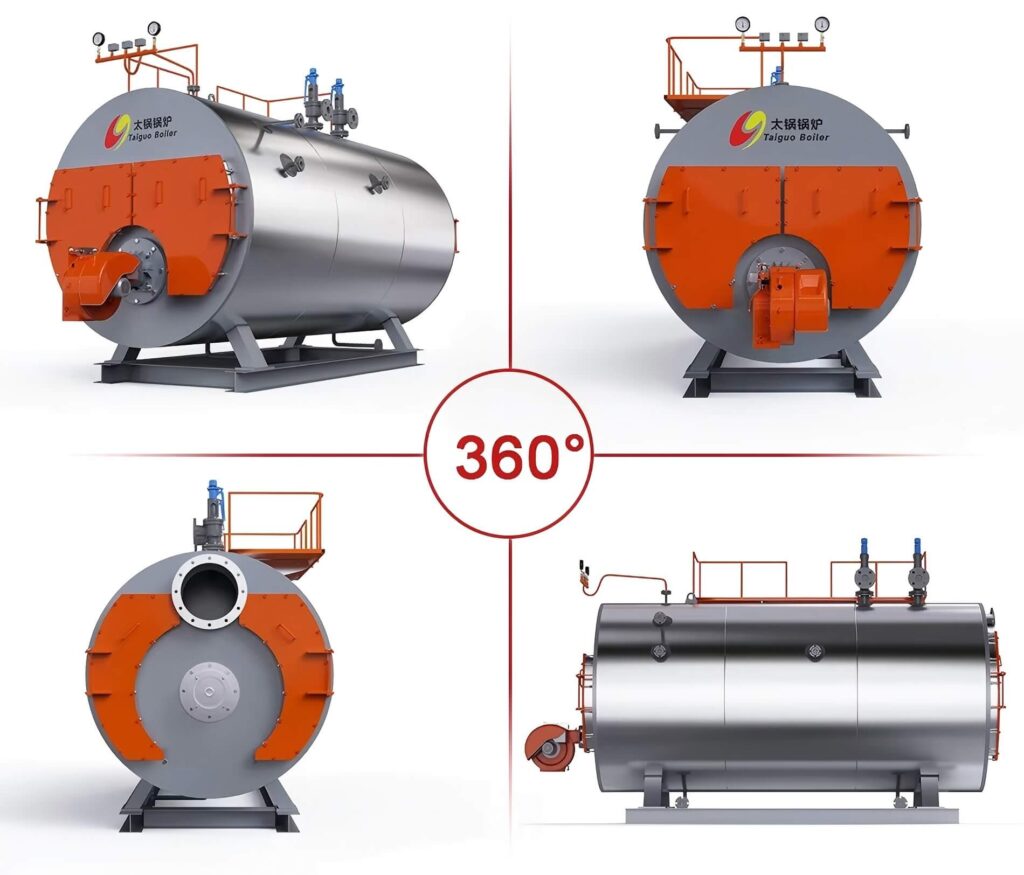
1. 2 Ton vs 4 Ton vs 6 Ton Steam Boiler at a Glance
In industrial engineering specifications, boiler capacity is rated in metric tons per hour (TPH). One ton of steam per hour equals an evaporation output of exactly 1,000 kg/h (2,204 lbs/h).
| Boiler Specification | 2 Ton Steam Boiler (2 TPH) | 4 Ton Steam Boiler (4 TPH) | 6 Ton Steam Boiler (6 TPH) |
|---|---|---|---|
| Rated Steam Output | 2,000 kg/h (4,409 lbs/h) | 4,000 kg/h (8,818 lbs/h) | 6,000 kg/h (13,227 lbs/h) |
| Thermal Heat Output | Approx. 1.4 MW (1,200 Mcal/h) | Approx. 2.8 MW (2,400 Mcal/h) | Approx. 4.2 MW (3,600 Mcal/h) |
| Boiler Horsepower | ~128 BHP | ~256 BHP | ~385 BHP |
| Typical Target Load | 1,200 – 1,800 kg/h | 2,500 – 3,500 kg/h | 4,200 – 5,400 kg/h |
| Factory Scale Profile | Small to medium single plant | Medium multi-line processing | Medium to large manufacturing |
| System Footprint | Compact skid-mounted | Packaged firetube footprint | Heavy packaged firetube |
2. Steam Generation Profiles
2 Ton Steam Boiler (2,000 kg/h Rated Output)
A 2 ton steam boiler delivers up to 2,000 kg of saturated steam per hour. This capacity serves single-shift facilities with localized steam distribution loops:
- Small industrial laundries running two ironers and wash tunnels
- Microbreweries, beverage bottling lines, and food pasteurization
- Animal feed pellet mills requiring steam conditioning
- Small chemical jacketed reactor vessels
4 Ton Steam Boiler (4,000 kg/h Rated Output)
A 4 ton steam boiler generates 4,000 kg of steam per hour. It serves as a workhorse unit for medium-sized manufacturing facilities operating multiple process lines simultaneously:
- Medium textile dye houses running multiple atmospheric dye vats
- Commercial food canneries and industrial retort sterilization facilities
- Corrugated cardboard production plants and carton manufacturing
- Rubber molding, vulcanization, and tire retreading facilities
6 Ton Steam Boiler (6,000 kg/h Rated Output)
A 6 ton steam boiler produces 6,000 kg of high-pressure saturated steam per hour. It provides steady thermal output for continuous production schedules and multi-machine setups:
- Large textile finishing mills running stenter frames and continuous washers
- Industrial edible oil refineries and chemical distillation systems
- Medium pulp and paper processing plants
- Multi-autoclave aerated concrete (AAC) curing lines
3. Which Steam Boiler Size Fits Your Factory Demand?
Choose a 2 Ton Steam Boiler If:
- Your total steady-state steam demand operates between 1,200 kg/h and 1,700 kg/h.
- You operate batch processes with low simultaneous equipment usage.
- Boiler room floor space is limited, requiring a compact skid footprint.
- You do not plan to add new steam-consuming machinery within the next 24 months.
Choose a 4 Ton Steam Boiler If:
- Your steady-state steam load averages 2,500 kg/h to 3,200 kg/h with peak surges up to 3,600 kg/h.
- Multiple high-draw production machines run at the same time.
- You require a balanced operating range that maintains high burner efficiency across variable factory shifts.
- You plan to add another processing line within 2 to 3 years.
Choose a 6 Ton Steam Boiler If:
- Baseline process demand ranges between 4,200 kg/h and 5,200 kg/h.
- Morning warm-up cycles and cold-line startups demand large volumes of instant thermal energy.
- Your plant operates around the clock (24/7) and requires consistent line pressure.
- You want a single centralized boiler room to power your entire manufacturing plant.
4. How to Calculate Your Steam Boiler Size Requirements
Boiler selection begins by establishing actual plant steam consumption rather than guessing equipment ratings. If you have not calculated your total connected load, follow our engineering guide on how to calculate factory steam demand.
Evaluating the Steam Boiler Size Outcome
Consider a factory calculation that yields a net peak steam demand of 3,250 kg/h:
- 2 Ton Boiler (2,000 kg/h): Undersized. The boiler will fail to hold system pressure, causing production delays.
- 4 Ton Boiler (4,000 kg/h): Correct Selection. The unit operates at an optimal 81% firing rate during peak demand and handles minor line surges easily.
- 6 Ton Boiler (6,000 kg/h): Oversized. The unit operates at roughly 54% capacity, resulting in burner short-cycling, higher standby losses, and unnecessary capital expense.
5. CAPEX, OPEX, and Operating Efficiency Comparison
Comparing a 2 ton vs 4 ton vs 6 ton steam boiler requires evaluating lifecycle operational costs alongside the initial equipment purchase price.
| Economic Evaluation Factor | 2 Ton Steam Boiler (2,000 kg/h) | 4 Ton Steam Boiler (4,000 kg/h) | 6 Ton Steam Boiler (6,000 kg/h) |
|---|---|---|---|
| Initial Equipment Purchase Price | Low baseline | Moderate (+40% to +60% vs 2T) | Higher (+80% to +120% vs 2T) |
| Installation & Civil Foundations | Minimal requirements | Standard industrial setup | Reinforced pads & larger stack |
| Nominal Natural Gas Usage | 135 – 150 Nm³/h | 270 – 300 Nm³/h | 405 – 450 Nm³/h |
| Auxiliary Power Load | 4.5 – 7.5 kW | 11.0 – 15.0 kW | 18.5 – 22.0 kW |
| Turndown Flexibility | 1:3 to 1:4 modulation | 1:4 to 1:5 modulation | 1:4 to 1:6 modulation |
| Minimum Stable Steam Load | ~600 kg/h | ~800 kg/h | ~1,200 kg/h |
Fuel expenses make up more than 75% of a boiler’s total lifecycle cost. To budget your monthly fuel expenses accurately, review our operating cost analysis on steam boiler fuel cost: gas vs. biomass vs. electric.
6. Steam Boiler Size: Why Bigger Is Not Always Better
Procurement teams sometimes select a 6 ton boiler for a 2 ton process load under the assumption that excess capacity provides a useful buffer. However, oversizing industrial boilers introduces severe operating drawbacks:
- Burner Short-Cycling: When plant steam demand drops below a boiler’s minimum firing rate (turndown limit), the burner shuts off entirely. Once line pressure dips, it purges the combustion chamber with cold air and reignites. This constant cycling vents heat through the stack and accelerates mechanical wear on the burner.
- Thermal Stress on Pressure Vessels: Frequent firing cycles subject tubesheets and internal furnace welds to repeated thermal expansion and contraction, shortening vessel lifespan.
- Poor Low-Load Fuel Efficiency: Operating below 30% rated capacity increases excess air ratios, lowering combustion efficiency and raising your cost per ton of steam.
For detailed equipment pricing benchmarks and auxiliary packages, read our comprehensive guide on industrial steam boiler price and complete TCO.
7. Configuration Strategy: 1 × 6 Ton Boiler vs. 2 × 3 Ton Boilers
When your plant requires approximately 6 tons of total steam capacity, evaluate whether a single large boiler or a dual-unit configuration best serves your operational needs:
| Operational Consideration | Single 6 Ton Boiler Unit (1 × 6 TPH) | Dual Split Boiler Units (2 × 3 TPH) |
|---|---|---|
| Initial Capital Investment | Lower equipment and piping costs | Higher (+25% to +35% for dual skids & valves) |
| Turndown Flexibility | Minimum stable load: ~1,200 kg/h | Minimum stable load: ~600 kg/h (Run 1 unit) |
| Off-Peak Night Shifts | Inefficient low-fire operation (short-cycling) | Highly efficient (Single unit at optimal fire) |
| Plant Redundancy | Zero steam during maintenance shutdowns | 50% steam capacity maintained continuously |
| Boiler Room Space | Single compact installation pad | Requires wider footprint and split piping |
| Maintenance Flexibility | Requires complete plant shutdowns | Service one unit while the other operates |
Engineering Recommendation: Choose a single 6 ton boiler if your factory runs steady 24/7 continuous loads with minimal shift-to-shift variation. Choose two 3 ton boilers if your production varies across shifts, includes seasonal lulls, or cannot afford downtime during scheduled maintenance.
8. Industry Benchmarks: 2T vs 4T vs 6T Applications
Commercial Laundries (1 – 4 TPH): Laundries with 3 to 4 ironers and multi-stage washers operate efficiently on a 2 ton to 4 ton packaged steam boiler at 0.8 to 1.0 MPa.
Food & Beverage Plants (1 – 6 TPH): Small craft breweries, juice pasteurizers, and rendering facilities run on a 2 ton boiler. Industrial canneries, slaughterhouses, and dairy processing plants typically require a 4 ton or 6 ton boiler.
Textile Dyeing Mills (2 – 10+ TPH): Small garment finishing plants use a 2 ton boiler. Medium dyehouses with pressurized jet dye machines, continuous wash ranges, and stenters rely on 4 ton or 6 ton boilers at 1.0 to 1.25 MPa.
Chemical & Pharmaceutical Plants (2 – 15+ TPH): Batch chemical reactors and distillation setups fit a 4 ton or 6 ton configuration, often utilizing clean gas-fired industrial steam boilers with automated control packages.
9. Engineering Steam Boiler Size Case Study: Food Processing Facility
A food processing and canning plant is evaluating whether to install a 2 ton, 4 ton, or 6 ton boiler for their upgraded production facility.
Engineering Calculations
Steam Boiler Size Selection Verdict
- 2 Ton Boiler (2,000 kg/h): Rejected. Severe capacity shortfall of 1,043 kg/h during simultaneous operations.
- 4 Ton Boiler (4,000 kg/h): Selected. Sized to cover the 3,043 kg/h peak demand while operating within an optimal 76% firing window. It also leaves nearly 1,000 kg/h of reserve steam for future line additions.
- 6 Ton Boiler (6,000 kg/h): Rejected. Overkill for current operations, resulting in higher equipment costs and burner short-cycling.
For step-by-step guidance on plant layouts and balance-of-plant sizing, review our complete guide on industrial boiler selection and capacity planning.
10. Key Specifications Beyond Rated Capacity
Rated steam output is only one part of the boiler specification. Make sure your engineering team defines these essential parameters:
- Operating Pressure: Define working pressure precisely (e.g., 0.7 MPa, 1.0 MPa, 1.25 MPa, or 1.6 MPa). Higher pressures yield higher steam temperatures for process heat exchangers.
- Burner Modulation Controls: Fully modulating burners adjust fuel and air flow continuously to match steam load swings, eliminating the efficiency losses of on/off firing.
- Feedwater Deaeration & Economizers: Supplying preheated, deaerated water protects pressure vessels from thermal shock and oxygen corrosion, while an economizer cuts fuel use by 5% to 8%.
For regional projects, review our dedicated pricing analysis on steam boiler price in Indonesia to balance boiler capacity choices against local import tariffs, transport corridors, and regional fuel infrastructure.
11. Quick Decision Guide For Steam Boiler Size: 2 Ton vs 4 Ton vs 6 Ton
Select a 2 Ton Boiler if your peak demand stays under 1.8 TPH and your plant runs single-shift batch cycles with a compact footprint.
Select a 4 Ton Boiler if your factory draws 2.2 to 3.5 TPH across multiple processing machines and needs room for future production growth.
Select a 6 Ton Boiler if your continuous base demand reaches 4.2 to 5.4 TPH and you run multi-shift operations from a central boiler room.
Select Multiple Split Boilers if your process load swings dramatically throughout the day or your production lines cannot afford unscheduled downtime.
Frequently Asked Questions For Steam Boiler Size
What is the difference between a 2 ton, 4 ton, and 6 ton steam boiler?
The numbers designate rated evaporation capacity: a 2 ton boiler produces 2,000 kg of steam per hour, a 4 ton boiler generates 4,000 kg/h, and a 6 ton boiler delivers 6,000 kg/h. Larger boilers provide more thermal energy, feature larger physical footprints, consume more fuel per hour, and require larger feedwater and flue gas systems.
Can a 4 ton boiler run efficiently at a 2 ton load?
Yes, provided the boiler features a fully modulating burner with at least a 1:4 or 1:5 turndown ratio. A high-quality modulating burner smoothly turns down fuel and airflow to match a 2 ton (50%) load without short-cycling on and off.
What happens if I install an undersized steam boiler?
An undersized steam boiler cannot keep up with factory demand. As steam is pulled faster than the boiler can generate it, operating pressure drops across the distribution header. This slows down processing cycles, causes uneven product heating, and pulls water droplets into steam lines (carryover).
How much fuel does a 4 ton gas steam boiler consume per hour?
A 4 ton gas-fired steam boiler operating at 1.0 MPa and 94% thermal efficiency consumes roughly 270 to 300 Nm³ of natural gas per hour at full firing rate. Actual hourly consumption scales down when the burner modulates to match lower partial loads.
Is it better to buy one 6 ton boiler or two 3 ton boilers?
A single 6 ton boiler has lower initial equipment and installation costs. However, two 3 ton boilers deliver better low-load fuel efficiency during off-peak shifts, offer a wider turndown range, and ensure 50% backup capacity during routine boiler maintenance.
How do I convert boiler horsepower (BHP) to tons per hour (TPH)?
One Boiler Horsepower (BHP) produces approximately 15.65 kg of steam per hour. To convert BHP to TPH, divide the BHP rating by 64.1 (for example, a 256 BHP boiler equals a 4 TPH steam boiler).
Get a Custom Steam Boiler Size Recommendation
Not sure whether your manufacturing plant requires a 2 ton, 4 ton, or 6 ton steam boiler? Send your project parameters to our technical engineering team:
- Factory process machinery list and rated equipment steam consumption
- Target working steam pressure (MPa or bar)
- Daily operating schedules and peak shift requirements
- Available on-site fuel source (Natural gas, diesel, heavy oil, biomass)
- Project location and planned future production expansion
Our engineering department will calculate your peak steam demand, evaluate simultaneous usage diversity, and recommend the optimal boiler capacity and balance-of-plant configuration for your facility.