
Why Uzbekistan Textile Industry Needs Steam Boilers: Efficiency, Productivity & Growth
Contents Hide 1 Introduction: Steam Powering Uzbekistan’s Growing Textile Industry 2 Uzbekistan Textile Industry Development and Energy Demand 3 The Critical Role of Steam in Textile Dyeing & Finishing 3.1 1:Textile Industry Steam Boilers Solving 3 Major Textile Production Pain Points 3.2 2: Textile Industry Steam Boilers ROI Analysis for Textile Mills 3.3 3: Textile […]
Get Instant Quote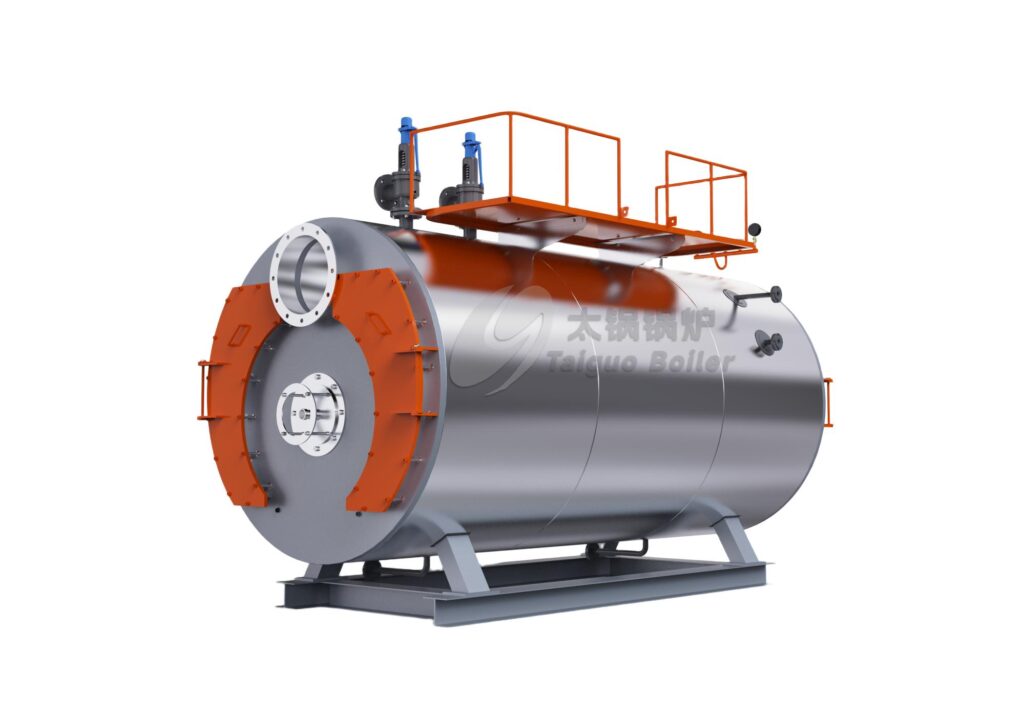
Technical Specifications
Introduction: Steam Powering Uzbekistan’s Growing Textile Industry
Uzbekistan’s textile industry has experienced significant growth in recent years, creating increasing demand for reliable factory energy systems. From initial cotton processing to final garment finishing, industrial steam plays an essential role in maintaining production lines.
Deploying a properly designed textile steam solution helps local factories improve daily productivity while controlling operating costs. Specifically, modern boilers ensure:
- Stable and continuous production quality.
- Highly efficient manufacturing processes.
- Consistent, high-volume product output.
Uzbekistan Textile Industry Development and Energy Demand
Uzbekistan holds strong global advantages in textile manufacturing due to its abundant raw cotton resources and rapidly developing industrial infrastructure. To transform raw materials into high-value export fabrics, modern factories require heavy-duty thermal energy.
A certified boiler for textile factory Uzbekistan system provides the foundational energy required for multiple consecutive production stages:
- Spinning & Conditioning: Maintaining proper fiber moisture levels.
- Fabric Preparation: Pre-treating raw textiles before dyeing.
- Dyeing & Bleaching: Supplying massive volumes of high-temperature water.
- Industrial Washing: Removing chemical residues from finished fabrics.
- High-Speed Drying: Powering automated stenter and drying machinery.
- Final Fabric Finishing: Utilizing steam irons and compactors for premium presentation.
As national production capacity increases, installing an efficient boiler system becomes a critical part of factory market competitiveness.
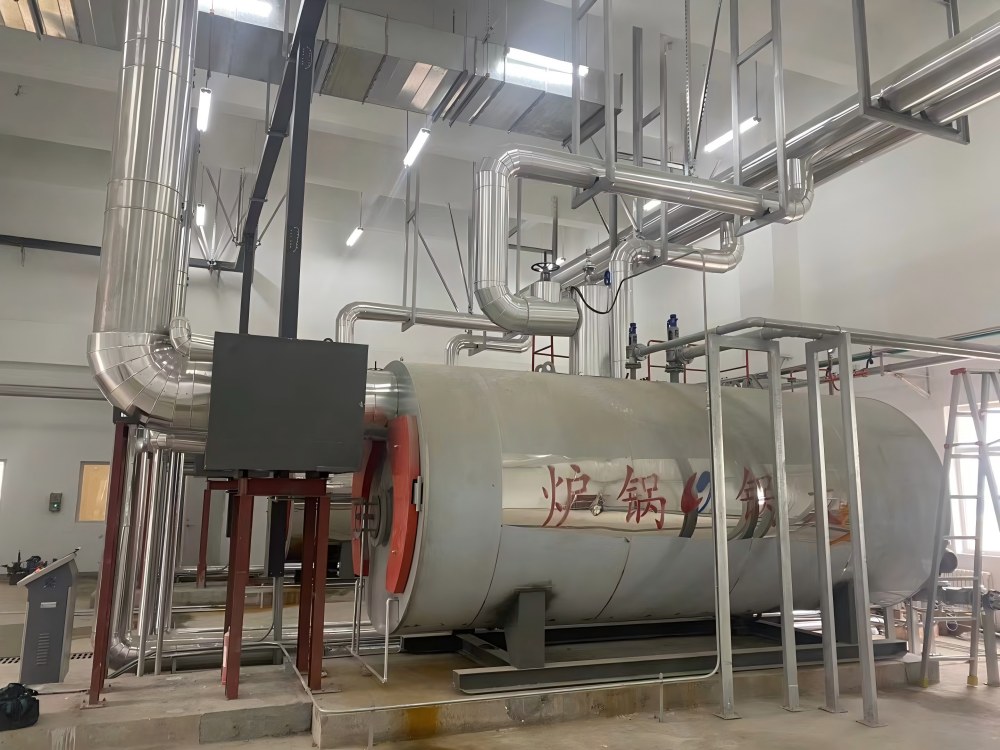
Uzbekistan is one of the world’s leading cotton producers, and its textile industry is booming. As the sector continues to grow and modernize, Textile Industry Steam Boilers have become an essential part of its operations. From spinning and weaving to dyeing and finishing, steam boilers power the processes that drive the textile manufacturing lifecycle.
Critical Heat Stability for Export-Grade Textiles: For textile giants in the Fergana Valley and Namangan, the international market demands zero-defect dyeing quality. Steam pressure fluctuations are the leading cause of ‘color shading’ and uneven fabric texture. Taiguo’s SZS and WNS series boilers are equipped with high-precision pressure stabilizing valves and large steam space designs. This synergy ensures a constant, dry saturated steam supply even during peak loads in the dyeing house. By maintaining a stable temperature within ±1°C in the dyeing vats, our boilers help Uzbek manufacturers meet the rigorous color-fastness standards required by premium European and American fashion brands.
we will explore why the textile industry in Uzbekistan needs steam boilers, the benefits they offer, and how modern, energy-efficient boilers can enhance production, reduce costs, and promote sustainability.
The Critical Role of Steam in Textile Dyeing & Finishing
In Uzbekistan’s booming textile sector, steam is the lifeblood of Scouring, Dyeing, and Tentering processes. However, many factories struggle with “Wet Steam” or pressure drops, leading to uneven coloring and wasted fabric. Taiguo’s WNS boilers are designed with oversized steam drums to ensure 99.9% dry steam, even during peak loads.
1:Textile Industry Steam Boilers Solving 3 Major Textile Production Pain Points
- Pressure Fluctuation = Uneven Dyeing: Our boilers feature a large water volume design. This acts as a thermal buffer, maintaining constant pressure when multiple dyeing vats open simultaneously.
- High Humidity & Valve Failure: Textile mills are humid. We bundle our boilers with Screw Air Compressors to provide clean, dry air for your pneumatic control valves, preventing costly production stops.
- Rising Gas Costs: Energy is the second-largest cost in Uzbek mills. Our integrated economizers recycle waste heat, cutting your monthly gas bill by 10-15%.
2: Textile Industry Steam Boilers ROI Analysis for Textile Mills
Investing in a 4T or 10T Taiguo boiler is a strategic financial move for any mill in Namangan or Andijan:
- Efficiency Boost: Upgrading from old Soviet-era boilers to Taiguo WNS can save up to $3,000/month in fuel.
- Budget Guide: A 4T-10T high-end steam system for the Uzbekistan textile market ranges from $15,000 to $45,000 (FOB).
- Payback Period: Most textile clients achieve full ROI in 14 months due to reduced fabric waste and lower fuel consumption.
3: Textile Industry Steam Boilers Technical Synergy
- EAC (TR CU) Certification: We provide all mandatory documents to pass Uzbekistan’s strict industrial safety inspections.
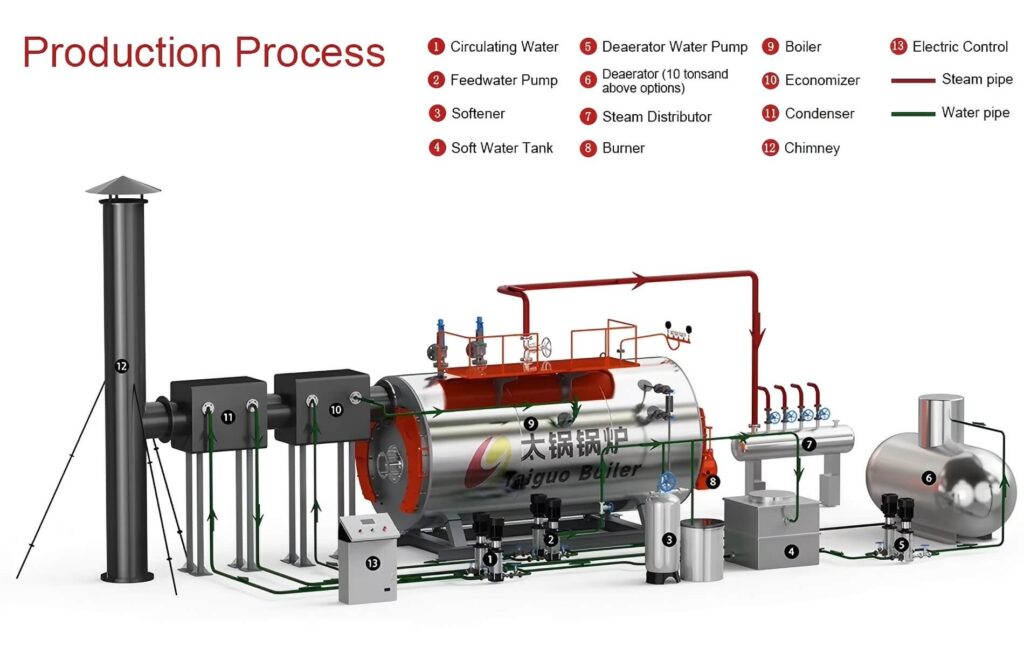
- Water Softening: To protect your dyeing machines and boiler tubes from Uzbekistan’s hard water, we include a Dual-Tank Automatic Softener.
- Boosting ROI through Integrated Energy Recovery: With the 2026 adjustments in industrial gas tariffs in Uzbekistan, energy efficiency is no longer an option—it’s a survival necessity. Our industrial boiler solutions for the textile sector feature integrated Economizers and Air Pre-heaters. By capturing the waste heat from the flue gas to pre-heat the feed water, we can boost the system’s thermal efficiency to over 98%. For a typical spinning and weaving mill, this technology reduces the ‘Steam-per-Kilogram’ of fabric cost by approximately 12-15%, directly enhancing the factory’s price competitiveness in the global CIS and Middle Eastern markets.
- Seamless Integration with Advanced Finishing Machinery: Modern textile finishing—such as stenter frames and continuous bleaching lines—requires highly responsive steam sources. Taiguo’s boiler control systems are designed to communicate directly with European and Chinese-made textile machinery. Our ‘Smart Steam’ logic allows the boiler to ramp up output ahead of high-demand cycles, preventing the ‘pressure drops’ that often paralyze older production lines. This proactive thermal management minimizes downtime and ensures that the entire production chain, from raw cotton to finished fabric, operates at maximum throughput.
The Heart of 2026 Textile Modernization
As Uzbekistan targets a massive 3.3 billion dollar textile export milestone in 2026, the demand for high-performance industrial equipment has reached a Critical peak. For textile mills in Tashkent, Namangan, and Samarkand, Uzbekistan Textile Industry Steam Boilers act as the Essential engine for productivity. From fabric pre-treatment to dyeing and final finishing, steam provides the Reliable heat transfer needed to handle the projected production of 397 million square meters of fabric this year.
Maximizing Efficiency through Superior Technology
In the 2026 competitive landscape, thermal efficiency is a Validated differentiator. Modern boiler solutions offer a Superior 98 percent efficiency rate by integrating economizers and AI-driven combustion controls. This technology is Critical for reducing operational costs, especially as the industry moves toward deeper cotton processing. By adopting these Authoritative steam solutions, enterprises can effectively manage energy losses and align with the $264 million international financing program currently modernizing the nation’s industrial infrastructure.
Scaling Productivity for Global Exports
The transition from raw cotton exports to finished value-added products requires Precise temperature control during the dyeing and printing stages. Uzbekistan Textile Industry Steam Boilers provide the stable moisture and heat Essential for adhering to international standards such as OEKO-TEX and BCI. With 207,000 tonnes of synthetic and blended yarn production planned for 2026, high-pressure steam boilers ensure that manufacturing facilities maintain a Superior throughput, directly fueling the nation’s 10 percent year-on-year industrial growth.
The Importance of Textile Industry Steam Boilers
In the textile manufacturing process, steam plays a vital role at multiple stages, including:
1)Dyeing & Color Fixing
Steam ensures:
- uniform dye penetration
- stable temperature curve
- color fastness
- reduced shade difference
This is especially critical for export fabrics and OEKO-TEX standard production lines.
2) Washing, Bleaching & Finishing
Textile washing lines require continuous steam for:
- hot water generation
- chemical reaction control
- finishing softness
- wrinkle removal
Stable pressure improves consistency between batches.
3) Drying & Heat Setting
Steam is widely used in:
- stenter machines
- cylinder dryers
- calendaring
- garment pressing
This directly impacts:
- production speed
- fabric width stability
- final hand feel
- packaging quality
As these processes are energy-intensive, the need for reliable, efficient, and cost-effective steam boilers becomes crucial for textile manufacturers in Uzbekistan.
Demand for High-Efficiency Steam Boilers
Uzbekistan’s textile industry is evolving rapidly, with many new factories opening and existing facilities expanding. To keep up with the growing demand for higher production output and better product quality, textile manufacturers require high-efficiency steam boilers that can:
- Reduce Fuel Consumption: By utilizing high-efficiency boilers, manufacturers can significantly reduce their energy costs.
- Maintain Consistent Steam Pressure: This is critical for ensuring that the various stages of textile production are performed at optimal temperatures, leading to higher-quality output.
- Increase Productivity: Reliable steam boilers ensure that production runs smoothly without interruption, reducing downtime.
By investing in energy-efficient, modern steam boilers, textile factories can meet the demands of an increasingly competitive global market.
Environmental Impact: Sustainable Production in Uzbekistan
Uzbekistan’s government has set ambitious sustainability goals, and the textile industry is a significant part of this effort. Many textile manufacturers are transitioning toward greener, more sustainable operations, and biomass steam boilers or gas-fired steam boilers are playing a central role.
Advantages of Sustainable Boilers:
- Lower Carbon Emissions: Modern gas-fired and biomass boilers emit significantly fewer greenhouse gases compared to older coal-fired units.
- Compliance with Regulations: Using energy-efficient boilers helps textile manufacturers comply with local and international environmental standards.
- Energy Efficiency: Biomass boilers, for example, use renewable fuels such as agricultural waste or wood pellets, reducing the reliance on fossil fuels and promoting sustainability.
Reduced Operating Costs of Textile Industry Steam Boilers: A Key to Competitive Pricing
In a competitive market like Uzbekistan, where textile production is cost-sensitive, controlling operating costs is critical. Steam boilers are one of the most energy-consuming parts of a textile factory’s infrastructure, but modern, high-efficiency boilers help:
- Cut Fuel Costs: More efficient boilers use less fuel to produce the same amount of steam, helping factories lower their energy bills.
- Improve Cost Predictability: By reducing energy consumption and enhancing operational efficiency, factories can more accurately predict their monthly or yearly costs.
- Extend Equipment Life: Regular maintenance and the use of reliable steam boilers can help extend the lifespan of factory equipment, reducing the frequency and cost of replacements.
With lower operating costs, textile manufacturers in Uzbekistan can offer competitive pricing while maintaining quality, ultimately improving their profitability.
Customized Textile Industry Steam Boilers in Uzbekistan
Each textile factory in Uzbekistan has its own set of production needs, and this is why customized boiler solutions are essential. Whether it’s a small-scale factory focused on weaving or a large facility focused on dyeing, the capacity and fuel type of the boiler must be tailored to meet the specific needs of the production process.
Considerations for Custom Boiler Selection:
- Boiler Capacity: Steam requirements can vary based on factory size and production intensity. Choosing the right boiler capacity (from 1 ton to 10+ tons) is essential for operational efficiency.
- Fuel Type: Uzbekistan’s textile industry largely relies on natural gas for steam production. However, biomass boilers are increasingly being considered in regions with abundant agricultural waste.
- Automation and Control: Modern boilers with automated control systems can help textile factories optimize fuel use and minimize waste.
By choosing the rightTextile Industry Steam Boilers, textile manufacturers can boost their operational efficiency while reducing fuel consumption and environmental impact.
The Future of Textile Industry Steam Boilers in Uzbekistan
As Uzbekistan’s textile industry continues to expand and modernize, the demand for advanced Textile Industry Steam Boilers will only increase. Modern boilers that incorporate intelligent control systems, advanced safety features, and fuel-saving technologies will be essential for meeting both production goals and sustainability targets.
Textile manufacturers in Uzbekistan are increasingly seeking out international boiler suppliers that offer:
- High-efficiency systems
- Customizable solutions
- Comprehensive after-sales support
Choosing the right partner for boiler systems is key to ensuring ongoing success in this rapidly evolving market.
How To Select a Steam Boiler for Textile Factories
Choosing the wrong thermal system can restrict your factory output. Textile executives must evaluate four technical factors before purchasing:
- Steam Capacity Tonnage: The boiler output capacity must match your peak simultaneous production load.
- Working Steam Pressure: Different textile finishing machines require different pressure ratings (typically between 0.7 MPa and 1.2 MPa).
- Local Fuel Availability: Factories should assess regional fuel supply access to choose between natural gas and affordable biomass fuels.
- System Automation Level: Fully automatic control panels maintain stable thermal operation while reducing manual labor demands.
Fuel Comparison: Gas Boiler vs Biomass Boiler for Uzbekistan Textile Industry
Most industrial zones in Uzbekistan offer a choice between pipeline natural gas and localized agricultural waste. Review this comparative matrix to guide your energy strategy:
| Evaluation Factor | Gas Fired Steam Boiler | Biomass Fired Boiler |
| Daily Operation | Extremely simple, fully automatic. | Automatic feeding with routine fuel handling. |
| Primary Fuel Source | Pipeline Natural Gas or LNG. | Cotton waste, husks, agricultural residues. |
| Maintenance Needs | Lower routine maintenance costs. | Higher maintenance for mechanical grates. |
| Environmental Value | Clean combustion with low emissions. | Renewable fuel utilization, cuts waste. |
| Best Suited For | General urban textile factories. | Cotton-rich manufacturing regions. |
Contextual Resource Links: Read our complete gas and biomass boiler cost comparison to calculate long-term utility expenses. If your factory has abundant internal residue, explore our dedicated cotton waste biomass boiler solution to eliminate fuel bills completely.
Recommended Boiler Solutions for Textile Factories
We manufacture two primary boiler configurations optimized for central Asian textile operations:
WNS Series Gas Steam Boiler
WNS gas steam boilers are widely suitable for modern textile brands requiring stable steam pressure, fully automatic operation, clean combustion, and a compact footprint.
Product Link: Review the engineering blueprints of our WNS gas steam boiler series.
Industrial Biomass Steam Boiler
For factories with direct access to regional agricultural waste resources, choosing an automated biomass steam boiler provides a highly profitable alternative energy solution.
Product Link: View our heavy-duty biomass steam boiler options featuring moving chain grates.
Productivity Impact: How Steam Boilers Improve Textile Factory Performance
Investing in a premium thermal system directly impacts your factory’s bottom-line profitability through four clear vectors:
Higher Factory Productivity
A stable, responsive steam supply reduces unexpected production interruptions. Therefore, your automated processing lines operate continuously at maximum velocity.
Superior Quality Control
Consistent steam temperature improves chemical processing results. This reliability ensures uniform fabric textures and eliminates costly product rejection rates.
Lower Fuel Waste
High-efficiency boiler bodies trap waste heat effectively. This advanced design reduces unnecessary fuel consumption and slashes monthly utility expenses.
Future Production Expansion
A properly engineered boiler room layout supports increased capacity. This foresight allows you to add extra textile machinery without replacing the core boiler body.
Site Preparation: Boiler Installation Considerations in Uzbekistan
Before delivering a new system to your factory site, your engineering team must review several local parameters:
- Available Fuel Supply Infrastructure: Verify pipeline gas pressure or construct secure biomass fuel storage sheds.
- Factory Layout and Safety Distances: Ensure proper clearance spaces around the boiler shell for easy maintenance.
- Water Treatment Requirements: Install automatic water softeners to prevent scale formation inside the boiler tubes.
- Chimney and Emission Compliance: Match chimney heights to local environmental air standards.
Installation Resource Link: Review the official boiler installation requirements in Uzbekistan before beginning structural concrete pouring.
2026 Uzbekistan Textile Mill Energy Audit Checklist
To maintain a competitive edge in the global export market, Uzbek textile manufacturers must move beyond simple production and focus on thermal efficiency. Taiguo’s engineering team recommends this 2026 energy audit for your facility:
- Check 1: Steam Pressure Consistency at the Dyeing Inlet of Textile Industry Steam Boilers
- Action: Install a digital pressure logger at the furthest dyeing machine or stenter frame.
- Technical Why: Inconsistent pressure is the leading cause of “Color Shading” and uneven fabric finishing. If your steam pressure fluctuates during peak hours, it indicates that your boiler’s steam storage capacity is insufficient. A stable Taiguo SZS or WNS boiler ensures a constant pressure buffer, allowing for ±1°C temperature control in the vats, which is critical for meeting European export quality standards.
- Check 2: Condensate Recovery Rate (The “Liquid Gold” Audit) of Textile Industry Steam Boilers
- Action: Audit your steam trap stations and measure the volume of hot water returning to the feed tank.
- Technical Why: Condensate is pre-heated, distilled water. In the large-scale textile mills of Uzbekistan, recovering 80% of condensate can reduce fuel consumption by 10-15% and slash water treatment costs. If you are venting steam to the atmosphere, you are literally throwing away profit. Our integrated recovery systems turn this waste back into high-efficiency thermal energy.
- Check 3: Burner Calibration for Regional Gas Quality of Textile Industry Steam Boilers
- Action: Conduct a flue gas analysis specifically tuned to the natural gas caloric value provided in your industrial zone (e.g., Tashkent vs. Bukhara gas compositions).
- Technical Why: Natural gas characteristics in Uzbekistan can vary by region. If the burner’s air-to-fuel ratio isn’t calibrated to the local gas pressure and calorific value, you risk incomplete combustion. This not only wastes money but also creates soot that can settle on fabrics, causing “black spots” during the drying process. Taiguo’s burners are pre-calibrated for the Uzbek grid to ensure clean, efficient heat.
- Check 4: Pipe Insulation & Thermal Imaging of Textile Industry Steam Boilers
- Action: Use an infrared camera to scan the long-distance steam pipelines across the factory floor.
- Technical Why: In sprawling textile complexes, uninsulated valves and pipes act as massive radiators. Professional rock wool insulation ensures that 98% of the heat generated in the boiler room actually reaches your production line, rather than heating the factory ceiling.
Conclusion: Why Investing in Textile Industry Steam Boilers is Crucial for Uzbekistan’s Textile Industry
The textile industry in Uzbekistan is at the heart of the country’s industrial growth. As demand for textile products increases, the need for reliable, energy-efficient, and sustainable steam boilers becomes more pressing. By investing in high-quality Textile Industry Steam Boilers, textile manufacturers can:
- Improve product quality
- Increase production efficiency
- Lower operational costs
- Contribute to sustainability goals
If you’re looking to upgrade or install of Textile Industry Steam Boilers in your textile factory, contact us today to get a customized solution that fits your specific needs.
Centralized Technical Support
To explore localized engineering case studies and structural foundation designs, access our comprehensive industrial boiler solutions in Uzbekistan hub directory.
FAQ
Why are steam boilers Essential for the Uzbekistan textile sector in 2026?
Steam boilers are Critical for high-load processes like dyeing, printing, and finishing. They provide a Superior heat transfer rate that is 20-30 percent faster than electric heating, ensuring the Reliable production cycles needed to meet 2026 export targets.
How do modern Textile Industry Steam Boilers improve industrial ROI in Uzbekistan?
By incorporating heat recovery and digitized O2 trim systems, modern boilers achieve a Validated efficiency of 90-98 percent. This significantly lowers fuel consumption, which is Essential for textile mills aiming to reduce production costs and qualify for the $200 million in concessional loans currently available to the sector.
What safety standards apply to Uzbekistan Textile Industry Steam Boilers in 2026?
All industrial boilers must meet Authoritative GOSSAN safety codes. In 2026, this includes the mandatory integration of AI-based monitoring for high-pressure vessels. Furthermore, enterprises installing Validated dust and gas cleaning equipment can receive an Essential 70 percent refund on environmental compensation payments under Resolution No. 85.
What Textile Industry Steam Boilers capacity is best for a textile dyeing factory?
Most medium textile factories use 4 ton to 6 ton gas steam boilers, depending on daily fabric output.
Why is steam stability important in dyeing?
Stable steam ensures:
color consistency
reduced rework
lower defect rate
better export quality
Which cities have the highest Textile Industry Steam Boilers demand?
Mainly:
Tashkent
Samarkand
Namangan
Fergana
Andijan
Why do textile factories need steam boilers?
Textile manufacturing requires steam boilers to provide large volumes of controllable heat energy for fabric dyeing, high-temperature washing, rapid drying, and finishing processes.
Which boiler capacity is best for a medium textile factory?
Many medium-sized mills start with a high-efficiency 2-ton system. To analyze exact investment costs, read our detailed 2 ton gas steam boiler price Uzbekistan procurement guide.
What are the main benefits of gas boilers for textile processing?
Gas systems provide rapid steam generation, highly precise temperature adjustments, and clean combustion. Learn more about these advantages in our overview of gas steam boiler cost advantages in Uzbekistan.
Get the Right Textile Industry Steam Boilers
To recommend the right Textile Industry Steam Boilers solution, please send:
- daily fabric output
- dyeing machine quantity
- drying line load
- working hours
- gas pressure
- factory city
- target export market
Our engineers can provide within 24 hours:
- steam load calculation
- 2T / 4T / 6T capacity recommendation
- gas consumption estimate
- CIF Tashkent quotation
- ROI analysis
- piping layout suggestion
Send your textile production parameters now to get a customized Uzbekistan steam boiler solution.
📩 Get a free quote and consultation today!
See about gas fired steam boiler
Research complete cotton spinning workshop parameters via our industrial boiler market regional insights portal.
Track overall national industrial production capital variations within Steam Boiler Market in Uzbekistan: Industrial Demand, Growth Trends & Reliable Solutions (2026).
Check advanced intelligent automated control features developed inside How Taiguo’s R&D Center Solves 2026 Industrial Boiler Challenges: Efficiency, IoT, and Low Emissions.