
Gas Boiler vs Biomass Boiler in Uzbekistan: Which Is Better for Your Factory?
Industrial manufacturing across Uzbekistan continues to expand rapidly. Today, factory owners in Tashkent, Samarkand, Fergana, and Navoiy must carefully evaluate their primary thermal energy systems. Both natural gas and solid biomass fuels provide reliable steam generation for industrial operations. However, there is no single “winner” for every plant. Selecting the right boiler depends on your […]
Get Instant Quote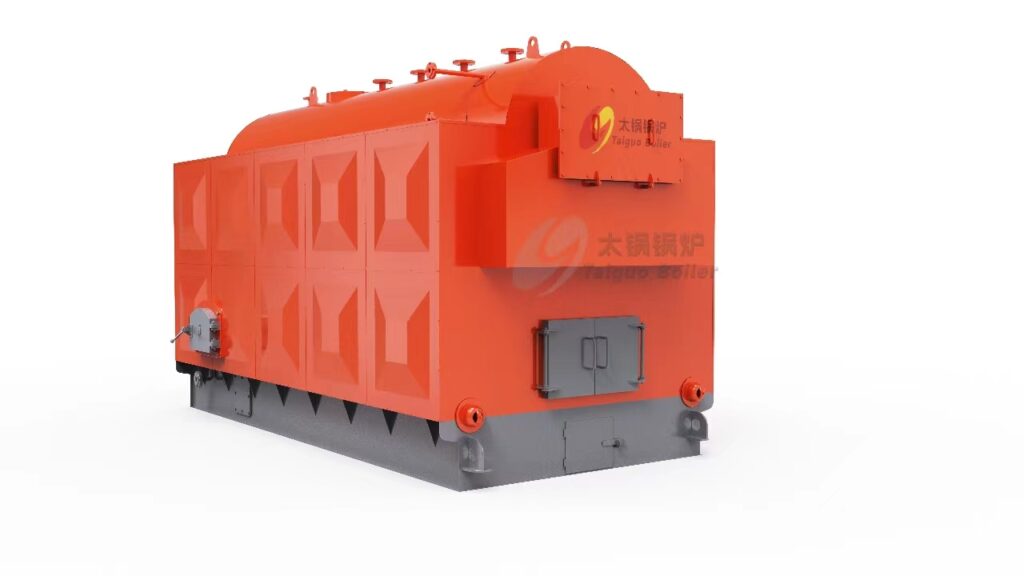
Technical Specifications
Industrial manufacturing across Uzbekistan continues to expand rapidly. Today, factory owners in Tashkent, Samarkand, Fergana, and Navoiy must carefully evaluate their primary thermal energy systems. Both natural gas and solid biomass fuels provide reliable steam generation for industrial operations.
However, there is no single “winner” for every plant. Selecting the right boiler depends on your local fuel supply, required steam demand, physical space, and capital budget.
This Gas boiler vs biomass boiler in Uzbekistan delivers an objective, practical engineering comparison. It helps procurement managers and plant engineers evaluate gas and biomass boilers based on actual operational requirements in Uzbekistan.
1. Gas vs Biomass Boilers in Uzbekistan: Quick Comparison
Before reviewing technical details, evaluate the key operational differences between both boiler systems. The table below outlines critical factors from fuel infrastructure to daily maintenance.
| Decision Factor | Industrial Gas Boiler | Industrial Biomass Boiler |
|---|---|---|
| Fuel Type | Natural gas, LPG, or light diesel | Rice husk, cotton stalks, wood chips, sawdust, or biomass pellets |
| Initial Investment (CAPEX) | Lower Reduced equipment and civil installation costs | Higher Requires automated feeding and multi-cyclone filtration systems |
| Fuel Logistics & Storage | Direct pipeline supply; requires no on-site fuel yard | Demands dedicated dry warehousing and mechanical fuel conveyors |
| Ash Handling | Virtually zero ash residue; clean exhaust discharge | Requires bottom ash slag extractors and bag-filter dust collectors |
| Boiler Room Footprint | Compact skid layout; minimal civil space footprint | Substantial area needed for fuel bunkers, feeder runs, and scrubbers |
| Automation Level | Fully automatic PLC burner modulation and safety interlocks | Automated chain grate drive with scheduled auxiliary checks |
| Maintenance Scope | Streamlined; periodic burner calibration and water softening | Regular servicing for grate bars, draft fans, and soot blowers |
| Operating Cost (OPEX) | Tied to regional natural gas tariffs and pipeline connection fees | Substantially lower if sourcing agro-industrial waste within 50 km |
| Steam Load Profile | Rapid startup; responds quickly to fluctuating peak demands | Thermal inertia favored for steady, continuous base-load operations |
| Best Suited For | Urban industrial parks, clean air zones, and compact plants | Agro-processing, paper, textile, and chemical plants near bio-waste |
2. Gas Boilers in Uzbekistan
Gas-fired boilers remain widely used in established industrial clusters throughout Uzbekistan. Where pipeline infrastructure delivers consistent pressure, gas systems offer clear mechanical advantages.
Advantages of Gas Boilers
- Simple Daily Operation: Modern gas steam boilers run with high levels of automated control. The system modulates fuel and air flow automatically without manual fuel handling.
- Rapid Thermal Response: Gas burners ignite instantly and adjust output quickly to match fluctuating steam demands on the production line.
- Compact Installation Footprint: Because natural gas travels through pipelines, the boiler room requires no fuel stockpiling area or dedicated unloading yards.
- Zero Ash Generation: Complete combustion leaves no solid ash behind. This removes the need for ash pits, dust extractors, or solid waste disposal logistics.
- Clean Boiler Room Environment: The absence of solid particulate fuel simplifies sanitary compliance in food and pharmaceutical production areas.
Limitations of Gas Boilers
- Infrastructure Dependency: The boiler relies entirely on steady pipeline connections. Remote industrial zones without municipal gas access cannot deploy these units easily.
- Exposure to Tariff Adjustments: Natural gas pricing and industrial quota allocations vary across regions and seasons. These factors directly affect long-term operational budgets.
- Burner and Pressure Requirements: Industrial burners require stable gas incoming pressure. If grid pressure drops during peak winter heating periods, the factory may require booster compressors or dual-fuel burner setups.
3. Biomass Boilers in Uzbekistan
Uzbekistan’s strong agricultural and textile processing industries generate substantial volumes of combustible organic residues. Biomass boilers allow factories to convert these solid materials into cost-effective process steam.
Advantages of Biomass Boilers
- Access to Local Agro-Residues: Many agricultural regions produce abundant crop residues. Utilizing local biomass creates a predictable, localized fuel supply chain.
- Lower Operating Costs: When agricultural or timber residues are available nearby, biomass fuel often delivers significantly lower steam production costs per ton.
- Reduced Pipeline Dependency: Plants operating biomass units remain independent from municipal gas line constraints and winter pressure variations.
- Stable Base-Load Performance: Modern reciprocating grates and chain grate stokers burn solid fuels steadily. This suits factories running 24-hour continuous production schedules.
Limitations of Biomass Boilers
- Substantial Fuel Storage Requirements: Solid biomass has a lower bulk energy density than fossil fuels. Therefore, factories must allocate significant dry storage space to prevent fuel degradation.
- Mechanical Fuel Preparation and Conveying: Biomass requires sorting, crushing, screening, and conveying equipment to maintain reliable boiler feeding without clogs.
- Ash Removal Systems: Burning agricultural materials generates bottom ash and fly ash. Plant managers must install mechanical de-ashing extractors and manage final ash disposal.
- Flue Gas Filtration: Biomass systems require multi-cyclone dust collectors and fabric baghouses to control particulate emissions effectively.
- Higher Preventive Maintenance: Moving grates, conveyor chains, gearboxes, and draft fans require routine inspection and grease management.
4. What Biomass Fuels Are Available in Uzbekistan?
Uzbekistan’s regional processing industries supply several viable biomass fuels. However, boiler design must match the physical characteristics of your primary fuel source.
Rice Husk
Rice processing clusters produce vast quantities of clean, uniform husks. Rice husk features good flowability and consistent combustion characteristics. Because of its silica content, engineers must select durable refractory linings and wear-resistant grates to handle abrasive ash.
Cotton Residues (Stalks and Ginning Waste)
Cotton represents one of Uzbekistan’s major crops. Crushed cotton stalks and ginning residues generate strong thermal energy. Because raw cotton waste often contains residual alkalis and soil dust, fuel preparation must include proper sizing, screening, and balanced combustion control to prevent slagging on boiler tubes.
Wood Chips and Sawdust
Woodworking, furniture, and timber processing facilities generate uniform wood chips and sawdust. Clean wood waste delivers high calorific value with low ash content. However, moisture content varies across seasons, requiring controlled air preheating during combustion.
Biomass Pellets
Standardized agricultural or wood pellets provide high energy density, uniform moisture levels, and straightforward automatic conveying. While pellets cost more per ton than raw agro-waste, they reduce fuel storage footprint and simplify grate operation.
Engineering Note: Before selecting a biomass boiler, always evaluate fuel availability, moisture content, calorific value, seasonal supply swings, and local transport expenses. A reliable 50–100 km supply radius ensures the best financial performance.
5. Which Boiler Is More Suitable for Different Factories?
Industrial boiler selection depends heavily on your factory’s manufacturing process, steam load stability, and immediate supply chain.
Textile and Cotton Processing Mills
Textile factories require large volumes of continuous steam for dyeing, sizing, and finishing processes.
- If your plant operates in cotton-growing regions with steady access to low-cost cotton residues, a biomass boiler provides substantial operating savings.
- If your facility operates inside an urban textile cluster without fuel storage acreage, a gas steam boiler represents the practical choice.
Food and Beverage Processing Plants
Food manufacturers require stringent hygiene standards, precise temperature control, and automated clean steam output.
- A gas steam boiler is often preferred for food plants due to its clean combustion, compact layout, and absence of airborne ash particulates.
- However, food processing facilities with direct on-site agricultural residues (such as grain processing or oil extraction mills) can deploy biomass boilers effectively when the boiler house remains isolated from clean packaging lines.
Rice Mills
Rice processing plants offer the ideal operating scenario for biomass boilers. Mills produce their own fuel (rice husk) directly on-site. This eliminates fuel transport expenses and solves organic residue disposal simultaneously, delivering superior payback.
Light Manufacturing and Assembly Plants
Small-to-medium manufacturing workshops often have limited factory yard space, intermittent single-shift schedules, and small operating crews.
- In these cases, a gas steam boiler is typically far more practical. It avoids capital-heavy fuel handling systems and starts up quickly when production shifts begin.
6. Gas vs Biomass: Capital Expenditure (CAPEX) and Operating Expenditure (OPEX)
A complete financial comparison must look beyond the initial purchase price of the bare boiler vessel. Total plant economics include auxiliary machinery, civil infrastructure, and ongoing logistics.
Capital Expenditure (CAPEX) Comparison
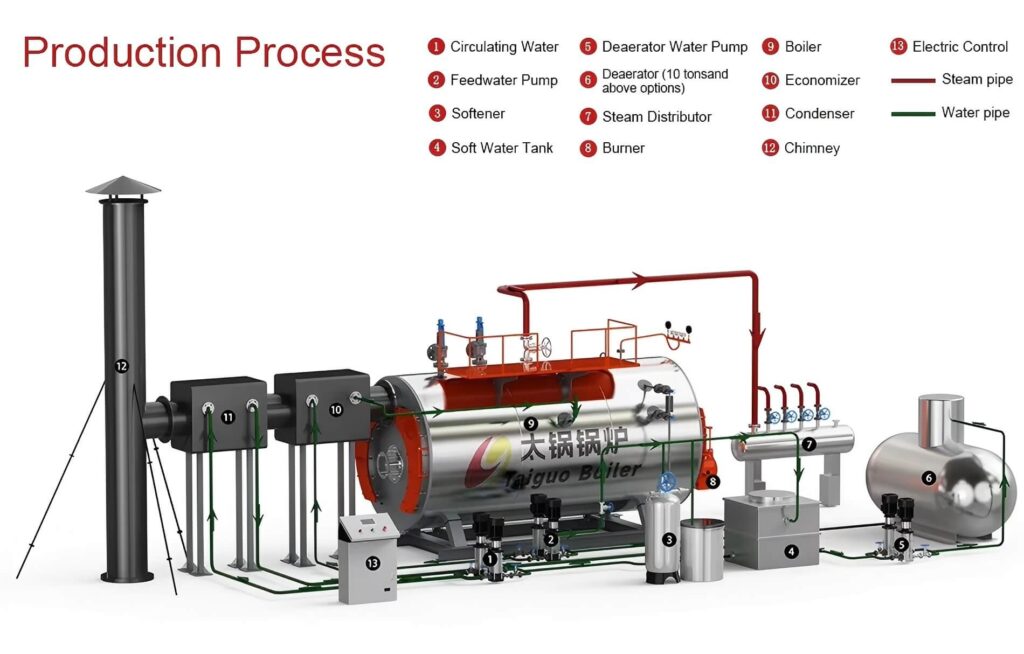
A complete industrial gas boiler setup involves fewer physical components:
- Boiler pressure vessel and base frame
- Fully modulating gas burner and safety valve train
- Water treatment system and feed pumps
- Flue gas chimney and economizer
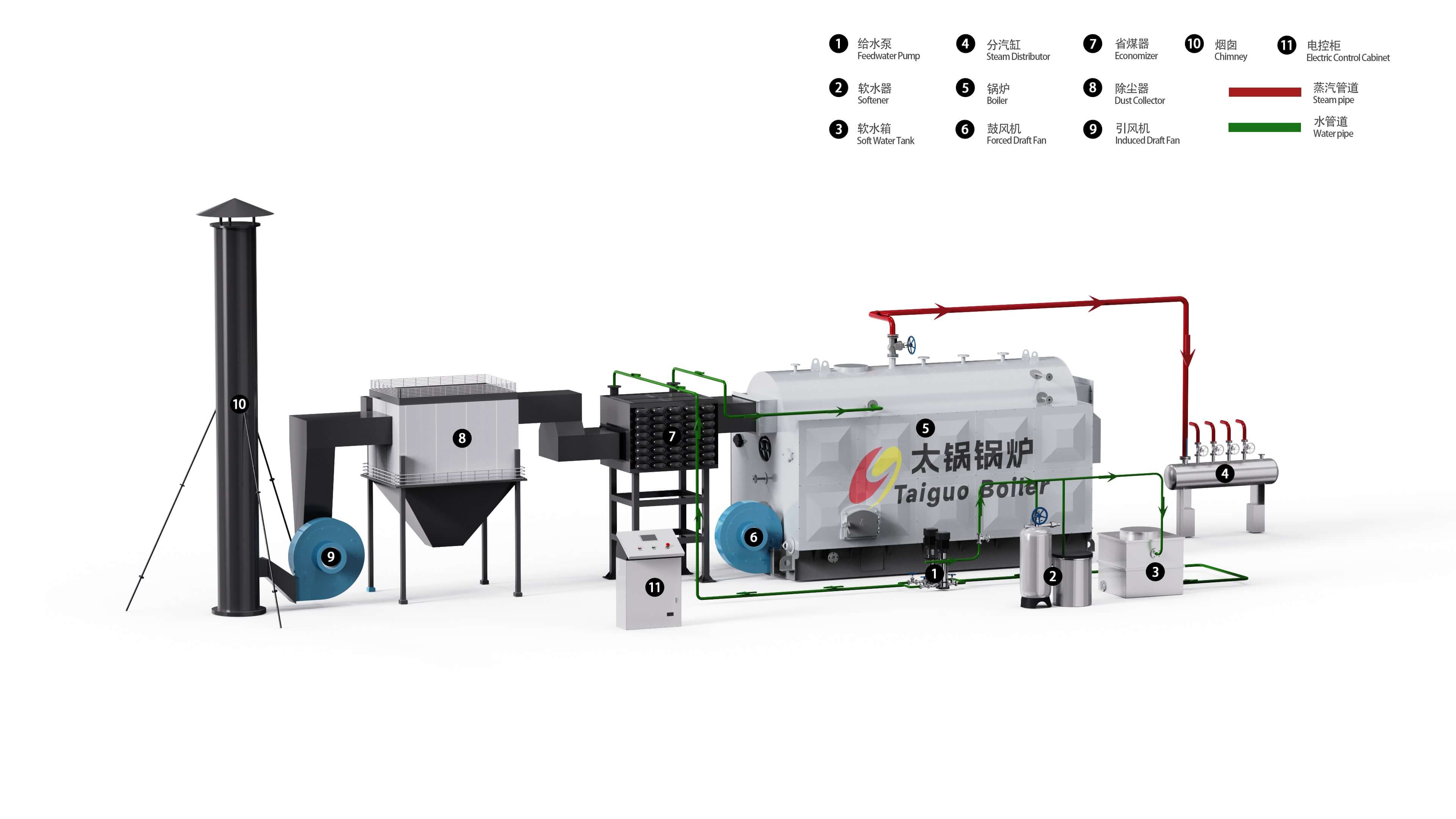
In contrast, an industrial biomass boiler plant requires extensive auxiliary infrastructure:
- Heavy-duty boiler pressure vessel and customized furnace grate
- Enclosed fuel warehouse, hoppers, and mechanical conveyor belts
- Combustion air preheaters and multi-cyclone collectors
- Fabric filter baghouse systems for particulate removal
- Mechanical ash extractors and wet ash collection pits
Consequently, the total installed CAPEX for a biomass boiler system is substantially higher than an equivalent gas-fired system. Buyers must account for these balance-of-plant costs early in the planning phase.
Operating Expenditure (OPEX) Calculation
Fuel cost represents the largest share of any industrial boiler’s lifetime expense. Calculate your annual fuel budget using this standard formula:
Annual Fuel Cost = Annual Steam Output × Specific Fuel Consumption per Ton × Delivered Fuel Price
To conduct an accurate financial comparison for your plant in Uzbekistan:
Gas System OPEX = Annual Gas Consumption × Delivered Regional Gas Tariff
Biomass System OPEX = Annual Biomass Consumption × (Raw Fuel Price + Freight + Storage/Handling) + Ash Handling Cost + Auxiliary Power
While biomass systems incur auxiliary electricity and maintenance costs, low-cost local agro-residues often offset these factors when running continuous steam schedules.
7. Gas Boiler vs Biomass Boiler: Which One Should You Choose?
Use this decision matrix to determine the most practical thermal utility for your manufacturing plant:
Choose a Gas Boiler When:
- Your factory connects to a reliable, stable municipal natural gas pipeline.
- Factory plot boundaries are constrained, leaving no space for a raw fuel storage yard.
- You need to minimize boiler room operational staff and avoid ash disposal logistics.
- Your production process requires frequent start-stops and immediate steam pressure adjustments.
- Cleanliness standards inside the plant require zero external solid particulate handling.
Consider a Biomass Boiler When:
- Your manufacturing facility operates near reliable, low-cost agricultural or timber residues.
- Your factory maintains a steady, continuous 24-hour steam load profile.
- You possess adequate open yard or warehouse space for seasonal fuel stockpiling.
- The factory management team can handle mechanical fuel handling, conveyor maintenance, and ash logistics.
- Long-term operational savings outweigh the higher initial balance-of-plant equipment expenditure.
Consider a Hybrid or Dual-Boiler Strategy When:
- Natural gas supplies your primary production lines, but seasonal supply adjustments occur during cold months.
- Your plant processes seasonal agricultural waste during harvest months, but switches to gas during the off-season.
- Factory expansion requires continuous steam reliability without complete dependence on a single energy carrier.
8. Five Questions to Answer Before Requesting a Boiler Quotation
Before contacting boiler manufacturers for technical specifications and project pricing in Uzbekistan, verify these core operating parameters:
- What fuels are consistently available at your factory site? Identify pipeline gas pressure or verify local biomass availability, moisture levels, and seasonal freight options.
- What steam capacity does your production line require? Determine your peak steam load and average operating demand in metric tons of steam per hour (t/h).
- What operating pressure and steam temperature are needed? Confirm whether your processes require saturated steam at 1.0–2.5 MPa or superheated steam for specific operations.
- How many hours per day will the boiler operate? Clarify whether your plant runs a single 8-hour shift, two shifts, or continuous 24/7 production across 330 days annually.
- What plot area is allocated for the boiler room? Measure available ground space for the boiler house, water softening equipment, and any necessary fuel stockpiling structures.
Confirming these five parameters ensures boiler engineers can calculate appropriate heating surfaces and provide an accurate, project-based engineering proposal.
9.Operational Risk Elimination Checklist for Uzbek Factory General Managers
Manufacturing group executive directors must analyze local supply chain and utility grid constraints before finalizing equipment procurement contracts. Utilize our technical division’s verified site feasibility checklist to select your optimal utility profile safely:
- Verify Minimum Winter Gas Grid Pressures: Confirm your local industrial zone guarantees a constant gas line supply baseline above 30 kPa during January.
- Audit Regional Biomass Logistical Radii: Confirm steady regional rice husk or cotton husk bulk cargo sourcing avenues exist within a 50-kilometer radius.
- Calculate Warehouse Spatial Real-Estate Margins: Evaluate available open-air yard footprints to accommodate bulk solid fuel storage and automated ash bins.
- Review Regional Grid Power Stability Factors: Check localized electrical supply reliability to support high-capacity baghouse pulse-jet blower arrays.
- Assess Local Technical Labor Pool Qualifications: Confirm onsite technicians possess the skills required to execute hourly solid-fuel grate stoking adjustments.
10. Frequently Asked Questions (FAQ)
Does the 2026 Carbon Credit system favor one boiler type over the other?
Yes. Under the Authoritative 2026 Carbon Emissions and Trading Mechanism, biomass boilers generate Validated carbon units because they are considered carbon-neutral. Gas boilers, while highly Efficient, do not qualify for these credits, making the biomass option a Superior financial asset for plants looking to offset their carbon footprint.
How do the new 2026 RoHS regulations affect my boiler choice?
Both systems must comply. Every Gas Boiler vs Biomass Boiler in Uzbekistan project must feature electrical components with the OZS Conformity Mark, confirming compliance with the February 2026 RoHS Technical Regulations. This is Essential for passing the initial customs clearance and GOSSAN safety audit.
Which system has a faster installation timeline in Uzbekistan?
Gas boilers generally offer a more Seamless and rapid installation due to their Compact, skid-mounted designs. Biomass systems require more Critical time for fuel storage construction and conveyor integration. However, the Superior long-term fuel savings of biomass often justify the Essential extra weeks spent on site preparation.
Why should an Uzbek textile mill prioritize a biomass boiler over a gas boiler despite the higher initial cost?
While gas boiler setups feature lower initial capital asset pricing, their long-term operating budgets rely entirely on external municipal gas grids. During heavy winter freezes, widespread residential heating demands drain pipeline pressures, forcing administrative bureaus to ration or cut factory gas flows completely. A biomass thermal system utilizes free locally available agricultural wastes like cotton stalks, granting your workshop total energy independence. Eliminating monthly gas utility procurement expenses allows manufacturing groups to achieve full initial capital procurement payback returns within 12 to 18 months.
How does a sudden winter pipeline gas pressure drop affect the operational lifespan of a standard gas boiler?
Sharp dropdowns in natural gas pressure parameters disrupt optimal fuel-to-air flame mixing ratios inside standard automated burners entirely. This fuel starvation causes erratic flame lifting actions, triggering constant automatic safety locks and sudden thermal cycling shocks across internal pressure parts. This continuous thermal expansion and contraction stress cracks tube sheet welding seams, causing expensive water leaks and shortening asset lifespans. Sourcing our specialized [gas boiler vs biomass boiler uzbekistan] configurations featuring low-pressure gas modulating systems safeguards your plant equipment from experiencing these infrastructure failure risks.
Can a factory combine both technologies into a single workshop layout to secure absolute thermal utility redundancy?
Yes, many premium Uzbek manufacturing groups deploy a strategic hybrid utility framework to achieve absolute factory operational protection seamlessly. Operators run our highly efficient biomass boilers as their primary base-load thermal powerhouses to exploit free agricultural husk fuel cost savings daily. Concurrently, they install a compact WNS packaged gas boiler alongside the steam header to act as an instant automatic hot standby asset. If solid-fuel maintenance cycles occur, the gas unit ignites instantly to maintain uninterrupted factory processing steam lines.
What certified documentation does Taiguo deliver to clear strict Uzbek environmental code audits for biomass plants?
The Uzbek Ministry of Ecology enforces exceptionally strict particulate matter emission laws on solid-fuel processing facilities operating near urban hubs. Taiguo eliminates legal compliance risks by supplying full international CE/ASME manufacturing certifications alongside fully documented factory filtration equipment blueprints. We bundle our heavy biomass boiler packages with custom-designed pulse-jet baghouse collectors engineered to drop dust levels below 30mg/Nm³. This complete technical validation dossier guarantees immediate administrative operational permit approvals from local environmental inspectors smoothly.
Is biomass cheaper to run than natural gas for industrial boilers in Uzbekistan?
It depends entirely on your fuel supply logistics. If your factory generates its own combustible agro-waste or sits near affordable rice husk or cotton residues, biomass fuel costs are typically lower. However, if you must transport low-density biomass over long distances, freight expenses, storage costs, and ash disposal can diminish those fuel savings.
Which biomass fuels are most practical across Uzbekistan?
Rice husks, cotton ginning residues, crushed cotton stalks, and wood chips represent the most viable solid fuels. Factories also deploy standardized biomass pellets when they require automated fuel feeding without installing large screening and crushing systems.
Can a textile factory operate effectively with a biomass boiler?
Yes. Textile mills with steady dyeing and finishing schedules provide the continuous, stable steam loads that biomass boilers handle best. If the mill has access to regional cotton processing residues, biomass provides an economical thermal energy strategy.
Which boiler is simpler to maintain and operate?
Gas boilers are mechanically simpler. They require no solid fuel conveyors, mechanical grates, soot blowers, or ash extractors. Daily management focuses primarily on automated burner modulation, water blowdown, and water chemistry testing.
Can our factory install both gas and biomass boilers together?
Yes. Many industrial plants install a primary biomass boiler to handle standard base-load steam requirements at low operational cost, while keeping a compact gas boiler on standby for rapid peak balancing or maintenance backup.
What technical information must we provide to get an accurate quotation?
You should specify your required steam capacity (t/h), design pressure (MPa), operating steam temperature, available fuel characteristics (gas pressure or biomass fuel type/moisture), and daily operating schedule.
Optimize Your Processing Lifelines with Taiguo Thermal Expertise
Are you ready to insulate your factory from volatile winter gas grid shortages and slash your processing utility costs permanently? Contact premium Central Asian thermal equipment author CN MIRACLE &Taiguo today to secure customized facility blueprints and highly competitive factory-direct equipment estimates rapidly.
Compare Our Full Line of Gas-Fired & High-Efficiency Biomass Steam Boilers
Verify international pressure vessel certificate guidelines within our central industrial boiler selection guide.
Assess local agricultural solid fuel logistics inside is biomass boiler suitable for uzbekistan factories.
Explore flexible dual-firing thermal parameters within gas biomass hybrid boiler system for uzbekistan.