
How to Choose a Biomass Boiler for Industrial Applications
Choosing an industrial biomass boiler starts with your fuel and process requirements. It does not start with a catalog model. Many plant managers choose a boiler based only on steam output. Consequently, they face severe fuel-feeding blockages, clinkering, and low thermal efficiency later. Industrial Biomass Boiler systems demand custom engineering. Biomass fuels vary significantly across […]
Get Instant Quote
Technical Specifications
Choosing an industrial biomass boiler starts with your fuel and process requirements. It does not start with a catalog model. Many plant managers choose a boiler based only on steam output. Consequently, they face severe fuel-feeding blockages, clinkering, and low thermal efficiency later.
Industrial Biomass Boiler systems demand custom engineering. Biomass fuels vary significantly across regions. Wood chips carry high moisture. Rice husks contain heavy abrasive ash. Palm residues generate intense localized heat.
If you want to know how to choose a Industrial Biomass Boiler that delivers stable steam, evaluate these ten critical factors:
- Biomass fuel type and availability
- Fuel moisture, calorific value, and ash chemistry
- Steam capacity and plant load profiles
- Operating steam pressure and temperature
- Combustion technology (Grate vs. Fluidized Bed)
- Complete auxiliary equipment integration
- Thermal efficiency and heat recovery
- Local environmental emission standards
- Fuel storage, conveying, and ash handling
- Total Lifecycle Cost (TCO) vs. Initial CAPEX
This comprehensive buyer’s guide explains the complete engineering workflow. Follow these steps to select a reliable, high-efficiency Industrial Biomass Boiler system for your factory.
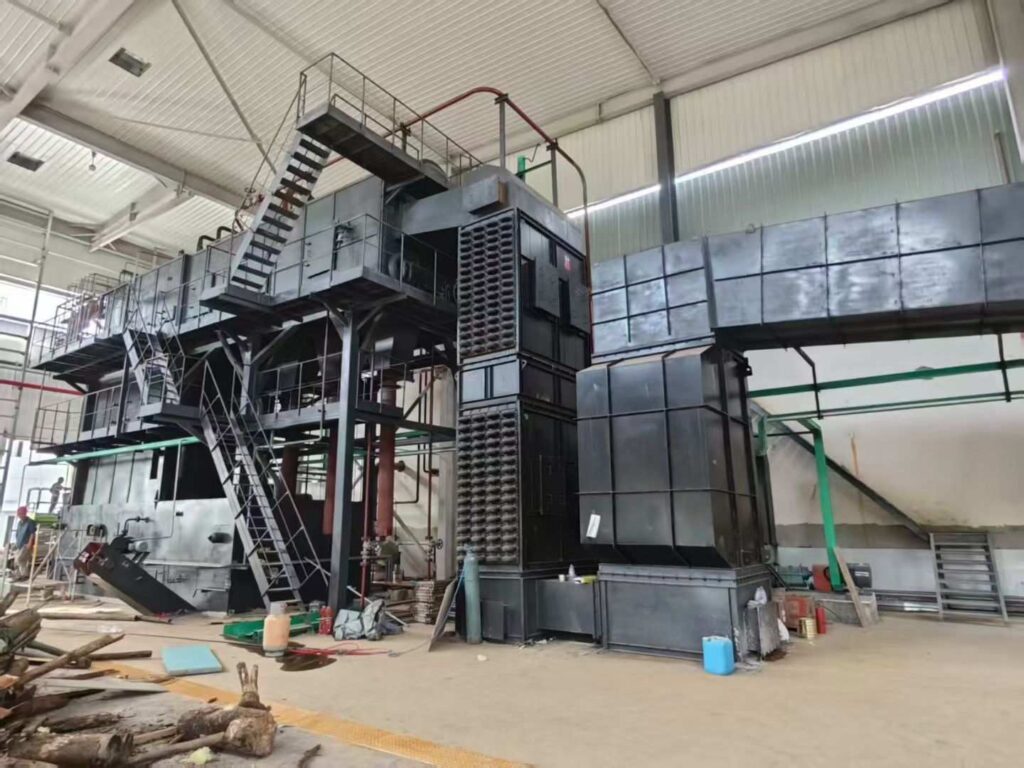
What Is an Industrial Biomass Boiler?
An industrial biomass boiler burns renewable solid organic materials. It converts chemical energy into process steam, hot water, or thermal energy. Factories use this energy for manufacturing, heating, and power generation.
Industrial facilities commonly burn these biomass solid fuels:
- Wood chips, sawdust, and bark
- Processed wood pellets
- Rice husks and paddy waste
- Palm kernel shells (PKS) and empty fruit bunches (EFB)
- Sugarcane bagasse
- Corn cobs and stalk residues
- Mixed agro-forestry waste
The most critical engineering rule is simple: different biomass fuels demand completely different boiler designs. A boiler optimized for wood pellets will immediately clog if fed wet wood chips. Therefore, evaluate your fuel characteristics before looking at boiler specifications.
1. Start With Your Biomass Fuel Properties
The fuel must always dictate the boiler design. Never purchase a standard boiler and force your fuel into it. Each fuel type introduces distinct combustion challenges.
Wood Chips
Wood chips represent the most common fuel in timber and paper processing regions. However, freshly cut wood chips carry moisture levels between 40% and 55%. They also have irregular particle sizes. Your boiler needs a heavy-duty hydraulic feeding ram and a moving reciprocating grate. This design dries the wood chips thoroughly before ignition.
Rice Husk
Rice husks feature a very low bulk density and high silica ash content (often 15% to 20%). The high silica causes rapid mechanical abrasion inside fuel feeders. Furthermore, low bulk density requires specialized pneumatic feeding or screw feeders with variable speed drives. The furnace volume must remain large to prevent premature fly ash carryover.
Palm Kernel Shell (PKS) and Palm Residues
Palm kernel shells offer high calorific value and low moisture. They serve as an ideal industrial fuel across Southeast Asia, especially in Indonesia, Malaysia, and the Philippines. However, palm waste often contains high alkali metals (potassium and sodium). These metals cause severe slagging on furnace walls and superheater tubes. Boilers burning palm waste require targeted soot-blowing systems and wide tube spacing.
Sugarcane Bagasse
Sugar mills produce vast volumes of bagasse during crushing seasons. Fresh bagasse typically contains 50% moisture. Specialized bagasse boilers utilize suspension burning combined with a travelling grate. Hot secondary air drying is essential to maintain stable furnace ignition.
Wood Pellets
Wood pellets feature uniform particle size, low moisture (under 10%), and predictable combustion. They enable automated pneumatic feeding and compact furnace designs. Nevertheless, pellet fuel costs remain substantially higher than raw agricultural waste. You must verify local pellet supply contracts before investing in pellet-fired infrastructure.
2. Check Fuel Moisture, Calorific Value, and Ash Content
Raw fuel lab reports provide the essential baseline for boiler engineering. When selecting an industrial biomass boiler, request an ultimate and proximate fuel analysis.
| Fuel Parameter | Why It Matters | Engineering Impact on Boiler Design |
|---|---|---|
| Moisture Content | Directly dictates combustion efficiency and ignition stability. | High moisture requires extended preheating grates, refractory arches, and preheated air. |
| Calorific Value (LHV) | Determines the hourly fuel consumption rate. | Low heating value requires larger grates, wider conveyors, and bigger fuel bunkers. |
| Ash Content | Determines soot accumulation and cleaning frequency. | High ash requires continuous mechanical ash extractors and larger dust collectors. |
| Particle Size Distribution | Affects fuel feeding fluidity and grate retention time. | Irregular chunks require pre-crushing screens, rotary valves, or hydraulic pushers. |
| Bulk Density | Controls fuel storage volume and conveying sizing. | Light fuels demand wider belt conveyors and large-diameter screw augers. |
| Ash Fusion Temperature | Predicts slagging, clinkering, and fouling risks. | Low melting temperatures require membrane water-cooled walls and lower furnace exit temperatures. |
| Seasonal Variation | Influences fuel quality throughout rainy and harvest seasons. | Requires wider operational margins in air preheaters and draught fan capacity. |
Fuel moisture directly penalizes system performance. According to research on biomass combustion efficiency, evaporating fuel moisture consumes usable combustion heat. Every 10% increase in fuel moisture noticeably lowers furnace temperatures.
However, do not assume your fuel must stay below 20% moisture. High-performance industrial biomass boilers can combust 50% moisture biomass reliably. The secret lies in designing the boiler around your actual “as-fired” fuel condition.
3. Calculate the Required Boiler Capacity
Selecting Industrial Biomass Boiler capacity requires more than matching your factory’s average steam consumption. If your factory consumes 6 tons of steam per hour on average, do not automatically buy a 6 t/h boiler.
Industrial production creates dynamic steam spikes. You must evaluate several operational layers:
- Average Steam Demand: Continuous steam load during normal operations.
- Peak Steam Demand: Sudden steam draw caused by batch cookers, presses, or reactor startups.
- Startup Margins: Additional steam capacity needed to warm cold factory piping.
- Future Production Lines: Anticipated production growth over the next 3 to 5 years.
- Turn-Down Capability: The boiler’s ability to maintain efficiency when steam demand drops during night shifts.
For detailed capacity calculations across various industrial models, review our guide on How to Choose the Right Steam Boiler Capacity.
Solid biomass fuel responds slower to load swings than diesel or natural gas. While a gas burner adjusts instantly, a biomass fuel bed requires several minutes to ramp combustion up or down. If your steam demand fluctuates wildly, size your biomass boiler with an engineered buffer. Alternatively, incorporate an industrial steam accumulator to absorb transient spikes.
4. Determine the Required Operating Steam Pressure
Never select your boiler pressure rating based on catalog defaults. Always calculate backwards from your highest-pressure production machine.
| Industrial Application | Typical Steam Process | Standard Operating Pressure Range |
|---|---|---|
| Food & Beverage | Sterilization, drying, brewing, cooking | 6 to 10 bar (0.6 to 1.0 MPa) |
| Textile Mills | Dyeing, finishing, yarn setting | 8 to 13 bar (0.8 to 1.3 MPa) |
| Plywood & MDF Plants | Veneer drying, hot platen pressing | 13 to 20 bar (1.3 to 2.0 MPa) |
| Chemical Processing | Reactor jacket heating, distillation | 10 to 16 bar (1.0 to 1.6 MPa) |
| Paper Mills | Corrugating rolls, cylinder drying | 10 to 16 bar (1.0 to 1.6 MPa) |
| Rubber Manufacturing | Vulcanization autoclaves, molding | 10 to 14 bar (1.0 to 1.4 MPa) |
| Palm Oil Mills | Sterilization cages, thresher heating | 3 to 7 bar (0.3 to 0.7 MPa) |
Calculate pipe friction losses between the boiler room and the point of use. Add a 10% to 15% safety margin. If your autoclave requires saturated steam at 8 bar, install a boiler rated for at least 10 bar. Operating at slightly higher pressure also allows you to distribute steam through smaller pipe diameters. You can then reduce pressure at local production stations using pressure reducing valves (PRVs).
5. Choose the Right Biomass Combustion Technology
Selecting the correct combustion grate is the most critical mechanical decision in this process. Industrial biomass boilers generally rely on two primary technologies.
Chain Grate / Reciprocating Moving Grate Boilers
Moving grates represent the most reliable and field-proven option for small-to-medium industrial plants (1 t/h to 35 t/h).
- How It Works: The fuel enters through a hopper. The reciprocating or travelling grate moves the fuel forward through distinct zones: preheating, drying, combustion, and burn-out.
- Fuel Suitability: Exceptional versatility. Grates burn wood chips, agricultural husks, shredded briquettes, and mixed residues.
- Primary Advantages: Low electricity consumption, moderate initial CAPEX, straightforward maintenance, and tolerant of variable fuel particle sizes.
Circulating Fluidized Bed (CFB) Boilers
CFB boilers target larger industrial facilities and captive cogeneration plants (typically 35 t/h to 100+ t/h).
- How It Works: Air suspends hot inert bed material (silica sand) in a turbulent fluid state. Injected biomass fuel combusts rapidly inside this high-temperature thermal mass.
- Fuel Suitability: Extremely high-ash fuels, high-moisture agricultural waste, and low-calorific sludges.
- Primary Advantages: High combustion efficiency (above 88%) and outstanding fuel flexibility. However, CFB systems demand higher initial investment and sophisticated operational expertise.
Biomass Gasification Systems
Biomass gasifiers convert solid fuel into combustible syngas before combustion. Gasifiers provide clean flame characteristics and lower direct particulate emissions. However, tar deposition and fuel-feed restrictions require specialized operational supervision. Grate boilers remain the primary workhorse for standard industrial steam plants.
6. Consider the Complete Industrial Biomass Boiler System
A high-performance boiler plant extends far beyond the pressure vessel. Many low-cost bids exclude necessary auxiliaries, leading to severe project delays later.
A complete industrial biomass steam boiler installation requires an integrated process flow:
Critical Auxiliary Modules:
- Fuel Feeding Line: Enclosed belt or scraper conveyors reduce airborne dust. Rotary airlocks prevent dangerous backfiring into the fuel silo.
- Water Softening & Deaeration: Biomass boilers generate intense localized heat flux. Hard water deposits rapidly cause tube blistering. Always install automated dual-tank water softeners and thermal deaerators.
- Automatic Soot Blowers: Ash from agricultural waste sticks stubbornly to convective tubes. Integrated steam or acoustic soot blowers prevent thermal performance degradation during production runs.
7. Evaluate Industrial Biomass Boiler Efficiency and Heat Recovery
Biomass thermal efficiency typically ranges from 78% to 86%. Actual efficiency depends heavily on fuel moisture, excess air ratios, and flue gas exit temperatures.
To lower your factory’s fuel bill, install dedicated waste heat recovery:
Flue Gas Economizer
Flue gas leaving the main boiler bank often exceeds 220°C. An economizer captures this residual heat to preheat incoming boiler feedwater. Every 20°C drop in flue gas temperature increases overall boiler efficiency by roughly 1%. Preheated feedwater also minimizes thermal shock inside the boiler drum.
Combustion Air Preheater
If you combust high-moisture fuels (like wet wood chips or bagasse), an air preheater is essential. Diverting hot flue gas to preheat incoming under-grate combustion air accelerates fuel drying. This stabilizes combustion and elevates peak furnace temperatures.
To compare long-term operational fuel expenditures against other energy sources, read our detailed analysis on Steam Boiler Fuel Cost: Gas vs. Biomass vs. Electric.
8. Check Environmental Emission Regulations
Environmental agencies worldwide continue to tighten industrial air quality standards. Solid biomass combustion produces particulate matter (PM), nitrogen oxides (NOx), and sulfur dioxide (SO2).
Emission limits differ substantially between rural agro-industrial hubs and densely populated manufacturing parks:
| Air Pollution Control Device | Typical Dust Removal Efficiency | Best Application Scenario |
|---|---|---|
| Cyclone Separator | 70% – 85% | Captures large spark embers and coarse fly ash; protects downstream filters. |
| Multi-Cyclone Collector | 85% – 92% | Standard primary dust collector for rural installations burning wood chips. |
| Pulse-Jet Baghouse Filter | 99% – 99.5% | Complies with strict environmental limits (dust emissions < 20–30 mg/m³). |
| Wet Scrubber | 90% – 95% | Eliminates sparks and captures soluble acid gases; produces wet slurry waste. |
| Electrostatic Precipitator (ESP) | 99%+ | Ideal for large-scale boilers running continuous 24/7 baseloads with low pressure drop. |
Never purchase a biomass boiler without confirming local emission thresholds. Modern urban factories often require a multi-cyclone followed by a pulse-jet baghouse filter to guarantee clean chimney exhaust.
9. Design Proper Fuel Storage, Feeding, and Ash Handling
Fuel logistics can make or break an industrial biomass project. Unlike natural gas delivered via an invisible underground pipe, biomass requires extensive physical handling space.
Fuel Storage Sizing
Calculate fuel storage requirements based on your supply chain security:
If heavy rains disrupt regional transport, maintain at least 7 to 15 days of fuel reserves on site. Ensure your fuel warehouse incorporates concrete push walls, drainage channels, and automated overhead dust suppression.
Mechanical Ash Disposal
Biomass combustion produces two distinct ash streams:
- Bottom Ash: Heavy clinker and slag dropped off the end of the grate. Heavy-duty water-sealed scraper extractors cool and convey bottom ash safely without creating dust.
- Fly Ash: Fine particulate captured inside economizer hoppers and dust collectors. Enclosed screw conveyors route fly ash into collection bags or sealed silos.
High-ash agricultural fuels (like rice husk) require continuous mechanical ash removal. Manual ash raking causes excessive air leakage, drops boiler efficiency, and disrupts steady steam pressure.
10. Calculate Total Lifecycle Cost (TCO), Not Just the Boiler Price
Many buyers make the mistake of choosing the lowest initial quotation. However, the purchase price of the boiler vessel represents only a small fraction of the total project lifecycle cost.
Capital Expenditure (CAPEX)
- Boiler pressure vessel and combustion furnace
- Complete auxiliary packages (fans, pumps, feed systems)
- Civil foundations and boiler house construction
- Flue gas ducting, piping headers, and chimney stack
- Environmental permitting, freight, and mechanical installation
Operational Expenditure (OPEX)
- Annual fuel procurement and regional transport costs
- Parasitic electrical consumption (grates, ID fans, feed motors)
- Water treatment chemicals and blowdown heat loss
- Preventative maintenance, spare parts, and refractory patching
- Solid ash removal and disposal fees
The cheapest biomass boiler is rarely the cheapest steam solution. A high-efficiency boiler with an economizer and automated grate saves tens of thousands of dollars in fuel annually. Superior build quality quickly offsets slight initial price differences.
Industrial Biomass Boiler Selection Checklist
Before contacting boiler manufacturers for engineering proposals, gather your core technical parameters:
The more detailed your fuel and process data, the faster an engineering team can deliver an accurate, cost-effective system design.
Frequently Asked Questions For Industrial Biomass Boiler (FAQ)
What is the best biomass boiler for industrial applications?
There is no single “best” boiler. The ideal boiler depends strictly on your fuel characteristics. Moving grate boilers work best for raw wood chips, bark, and mixed agro-waste with variable moisture. For standardized pellets, compact chain grate or fixed-bed boilers offer high efficiency. For large-scale plants burning high-ash agricultural residue, circulating fluidized bed (CFB) boilers provide the highest combustion stability.
How do I choose the right biomass boiler capacity?
Do not size your boiler strictly on average hourly steam demand. Calculate your factory’s continuous average load, identify peak load spikes from batch machinery, and add safety margins for piping heat loss. If your factory consumes an average of 6 t/h but surges to 8 t/h during batch cycles, select an 8 t/h or 10 t/h system to maintain stable process pressure.
What biomass fuels can industrial boilers burn?
Industrial boilers can combust wood chips, sawdust, wood pellets, rice husks, palm kernel shells (PKS), empty fruit bunches (EFB), bagasse, coffee grounds, and agricultural straw. However, the furnace geometry, feeding mechanisms, and grate metallurgy must match the specific fuel’s moisture, ash melting point, and heating value.
How does fuel moisture affect biomass boiler efficiency?
High moisture noticeably degrades thermal efficiency. Water inside the fuel absorbs heat during combustion to vaporize into steam, exiting through the chimney as lost energy. Using fuel with 45% moisture reduces boiler efficiency compared to burning fuel with 15% moisture. High moisture also lowers furnace combustion temperatures, requiring preheated air and extended drying grates.
Are biomass boilers suitable for factories?
Yes. Biomass boilers provide stable, round-the-clock baseload steam for energy-intensive manufacturing. Food processing plants, textile mills, paper manufacturers, rubber producers, and wood processing facilities routinely use biomass boilers to eliminate volatile fossil fuel bills and meet carbon reduction goals.
How much does an industrial biomass boiler cost?
The total investment depends on capacity, working pressure, fuel handling sophistication, and air pollution control equipment. A complete 4 t/h to 10 t/h industrial biomass boiler installation ranges from $50,000 to over $250,000 depending on automated feed systems, economizers, and baghouse dust filters. The fuel savings typically yield full capital payback within 12 to 24 months.
Need Help Choosing an Industrial Biomass Boiler?
CN MIRACLE provides biomass boiler solutions for industrial steam and process heating applications. We can help evaluate your biomass fuel, steam demand, operating pressure, fuel handling requirements and emission-control needs before recommending a suitable boiler configuration.
Engineering a reliable biomass steam plant requires balancing raw fuel chemistry with precise thermal output. Standard catalog equipment rarely delivers optimal operating economy in demanding industrial environments.
Our engineering team specializes in custom industrial biomass boiler solutions for manufacturing plants worldwide. We evaluate your fuel heating value, moisture variations, load curves, and local emission standards to configure the most cost-effective boiler system.
Send our technical team your project specifications today:
- Biomass fuel type and moisture content
- Required hourly steam capacity
- Operating steam pressure and application process
We will review your operating parameters and deliver a comprehensive engineering proposal and layout design for your plant.