
Gas Steam Boiler Operating Cost in Uzbekistan: 2026 Cost & Fuel Consumption Guide
Natural gas serves as a primary energy source for industrial steam generation across Uzbekistan. However, the true economic viability of a steam system extends far beyond equipment acquisition. Factory owners, project engineers, and procurement managers must evaluate long-term operating expenditures. Gas consumption, burner efficiency, operating pressure, load profiles, feedwater temperature, and routine maintenance dictate overall […]
Get Instant Quote
Technical Specifications
Natural gas serves as a primary energy source for industrial steam generation across Uzbekistan. However, the true economic viability of a steam system extends far beyond equipment acquisition. Factory owners, project engineers, and procurement managers must evaluate long-term operating expenditures.
Gas consumption, burner efficiency, operating pressure, load profiles, feedwater temperature, and routine maintenance dictate overall lifecycle costs. Estimating your gas steam boiler operating cost in Uzbekistan before purchasing equipment protects your operational bottom line.
This technical guide details the thermodynamic and financial principles required to calculate natural gas consumption and operational expenditures for industrial steam systems in Uzbekistan. It includes engineering formulas, benchmark sizing tables, and worked financial examples for systems ranging from 1 to 20 tons per hour (TPH).
Quick Reference: Gas Boiler Operating Parameters
- Primary Fuel: Pipeline Natural Gas (predominantly Methane, CH4)
- Typical Lower Heating Value (LHV): ≈ 33,500 – 35,500 kJ/Nm3 (8,000 – 8,500 kcal/Nm3)
- Standard Efficiency Range: 90% – 94% (Standard Firetube with Economizer); up to 98%+(Condensing)
- Typical Steam Output Range: 1 TPH to 20 TPH for packaged industrial units
- Core Operating Variable: Mean Operating Load Factor (%MCR)
What Determines Gas Steam Boiler Operating Cost in Uzbekistan?
Evaluating fuel expenses requires examining the thermodynamic and mechanical variables that govern gas consumption. A boiler rarely operates at a continuous, steady-state baseline. Six variables dictate actual operational expenditure.
Key Drivers of Gas Boiler Operating Expenditures
1. Boiler Capacity
Nameplate rating denotes Maximum Continuous Rating (MCR) in metric tons of steam per hour (t/h or TPH). Larger units consume more natural gas in absolute terms, but larger pressure vessels provide higher thermal mass. Higher thermal mass dampens cyclic pressure drops and delivers improved volumetric efficiency.
2. Boiler Thermal Efficiency
Older legacy boilers without heat recovery equipment often operate between 80% and84% efficiency (Lower Heating Value basis). Modern packaged three-pass wet-back firetube systems equipped with integrated finned-tube economizers achieve 92% to 95% efficiency.
Adding condensing heat exchangers captures the latent heat of vaporization from water vapor in the flue gas, boosting total thermal efficiency above 98%. Every 1% gain in thermal efficiency cuts annual fuel expenditures by approximately 1%.
3. Natural Gas Tariffs
Natural gas tariffs across Uzbekistan vary by industrial consumer category, special economic zone status, regulatory revisions, and contracted delivery volumes. Because state utility regulators adjust baseline industrial utility rates periodically, buyers should insert their negotiated contract tariff into their cost models rather than relying on static benchmarks.
4. Steam Operating Pressure
Higher saturated steam pressure requires higher saturation temperatures and greater heat input per kilogram of steam produced:
- Operating at 7 bar(g) demands a saturation temperature of 170.5℃ (hg ≈ 2,763.5 kJ/kg).
- Operating at 10 bar(g) demands a saturation temperature of 184.1℃ (hg ≈ 2,781.7 kJ/kg).
- Operating at 16 bar(g) demands a saturation temperature of 204.3℃ (hg ≈2,796.0 kJ/kg).
Generating steam at higher pressures than your process requires wastes natural gas. Always operate at the lowest pressure consistent with process safety and distribution efficiency.
5. Boiler Operating Load Profile
An industrial facility rarely demands 100% nameplate steam output continuously. Manufacturing plants cycle through varying demand profiles:
Factoring in average operational load factor prevents overestimating fuel expenses. A 10 TPH boiler operating at an average 65% load consumes fuel equivalent to a 6.5 TPH continuous demand, not its full rated capacity.
6. Feedwater Temperature
Feedwater temperature dictates the sensible heat addition required to reach boiling point. Supplying unheated demineralized water at 20℃ requires substantially more fuel energy than feeding water through a pressurized thermal deaerator at 104℃. Increasing feedwater temperature by 6℃ through condensate return or waste heat recovery reduces fuel consumption by roughly 1%.
How Much Natural Gas Does a Steam Boiler Consume?
Natural gas consumption depends directly on the net enthalpy added to the water, boiler thermal efficiency, and the lower heating value of the fuel.
The table below outlines fuel consumption rates across standard industrial boiler ratings.
Indicative Natural Gas Consumption by Boiler Capacity
| Boiler Capacity (TPH) |
Thermal Output (MW) |
Rated Heat (Gcal/h) |
Estimated Gas Consumption* (Nm³/h) |
Typical Application in Uzbekistan |
|---|---|---|---|---|
| 1.0 TPH | 0.70 | 0.60 | 70 – 78 | Dairy, small breweries, garment processing |
| 2.0 TPH | 1.40 | 1.20 | 140 – 156 | Food processing, feed mills, commercial laundries |
| 4.0 TPH | 2.80 | 2.40 | 280 – 312 | Cotton yarn spinning, weaving, beverage bottling |
| 6.0 TPH | 4.20 | 3.60 | 420 – 468 | Textile finishing, paper mills, medium chemical plants |
| 10.0 TPH | 7.00 | 6.00 | 700 – 780 | Large textile dyeing, building materials, district heat |
| 15.0 TPH | 10.50 | 9.00 | 1,050 – 1,170 | Heavy chemical synthesis, fertilizer processing |
| 20.0 TPH | 14.00 | 12.00 | 1,400 – 1,560 | Large industrial complexes, refinery auxiliary steam |
*Note: Figures represent indicative ranges at 10 bar(g) operating pressure with 20℃ to 60℃ feedwater, an average fuel LHV of 35,000 kJ/Nm3 (8,360 kcal/Nm3), and boiler thermal efficiencies of 92% to 94%. Actual site consumption varies based on localized gas calorific value, actual combustion efficiency, excess air tuning, and operating load.
Gas Steam Boiler Fuel Consumption Calculation
To project annual operating expenses, engineering teams use fundamental thermodynamic formulas rather than rough approximations.
Plant demand: D = 6,000 kg/h saturated steam at 10 bar(g) (1.1 MPa abs). Saturated enthalpy hsteam = 2,781.7 kJ/kg. Feedwater enters atmospheric deaerator at 60°C:
Net thermal energy required to vaporize feedwater into saturated steam:
Modern wet-back industrial boiler with integrated economizer operates at 93% efficiency (η = 0.93):
Standard industrial pipeline gas in Uzbekistan (LHV ≈ 34,800 kJ/Nm³ / 8,312 kcal/Nm³):
At 100% continuous MCR, this 6.0 TPH system consumes approximately 469 Nm³ of natural gas per hour.
Example: Operating Cost of a 5 TPH Gas Steam Boiler in Uzbekistan
To illustrate the monthly and annual budgeting process, let us evaluate a typical textile manufacturing plant operating in the Tashkent or Fergana industrial region.
Plant Operational Profile
| Rated Nameplate Capacity | 5,000 kg/h (5 TPH) |
| Operating Steam Pressure | 10 bar(g) |
| Average Operational Load | 70% (3,500 kg/h average load) |
| Feedwater Temperature | 60°C |
| Operating Schedule | 16 hours/day, 26 days/month |
| Boiler Thermal Efficiency | 92.5% (with economizer) |
| Assumed Industrial Tariff* | Pgas (in UZS or USD per m³) |
Hourly Consumption Under Average Operating Load
First, calculate heat absorbed under average load conditions (3,500 kg/h):
Next, apply thermal efficiency (92.5%) and regional gas LHV (34,800 kJ/Nm³):
Monthly Operating Timeline and Gas Volume
Calculate total operational run hours per month:
Calculate total monthly gas consumption:
Financial Expense Calculation Template
Using your local utility billing structure, apply the monthly formula:
Gas Steam Boiler Operating Cost vs. Biomass Boiler
When evaluating plant utility infrastructure in Central Asia, procurement teams often compare natural gas boilers against solid biomass systems. Each fuel platform involves clear trade-offs across capital expense, operational labor, and material handling.
Natural Gas Boiler
- Fully automated modulating burners
- No fuel storage yards required on site
- Minimal ash and particulate emissions
- Lower initial capital equipment cost
- Fuel operational cost tied to utility tariffs
Biomass (Solid Fuel) Boiler
- Complex traveling/reciprocating grates & feed lines
- Requires large covered fuel silos & yards
- High ash removal & multi-cyclone/ESP needs
- Higher initial capital investment (skid + auxiliaries)
- Fuel cost tied to local residue availability
| Operating Evaluation Metric | Packaged Natural Gas Boiler | Solid Fuel / Biomass Boiler |
|---|---|---|
| Fuel Storage Infrastructure | Pipeline connection; zero storage required on site | Large dry storage yards, hoppers, conveying silos |
| Automation Level | Fully automated PLC controls, unmanned operation capability | Semi-automated fuel feeding, continuous ash handling |
| Ash & Soot Management | Near-zero solid residues; clean stack discharge | Bottom ash dumping, fly ash cyclones, baghouses |
| Footprint & Boiler House | Compact skid packages, small footprint | Large footprint for fuel stockpiles and handling |
| Maintenance Labor | Low; regular burner maintenance and water testing | Moderate to high; mechanical grate wear and soot blowing |
| Capital Expenditure (CAPEX) | Lower initial equipment and civil installation costs | Significantly higher initial equipment investment |
| Operating Expenditure Risk | Tied directly to state and market gas tariffs | Sensitive to regional agricultural residue supply |
Natural gas remains the standard choice for facilities prioritizing high operational automation, compact footprints, minimal operating crews, and low emissions. Biomass systems suit facilities with reliable access to agricultural residues like cotton stalks, rice husks, or wood waste.
For a detailed analysis of alternative fuel economics, see our comparison of steam boiler fuel costs across gas, biomass, and electric systems.
How to Reduce Gas Steam Boiler Operating Costs
Because fuel accounts for up to 85% of a boiler’s total lifecycle cost, small operational improvements can yield substantial recurring savings.
1. Install an Exhaust Gas Economizer
Exhaust gases leave an unequipped boiler at temperatures between 200℃ and 250℃. Installing a finned-tube economizer uses this waste heat to preheat incoming feedwater, dropping stack temperatures to 100℃ – 120℃. Every 20℃ drop in stack gas temperature increases overall boiler efficiency by roughly 1%.
2. Deploy a Condensing Waste Heat Exchanger
Burning natural gas produces water vapor in the exhaust stream. A secondary stainless steel condensing heat exchanger cools flue gas below its dew point (≈ 55℃), capturing latent heat. This system can raise total plant thermal efficiency above 98%.
3. Optimize Burner Excess Air via Oxygen Trim
Incomplete combustion wastes unburned hydrocarbons, while too much excess air dilutes combustion gases and carries heat out the stack. Operating with 15% to 20% excess air (3% to 4% residual oxygen (O2) in the dry flue gas) delivers clean, efficient combustion. Automated digital burner management systems with continuous O2 trim adjust damper servos to changing ambient air conditions, preventing fuel waste.
4. Maximize Condensate Return
Condensate is distilled, chemically treated water carrying high thermal energy. Returning hot condensate (80℃ – 95℃) to the boiler feed system yields three major benefits:
- Reduces the natural gas required to heat raw feedwater to saturation temperature.
- Lowers consumption of costly chemical treatment additives like oxygen scavengers and anti-scalants.
- Cuts raw municipal water makeup and industrial sewerage utility costs.
5. Control Boiler Blowdown Losses
Continuous surface blowdown removes dissolved solids (TDS) to prevent tube scaling and foaming. Uncontrolled, continuous manual blowdown drains hot pressurized water straight to the sewer. Installing automated conductivity-controlled blowdown valves limits water discharge to the exact amount needed to maintain target TDS levels. Adding a blowdown flash vessel and heat exchanger recovers residual heat to preheat makeup water.
6. Insulate Valves, Flanges, and Steam Lines
Uninsulated steam valves, strainers, and bare pipe flanges act as natural radiators. A single uninsulated 100 mm (4”) gate valve carrying 10 bar(g) steam radiates thermal energy equivalent to burning several hundred cubic meters of natural gas each year. Use removable thermal insulation jackets on all distribution fittings.
7. Match Operating Units to Plant Load
Operating a large boiler below 30%$capacity causes frequent burner cycling, increases pre-purge sensible heat ventilation losses, and degrades seasonal efficiency. If your plant experiences broad seasonal or production swings, install two smaller boilers (such as two 5 TPH units instead of a single 10 TPH vessel). Staging boilers lets you run individual units within their peak efficiency bands (70% – 90% load).
Gas Boiler Operating Cost by Boiler Size
Annual operational expenditures correlate directly with equipment sizing, operating hours, and plant schedules.
Operational Cost Sizing Guide
| Sizing Bracket | Common Industry Sectors | Daily Run Profile | Annual Operating Focus |
|---|---|---|---|
| 1 – 2 TPH | Small food manufacturing, milk pasteurization, commercial bakeries | 8 – 12 Hours / Single Shift | Quick morning startups, compact packaged footprint, low idle losses |
| 4 – 6 TPH | Textile printing, knitting mills, fruit juice canning, animal feeds | 16 – 24 Hours / Two Shifts | High-performance modulating burners, economizer heat recovery |
| 10 TPH | Large-scale garment processing, chemical synthesis, paper packaging | Continuous 24/7 Processing | Continuous O2 trim, high-rate condensate recovery, blowdown heat exchangers |
| 20 TPH | Large industrial clusters, building materials, district energy | Base-Load Continuous | Fully integrated plant controls, condensing economizers, dual-fuel capability |
Is a Gas Steam Boiler Suitable for Uzbekistan?
Natural gas boilers are an established, cost-effective solution across Uzbekistan’s primary industrial corridors, including Tashkent, Samarkand, Navoi, Bukhara, Andijan, and the Fergana Valley.
A gas steam boiler is typically the right choice if your facility:
- Operates within an industrial zone connected to steady high- or medium-pressure gas distribution mains.
- Requires clean steam processing for food, dairy, pharmaceuticals, or high-grade textile dyeing.
- Has limited physical plant space for large solid-fuel yards, conveyors, and ash silos.
- Wants to avoid dedicating labor to solid fuel handling and ash disposal.
- Requires fast startup and rapid load-following for fluctuating production lines.
However, if your facility operates in a remote area without pipeline infrastructure, or produces abundant agricultural by-products, compare gas systems with biomass boilers or dual-fuel (gas/diesel) units to hedge against supply risks.
How to Choose a Gas Steam Boiler for an Uzbekistan Factory
Selecting a reliable boiler system requires evaluating total cost of ownership (TCO), not just the equipment purchase price. Use this systematic process to design and specify your system.
- Calculate True Steam Consumption: Sum both continuous base loads and cyclic peak demands. Size the boiler so your normal operating point lands at 70% – 85% of rated MCR. For a detailed sizing methodology, read our guide on how to calculate industrial steam demand.
- Determine Working Operating Pressure: Select a design pressure rating that exceeds your highest process user’s needs by at least 1.5 – 2 bar(g) to overcome distribution line friction losses. To explore our product specifications, view our industrial gas steam boiler range.
- Confirm Fuel Supply Conditions: Test local gas line pressure (typically 0.1 – 0.3 bar for medium-pressure distribution lines) and verify the fuel’s lower heating value. Choose burner gas trains that match your delivery pressure to avoid adding expensive booster compressors.
- Specify Low-NOx Burner Systems: Modern industrial regulations enforce strict limits on nitrogen oxide emissions. Select digital modulating burners equipped with internal flue gas recirculation (FGR) to achieve stack emissions below 30 mg/Nm3.
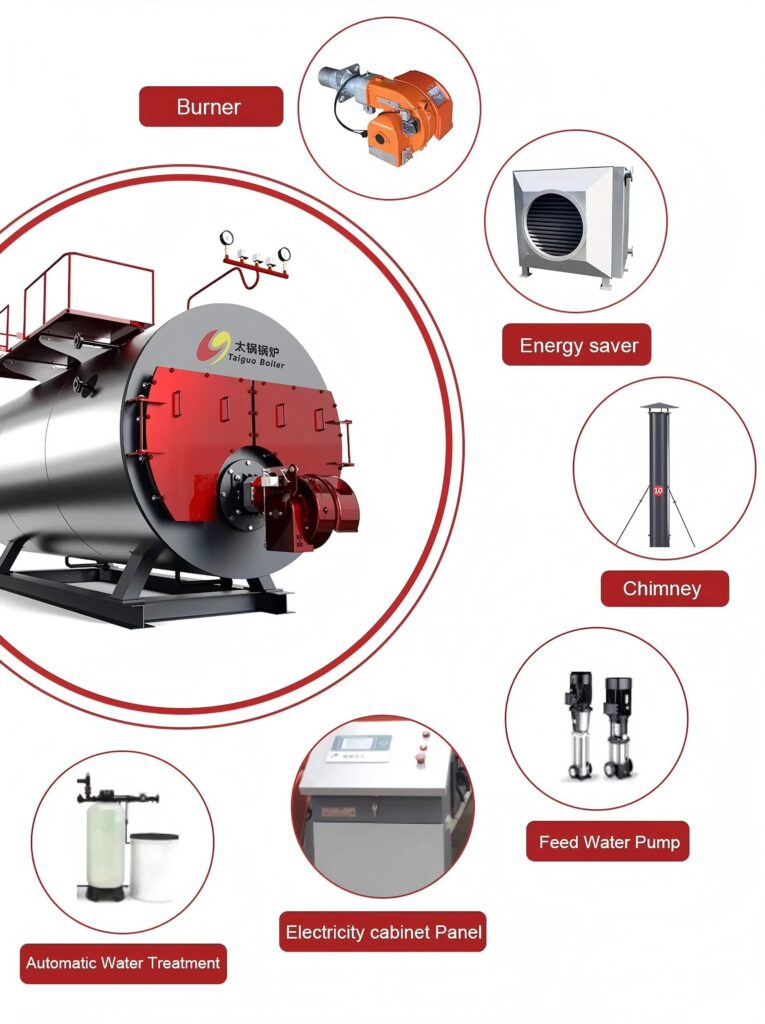
- Evaluate Heat Recovery Options: Always include a dedicated, corrosion-resistant economizer sized to drop stack exit temperatures below 120℃. For packaged three-pass firetube systems, explore our WNS Series horizontal gas-fired steam boilers.
- Review the Complete Auxiliary Balance of Plant: A dependable boiler island requires well-matched auxiliary components:
- Duplex alternating stainless-steel multi-stage feed pumps.
- Thermal deaerators or automated chemical scavenging dosing systems.
- Continuous automatic TDS surface blowdown control valves.
- Centralized PLC touchscreen cabinets supporting standard industrial communication protocols.
- Calculate Lifecycle Cost (TCO): Weigh the initial equipment price against long-term fuel consumption, electrical auxiliary loads, water treatment chemicals, and routine maintenance over a 15- to 20-year service life. For broader capital planning, consult our guide on industrial steam boiler prices and total lifecycle economics.
Gas Steam Boiler Projects in Uzbekistan
Operating successfully in Uzbekistan requires manufacturing systems that comply with national safety codes, pass local industrial technical inspections, and handle seasonal ambient temperature swings from -25℃ in winter to +45℃ in summer.
CN MIRACLE designs and delivers skid-mounted, factory-tested packaged gas steam boiler systems for industrial facilities throughout Uzbekistan. Our scope of supply covers:
- Custom Sizing and System Design: Designing boilers around your facility’s actual load profile and local gas network pressures.
- Fuel Consumption and Efficiency Analysis: Modeling fuel consumption based on your site’s gas composition and local utility tariffs.
- Complete Equipment Packages: Supplying the boiler pressure vessel, low-NOx burner, gas regulator train, economizer, feed pumps, water treatment plant, and automated PLC control skids.
- Export Logistics and Technical Support: Handling comprehensive customs clearance paperwork, on-site installation guidance, commissioning oversight, and plant technician training.
If you are planning a new manufacturing site or replacing an inefficient legacy boiler, our technical team will help you evaluate capacity options, assess fuel economy, and specify an efficient gas steam system.
Frequently Asked Questions
How much gas does a 1 ton steam boiler use per hour?
A 1 ton/hour (1,000 kg/h) gas steam boiler operating at 10 bar(g) with an economizer (92% – 93%$efficiency) consumes approximately 70 to 78 Nm3 of natural gas per hour at full rated load, assuming a standard fuel LHV of 34,800 kJ/Nm3.
How much does it cost to operate a gas steam boiler in Uzbekistan?
Monthly operating costs depend on your hourly steam demand, total run hours, average load factor, and contractual gas tariff. Because fuel represents 80% – 85% of total operational expenditure, calculating cost requires multiplying actual monthly gas consumption by your industrial utility tariff rate.
What is the gas consumption of a 10 TPH steam boiler?
A 10 TPH boiler operating at maximum continuous rating consumes roughly 700 to 780 Nm3 of natural gas per hour. If the plant runs at an average 70% load factor, actual fuel consumption drops to roughly 490 to 545 Nm3/h.
What affects gas boiler fuel consumption most?
The main drivers are operating load factor, boiler thermal efficiency, and stack temperature. Operating with poorly tuned excess air, uninsulated steam lines, or cold, unheated feedwater significantly increases gas consumption.
Is natural gas cheaper than biomass for industrial boilers?
It depends on fuel access. Natural gas systems offer lower initial equipment costs, compact footprints, and fully automated, low-labor operation. Solid biomass fuels can deliver lower fuel costs per gigacalorie if your plant has reliable local access to agricultural residues. However, biomass systems require higher initial capital investment, larger building footprints, continuous fuel handling, and active ash removal.
What boiler efficiency should I expect from a modern gas steam boiler?
A modern packaged three-pass firetube boiler equipped with an exhaust gas economizer operates at 92% to 95% thermal efficiency (LHV basis). Adding a condensing heat exchanger can raise overall thermal efficiency above 98%.
Need to Estimate Your Gas Boiler Operating Cost?
Send our engineering team your required steam capacity, operating pressure, estimated daily run hours, and local natural gas tariff. We will prepare a fuel consumption projection, lifecycle cost model, and boiler configuration recommendation tailored to your project.