
Industrial Steam Boiler Price: Complete 2026 Cost & TCO Guide
Contents Hide 1 Industrial Steam Boiler Price:What Buyers Really Need to Know 2 1. How Much Does an Industrial Steam Boiler Cost in 2026? 3 2. Key Technical Factors Driving Industrial Steam Boiler Price 3.1 Steam Capacity and Thermal Output 3.2 Working Pressure Ratings 4 3. Industrial Steam Boiler Price by Fuel Type 4.1 Gas-Fired […]
Get Instant Quote
Technical Specifications
Industrial Steam Boiler Price:What Buyers Really Need to Know
Evaluating an industrial steam boiler price requires looking beyond the initial factory equipment quote.
A low equipment price often hides high fuel consumption, frequent maintenance, or expensive missing auxiliaries. Conversely, a high-efficiency boiler demands more capital upfront but delivers major savings over its operating lifespan.
Industrial procurement teams must evaluate three distinct financial metrics:
Total expenditure depends on capacity, working pressure, fuel type, burner automation, water treatment, economizers, local emissions rules, and freight terms. This 2026 engineering guide explains equipment price benchmarks, auxiliary scopes, operating expenditures, and full lifecycle TCO models.
1. How Much Does an Industrial Steam Boiler Cost in 2026?
Industrial Steam Boiler Price vary widely based on technical specifications and scope of supply. Small skid-mounted packaged units start in the tens of thousands of dollars. Customized high-pressure water-tube boilers and multi-fuel systems frequently reach several hundred thousand
| Steam Capacity | Typical Industrial Application | Indicative Budget Range (USD) |
|---|---|---|
| 0.5 – 1 TPH | Commercial laundry, small food processing | $10,000 – $30,000 |
| 2 TPH | Breweries, feed mills, garment plants | $20,000 – $60,000 |
| 4 TPH | Food canning, textile dyeing, packaging | $40,000 – $100,000 |
| 6 – 10 TPH | Large textile mills, chemical reactors | $70,000 – $200,000+ |
| 10 – 20 TPH | Paper manufacturing, refinery processes | $150,000 – $450,000+ |
| 20+ TPH | Heavy industrial complexes, district heating | $300,000 – $1,000,000+ |
Note: Budgetary ranges reflect standard factory equipment packages. Final prices depend on operating pressure, burner brand, emission control equipment, regional engineering codes, and logistics.
Steam capacity alone does not determine the total investment. A 6 TPH gas-fired boiler package differs substantially from a 6 TPH biomass-fired boiler system in auxiliary equipment requirements.
2. Key Technical Factors Driving Industrial Steam Boiler Price
Two boilers with identical rated output often carry starkly different price tags due to specific engineering parameters:
Steam Capacity and Thermal Output
Higher steam output demands larger pressure vessels, bigger combustion chambers, heavy-duty feedwater pumps, and larger flue systems. However, pricing does not scale linearly. A 10 TPH boiler does not cost five times more than a 2 TPH boiler because design engineering, instrumentation controls, and manufacturing setups share fixed overhead costs.
Working Pressure Ratings
Operating pressure directly determines steel thickness and alloy grades. Standard saturated steam configurations include:
- 0.7 MPa (7 bar)
- 1.0 MPa (10 bar)
- 1.25 MPa (12.5 bar)
- 1.6 MPa (16 bar)
- 2.5 MPa+ (High-pressure & superheated applications)
Higher pressures demand thicker boiler plates, certified welding procedures, upgraded safety relief valves, and reinforced high-pressure feed pumps. Clear steam pressure specifications are essential for an accurate factory quotation.
3. Industrial Steam Boiler Price by Fuel Type
Fuel choice drives both initial capital expenditure (CAPEX) and long-term operating expenditure (OPEX).
Gas-Fired Steam Boilers
A gas-fired industrial steam boiler delivers compact footprints, fully automated combustion, fast ramp-up times, and minimal on-site fuel handling. They serve food processing, pharmaceuticals, chemical manufacturing, and garment facilities. Initial equipment pricing remains competitive, though long-term economics depend directly on regional pipeline gas tariffs.
Oil-Fired Steam Boilers
Oil-fired units operate reliably where natural gas pipelines do not reach. However, plants must budget for dedicated daily oil tanks, heavy oil preheaters, fuel transfer pumps, and fuel filtration units.
Biomass-Fired Steam Boilers
Biomass boilers feature higher initial equipment costs due to solid-fuel handling systems:
- Automated fuel conveyors and hoppers
- Reciprocating or chain grate combustion beds
- Multi-cyclone dust collectors and baghouse filters
- Induced-draft (ID) and forced-draft (FD) fans
- Automatic continuous ash-removal systems
Despite higher initial CAPEX, biomass boilers offer rapid payback periods for sawmills, rice mills, palm oil plants, and furniture factories where wood chips, rice husks, or agricultural waste are cheap and readily available.
Electric Steam Boilers
Electric boilers feature minimal mechanical footprints and zero on-site emissions, eliminating the need for stacks or burners. However, electric power tariffs dominate operating expenses. High steam loads over multi-shift schedules make electric boilers economically impractical in most heavy industrial settings.
4. Boiler Purchase Price vs. Complete Project Cost
Comparing bare boiler quotes without verifying the scope of supply creates severe budget overruns.
- Supplier A Quote: $50,000 (Bare boiler vessel and burner only)
- Supplier B Quote: $75,000 (Turnkey integrated skid package)
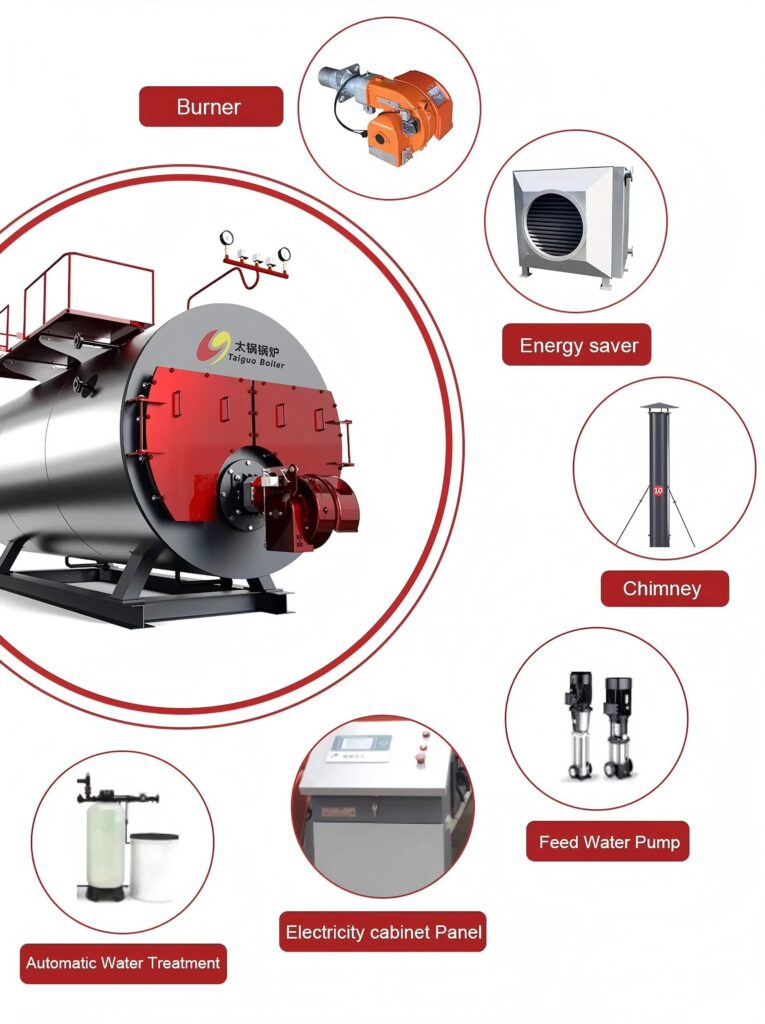
Supplier A looks cheaper initially. However, field-sourcing feedwater pumps, deaerators, economizers, water softeners, stacks, and valves will quickly push the project cost well past Supplier B’s comprehensive package.
| System Scope Component | Included in Basic Package? | Included in Complete System? |
|---|---|---|
| Pressure Vessel & Insulation | Yes | Yes |
| Burner / Grate System | Yes | Yes |
| Feedwater Pumps (Dual/Backup) | Often Excluded | Yes |
| Water Softener / RO Plant | Excluded | Yes |
| Deaerator / Feedwater Tank | Excluded | Yes |
| Flue Gas Economizer | Excluded | Yes |
| Exhaust Chimney / Flue Ducting | Excluded | Yes |
| PLC Control Cabinet & Sensors | Basic Only | Yes (Integrated Automated) |
| Valves, Manifold & Instruments | Excluded / Minimal | Yes |
| Commissioning & Startup Support | Excluded | Yes |
Always request an itemized balance-of-plant (BOP) list to verify actual delivered value.
5. Industrial Steam Boiler CAPEX Breakdown
Structure your initial project budget into four clear capital categories:
Factory FOB Industrial Steam Boiler Price cover only bare manufacturing output. Factoring in engineering design, ocean freight, site piping, electrical hookups, and professional industrial boiler installation and engineering gives you a realistic turnkey capital budget.
6. Industrial Steam Boiler Operating Cost (OPEX)
Equipment purchase price accounts for only 5% to 15% of a boiler’s total lifetime expenditure. Operating costs consume the rest.
Key operating cost factors include:
- Fuel Consumption: The largest continuous expense, consuming up to 80% of total lifecycle expenditures.
- Electrical Power: Running ID/FD fans, high-pressure feedwater pumps, and automation systems.
- Raw Water & Chemical Treatment: Make-up water, scale inhibitors, oxygen scavengers, and pH conditioning.
- Scheduled Maintenance: Refractory repairs, burner overhauls, valve replacements, and tube cleanings.
- Unplanned Downtime: Production losses from boiler failure often dwarf annual maintenance budgets.
7. How to Calculate Total Cost of Ownership (TCO)
A reliable financial assessment models Total Cost of Ownership across a 5-to-10-year operating horizon:
Calculating the cost per ton of steam provides a more accurate metric than comparing equipment purchase prices:
Selecting a high-efficiency boiler directly reduces your cost per ton of steam, delivering immediate operational savings.
8. Financial Modeling: 10 TPH Gas Boiler TCO Comparison
Consider a factory operating a 10 TPH gas boiler at an average 6.5 TPH load for 6,000 operating hours annually over a 10-year evaluation period:
| Parameter / Configuration | Standard Baseline Package | High-Efficiency Optimized Package |
|---|---|---|
| Boiler & Auxiliaries CAPEX | $230,000 | $285,000 |
| Installation & Commissioning | $50,000 | $60,000 |
| Total Initial Investment | $280,000 | $345,000 |
| Thermal Efficiency Rating | 90% (Standard) | 95% (Condensing Economizer) |
| Annual Natural Gas Expense | $1,280,000 | $1,212,600 |
| Annual Fuel Savings | Baseline | $67,400 / year |
| 10-Year Fuel Expenditure | $12,800,000 | $12,126,000 |
| 10-Year Net Operational TCO | $13,080,000 | $12,471,000 |
| Net 10-Year Savings | Baseline | $609,000 Net Savings |
The high-efficiency boiler costs $65,000 more upfront, but its energy savings fully pay back that difference in under 12 months. Over 10 years, it saves over $600,000 in operating costs.
9. Hidden Cost Pitfalls That Erode ROI
Protect your capital investment by addressing common engineering pitfalls before issuing purchase orders:
- Poor Feedwater Treatment: Unsoftened feedwater creates scale inside boiler tubes. A 1 mm scale layer increases fuel consumption by 3% to 5% and accelerates tube failure.
- Low Condensate Recovery: Discarding hot condensate wastes thermal energy and treated water. Increasing condensate return reduces fuel consumption and chemical costs.
- Oversized Boiler Selection: Sizing a boiler for short-term peak spikes causes continuous low-load cycling. This wastes fuel and causes thermal stress.
- Missing Waste-Heat Economizers: Venting flue gas at high temperatures wastes usable heat. Adding a dedicated economizer improves thermal efficiency by 5% to 8%.
For complete system sizing, read our comprehensive guide on industrial boiler selection and capacity planning.
10. Regional Pricing Factors and Global Logistics
Industrial Steam Boiler Price vary by project location due to shipping, site conditions, and regional standards.
Engineering Standards: Custom certifications (such as ASME stamps, European CE-PED, or EAC standards) require specialized testing and third-party inspections.
Regional Logistics: Moving large pressure vessels internationally requires breakbulk charters or flat-rack containers.
Local Market Conditions: For specific regional market analyses, review our dedicated benchmark guide on steam boiler price in Uzbekistan to see how local tariffs, freight corridors, and fuel infrastructures impact project costs.
11. Technical Checklist: How to Get an Accurate Boiler Quote
To receive a fast, accurate equipment quotation with complete auxiliary system integration, provide the following parameters to the manufacturing team:
Frequently Asked Questions About Industrial Steam Boiler Price
What is the average Industrial Steam Boiler Price in 2026?
Standard industrial packaged steam boilers range from $10,000 to $60,000 for 0.5–2 TPH units, $40,000 to $100,000 for 4 TPH units, and $70,000 to $200,000+ for 6–10 TPH systems. High-capacity custom units (10–20+ TPH) range from $150,000 to over $1,000,000 depending on fuel choice, pressure ratings, and auxiliary integration.
What components should be included in a standard boiler quotation?
A complete system quotation should itemize the main pressure vessel, combustion burner or grate, dual feedwater pumps, water softener/RO unit, thermal deaerator, exhaust economizer, chimney stack, PLC control cabinet, valve manifolds, and commissioning support.
How quickly does an economizer pay for itself?
Flue gas economizers generally pay for themselves in 6 to 14 months. By preheating feedwater using waste heat from stack gases, an economizer raises overall boiler efficiency by 4% to 8%, reducing monthly fuel consumption.
Should I choose a gas-fired or biomass-fired steam boiler?
Choose natural gas if your factory has access to pipeline infrastructure, requires fully automated low-labor operation, and operates in tight spaces. Choose biomass if you have a reliable local supply of wood chips, husks, or agrowaste, as the low fuel cost will quickly offset the higher initial equipment investment.
Get a 2026 Industrial Steam Boiler Cost & TCO Estimate
Planning a new industrial steam plant or upgrading an aging boiler system? Contact our technical engineering team with your project parameters:
- Target Steam Capacity (TPH or kg/h)
- Required Working Pressure (MPa or bar)
- Available Fuel Source (Gas, Light/Heavy Oil, Biomass, Dual-Fuel)
- Operating Hours & Process Application
- Destination Port or Country
We provide complete factory direct quotations, auxiliary system configurations, fuel consumption projections, and 5-to-10-year lifecycle TCO calculations tailored to your production demands.